

Linker Nutrients

Feed Solutions · Digestion and performance

Emulsifier

Linkalyso

Linkalyso: lysophospholipid emulsifier for feed fats

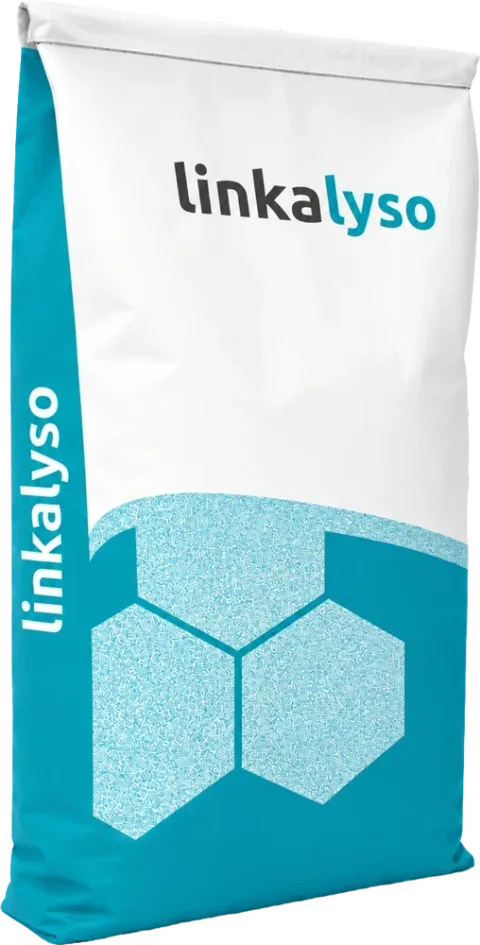
A lysophospholipid is a phospholipid that has lost one of its two fatty acid chains. More water-soluble than the lecithin it comes from, it emulsifies dietary fat better. Linkalyso is a lysolecithin emulsifier supplied as a beige to light-brown powder, a feed additive for poultry, pigs and aquaculture.

Form
Beige to light-brown powder, 25 kg bag
Nature
Emulsifier based on lysophospholipids
Species
Poultry, pigs, aquaculture
Use
At the feed mill, in diets rich in fat
Broilers in an open-sided house in Southeast Asia

The problem

Poorly emulsified fat is energy paid for and lost

Fats are the most concentrated energy source in the diet, and often one of the most expensive. To be digested, they first have to be emulsified into fine droplets that lipase can work on. In young animals, whose bile salt and lipase production has not yet reached its full level, this step limits fat digestion.

An emulsifier added to animal feed helps this step: more surface offered to lipase, and fatty acids, fat-soluble vitamins and pigments that are better absorbed.

Getting more out of the same formula is what the cost of energy in feed is all about.

The principle

From phospholipid to lysophospholipid

Removing one fatty acid chain changes how the molecule behaves in water.

  1. One chain less.The lysophospholipid carries only one fatty acid chain: it is more hydrophilic than a phospholipid.
  2. Smaller droplets.It forms micelles where a phospholipid forms bilayers, and emulsifies fat into smaller droplets.
  3. More surface.Fat droplets offer more surface to lipase.
  4. Better absorption.Fatty acids, fat-soluble vitamins and pigments cross the intestinal wall more easily.

When an emulsifier is worth it

Added fat
The more fat in the diet, the more emulsification weighs on its digestion.
Type of fat
Saturated fats are harder to emulsify than oils.
Age
In young animals, bile salts and lipase are still limited.
Presentation
A beige to light-brown powder, easy to incorporate.

Linkalyso at a glance

1 min 3 s, subtitled in English

Lecithin or lysolecithin

Lecithin vs lysolecithin: what is the difference?

Lecithin is a mixture of phospholipids: two fatty acid chains per molecule, and a real but limited emulsifying power in a watery medium such as the gut content.

Lysolecithin is derived from it by enzymatic hydrolysis, which removes one of the two chains. Its structure becomes more hydrophilic: it forms finer, more stable emulsions, at a lower concentration. That is what the term lysophospholipids refers to.

In feed, lecithin and lysolecithin are therefore not compared at the same rate: what counts is the emulsion obtained and the digestibility of the fat in your diet.

Measuring the value

How to measure the value of an emulsifier?

An emulsifier is judged on the energy it recovers, not on a promise. The right method is a comparative trial on your formula: a control batch, a Linkalyso batch, the same diet, and measurements of growth, feed conversion and, where possible, fat digestibility.

Another approach is to take a little energy out of the formula for the Linkalyso batch and check that performance holds. That is the formulator’s question: what is one point of energy worth in my formula? We build that protocol with you.

The grade

One grade, as a powder

Linkalyso comes as a beige to light-brown powder, for all species.

Simplified technical data sheet

linkalyso

What it is
Emulsifier
Range
Feed Solutions · Digestion and performance
Species
Poultry, pigs, aquaculture
Use
Get more energy out of the fat in the diet.
Form and appearance
Beige to light-brown powder
Packaging
25 kg bag
Key ingredients
Lysophospholipids.
Indicative rate
All species: 0.15–0.30 kg/tFor diets with more than 3.5% fat

Simplified sheet, for information only: the full technical data sheet of the grade and the label prevail.

Get the full technical data sheet →

Made on sites certified to GMP+ FSA, FAMI-QS, FCA or an equivalent feed safety scheme.
Linker Nutrients SAS · Centre d’Affaires Lorient Mer, 1 rue Honoré d’Estienne d’Orves, 56100 Lorient, France · +33 2 30 91 59 15 · contact@linkernutrients.com
www.linkernutrients.com/en/products/linkalyso · Updated 4 November 2026

Indicative rate; we fine-tune it with you according to species, the fat in the diet and the type of fat.

What has been measured

Each result comes with its conditions; the full details are available on request.

  • Trial on the product

    In tilapia, over 60 days at 0.3 kg/t: feed conversion ratio of 1.42, against 1.82 for the control (university trial published in 2021).

    feed conversion ratio (lower is better)
    Control1.82
    With Linkalyso1.42
    Conditions
    Nile tilapia of about 70 g at the start, three replicates per rate; 4 rates compared.
    On request
    Publication reference
    Ask for the details, result 1 →

Trial results available on request.Ask for the trial results →

In practice

What Linkalyso is

Emulsifier for animal feed, based on lysophospholipids. Its status varies by country: status in your country and documents on request.

The documents, and someone to read them with you

The documents you need

Send us your formula

Species, stage, fat content and fat sources of the diet: with these, a technician will suggest a rate and a trial protocol.

Ask about Linkalyso →Propose a trial →

Frequently asked questions

What are lysophospholipids?

Phospholipids that have lost one of their two fatty acid chains through enzymatic hydrolysis. More hydrophilic, they form micelles where a phospholipid forms bilayers, and emulsify fat into smaller droplets. Lysolecithin is the best-known form.

Lecithin or lysolecithin for feed?

Lysolecithin is derived from lecithin: one fatty acid chain less makes it more hydrophilic, so more effective at emulsifying in the gut content, at a lower concentration. The choice is confirmed on the fat digestibility of your diet.

Which emulsifier is used in poultry feed?

Poultry feed emulsifiers include lecithins, lysophospholipids and other emulsifiers. Lysophospholipids offer high emulsifying power at a low rate; the right choice depends on the fat in your diet and is confirmed by a trial.