
Salmonella in feed and water: raw materials, the mill, the water line
Where Salmonella and other bacteria enter feed and water, what it costs, then the levers: management, feed, water.
In short
The bacterial load in feed is the amount of bacteria it carries: from Enterobacteriaceae, a mill hygiene indicator, to Salmonella, which official programmes and customer specifications test for. It enters through raw materials, through the mill after the press, in storage and transport, and through drinking water. It is controlled at every step and checked by measurement.
- Species
- Poultry and pigs
- Where it enters
- Raw materials, the mill after the press, silos and trucks, the water line
- Indicator
- Enterobacteriaceae, more frequent and easier to count
- First lever
- Raw materials analysed at intake and heat processing that is validated
The problem
Where bacterial load enters: from intake to the last nipple
Five places, in the order feed and water pass through them. They are points of contamination that you measure and manage.
- Raw materials.Oilseed meals, animal protein meals and milling by-products sometimes arrive already loaded. EFSA names oilseed meals and animal proteins as the main entry points into industrial feed; the French authorities add milling by-products.
- The mill, before and after the press.Dust, footwear, elevator boots: studies of mills almost always find positive points in culture. The heat of pelleting lowers the load, but it leaves nothing behind.
- The cooler, the silos, the trucks.After the press, feed meets the air of the mill again, then silos and trucks. Moisture and temperature decide how long bacteria survive there: this is where recontamination happens.
- The water line.In the house, biofilm re-forms in the pipes over the course of the flock, despite cleaning and chlorination. Bacteria from the biofilm turn up in the water at the nipples.
- The house.Litter, pests, the movement of people and trucks, downtime between flocks: biosecurity belongs to farm management and to the veterinarian, with the farmer.
What widens the gap from one mill to the next
- The material
- Materials of animal origin are found contaminated 3.9 times more often than plant materials (Parker et al., 2022).
- The season
- A hot, humid summer favours multiplication in oilseed meals (DGAL, 2024).
- Temperature and time
- The reduction an acid gives in feed follows the product of temperature and time: it takes longer in the cold (Koyuncu et al., 2013).
- Free water
- Moisture of materials at intake, silos that warm by day and cool at night, poorly sheeted trucks: free water drives multiplication.
Raw materials
Raw materials: oilseed meals, animal protein meals, milling by-products
For EFSA (its 2008 opinion on microbiological risks in animal feed), oilseed meals and processed animal proteins are the main materials that bring zoonotic bacteria into industrial feed. The French technical instruction DGAL/SDEIGIR/2024-205 ranks these bacteria among the first-rank microbiological hazards for the poultry and pig sectors, and puts soybean meal first. It lists aggravating factors: several weeks of transport, unloading at the port, flat storage that is hard to clean, pests, swings in moisture and temperature, mixing of lots. Milling by-products (fines, bran) also need watching.
The figures give the measure, without exaggerating it. In the European Union, 0.68% of the feed units sampled in 2024 were positive in the official test (78,281 units), including 0.61% for compound poultry feed and 0.35% for compound pig feed (One Health 2024 report, EFSA and ECDC). A meta-analysis of 85 papers finds the bacteria in 18% of raw materials, 9% of finished feed and 8% of mill equipment; the differences between studies explain 99% of the variance, hence the phrase “depending on the study” (Parker et al., 2022).
These figures describe the state of official controls, not the risk of a given lot: the analysis of the lot, at intake, is what tells you. Feed is not the only source along the chain, but it is the one the feed mill controls.
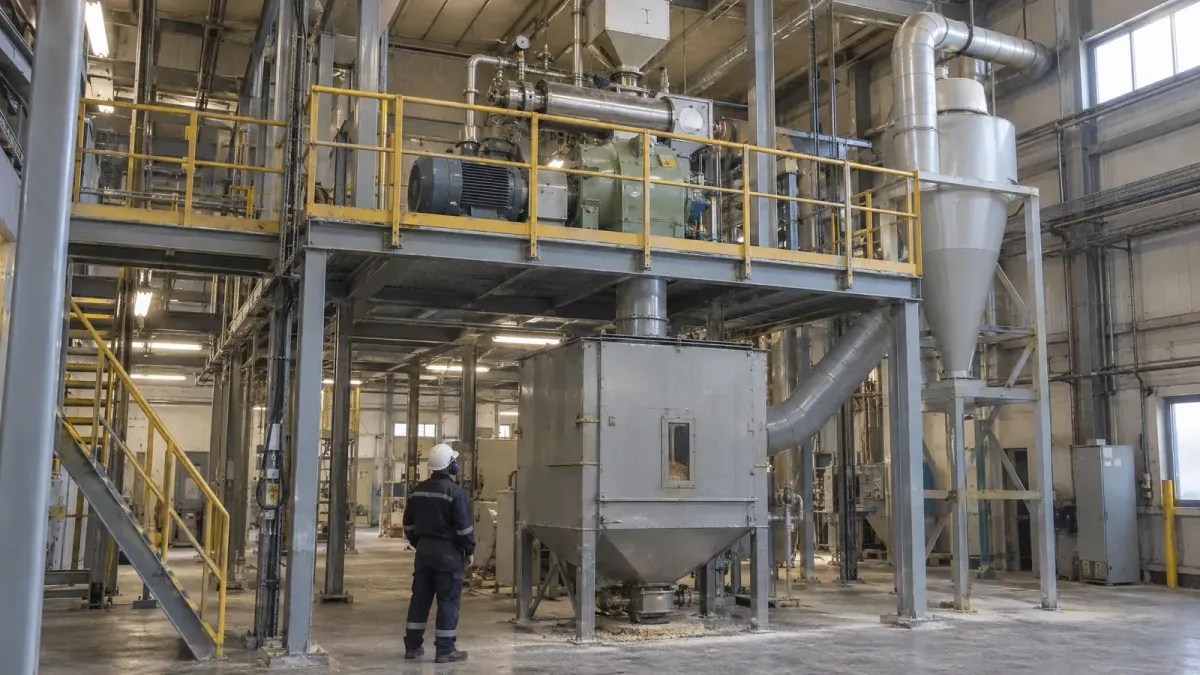
The mill
Recontamination after pelleting: where feed picks bacteria up again
Heat cleans up; it does not protect afterwards. The table follows the feed from intake to loading, your line first.
| Step | What happens | What you check |
|---|---|---|
| Intake and receiving pit | Trucks, footwear and dust carry the load of the materials into the mill. In eleven US mills, the receiving pit grate and operators’ footwear were among the points most often positive in culture, a culture that also counts other Enterobacteriaceae (Magossi et al., 2019). | At-risk materials, lot by lot or vessel by vessel; a dirty zone and clean zone layout; footwear and traffic under control |
| Press and conditioner | Moist heat is the method that lowers the load most. Usual temperatures run from 65 to 85 °C; according to FEFAC, the usual time and temperature combinations of commercial pelleting do not kill bacteria effectively, but they reduce their presence. In a pilot mill, at least 50 seconds per log were needed at 80 and 85 °C for a surrogate organism, longer than laboratory estimates suggested (2025). | Temperature and time, recorded and validated with a surrogate organism, not by a set point |
| Cooler | Hot feed cools in the ambient air of the mill: EFSA describes recontamination during cooling and the handling that follows. | Surfaces and dust in the cooler and its room; feed leaving a few degrees above ambient air, with no pick-up of moisture |
| Elevator boot, screws, finished-product bins | Cold, damp spots where dust builds up. The authors single out the finished-product elevator boot as a high-risk entry point (Magossi et al., 2019). Of 22 British broiler feed mills, 20 had positive samples, but 15 of them with fewer than 5% of samples positive, and finished-product areas were positive less often (Vet Sci, 2022). | A planned cleaning schedule; the environment sampled every week, and the trend followed rather than a single result |
| Silos and trucks | Moisture and temperature govern survival and multiplication. Water coming back into a silo or a truck bed is explained on the page mouldy feed in storage. | Silos emptied and cleaned; truck beds dry and swept; first in, first out |
| Loading and delivery | The last link in the mill: the feed that leaves is the feed the farmer receives. | Feed at loading, sampled in several small samples that are pooled; serotyping of positive strains to trace the origin |
Almost every mill studied has at least one positive point in culture. What matters is the level, the place (intake or finished product) and the trend. Sources are listed at the end of the page: sources.
Water
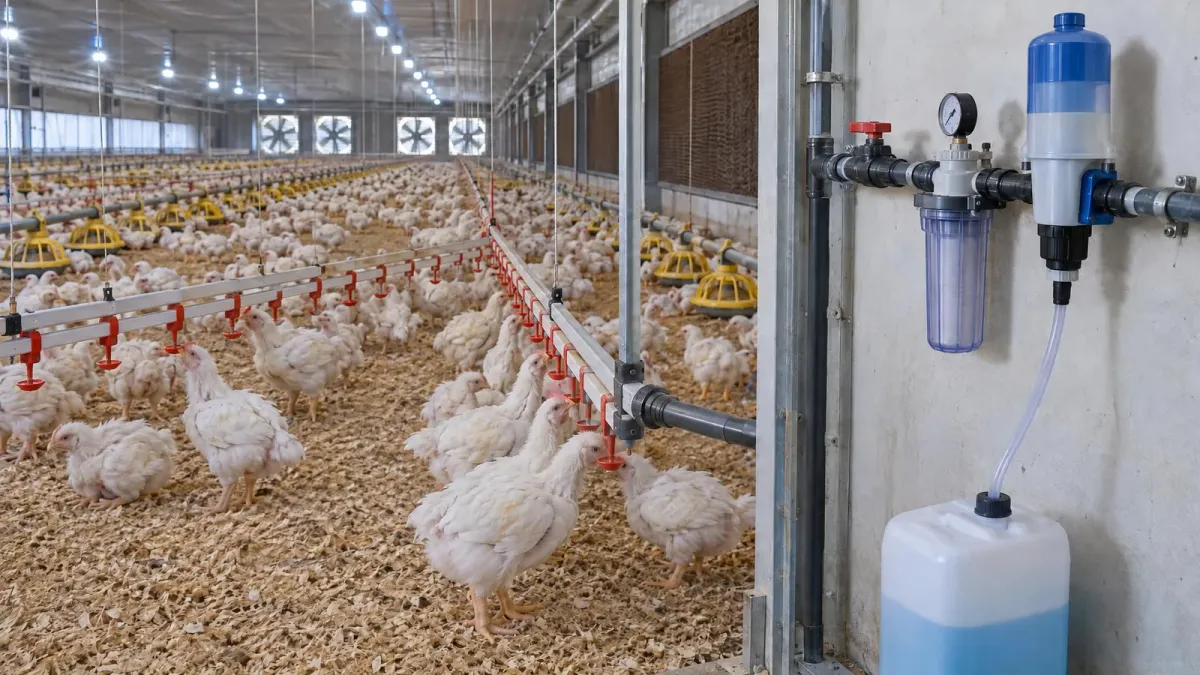
Water line biofilm: hygiene of the drinking water
A bird or a pig drinks more each day than it eats, and drinking water has its own hygiene programme. Pipes are not neutral: in a field study published in 2024, on a single farm, biofilm built back up to above 4 log CFU/mL before the end of a 42-day flock, despite lines flushed with concentrated chlorine between flocks and water chlorinated at about 1 ppm (Raut et al., 2024). In another study, all 15 broiler houses followed had biofilm in their lines, and 7 of the 15 had Enterobacteriaceae (Ogundipe et al., 2024). These are field results from few farms: they show that biofilm comes back, not how much.
Hence the rule from the University of Arkansas extension: clean first. Even a low dose of disinfectant in a dirty line can lift biofilm, which then clogs the drinkers, and acid products can favour yeasts and moulds, which form a slime at low pH. A clean line first, then a pH that is held.
That leaves the target and the rate. Water at pH 6.2 to 6.8 appears well suited to chickens, which accept slightly acidic water better than alkaline water (Mississippi State University extension). And the acidifier rate depends on the water: across 45 swine farm waters, hardness ranged from 142 to 1,181 mg CaCO3/L and starting pH from 7.42 to 8.47, and the acid demand varied widely from one water to another; the authors recommend titrating each water (Corso et al., 2025). The analyses to ask for are described in drinking water quality.
What bacterial load costs a feed mill
Four items, rarely counted together.
The suspect lot
A positive result on a raw material or a lot of finished feed sets off isolation of the lot, new analyses, then a decision: set aside, rework or use under conditions. The cost is that of the lot held up and the line that has to be cleaned.
The measurement plan
Enterobacteriaceae and the test for the target bacteria on at-risk materials, the environment and finished feed, with serotyping of positive strains: samples every week, analyses, laboratory time.
Official controls and the customer’s specification
The 2024 DGAL instruction specifically targets poultry feed, ranks feed that has not been heat processed as the highest risk, and increases the inspection frequency for plants that do not take part in the industry’s pooled plan. The customer’s specification adds its own limits.
The control itself
In Sweden, where feed is kept free of the target bacteria, feed producers estimated in 2009 and 2010 that control added 0.6 to 0.7% to the price of feed to the farmer, 25% of it at the intake of high-risk materials and 75% inside the mill (Wierup and Widell, 2014).
An old estimate, from a single country: the cost for your mill is measured on your line, with your materials and your analyses.
Bacterial load: the levers, route by route
Management first: raw materials, mill, house. Then feed hygiene at the mill, and drinking water on the farm. Every lever is checked by a measurement.
No product
Management first
No product replaces validated heat, a clean mill and tight biosecurity.
Raw materials: a specification and analyses
Oilseed meals, animal protein meals and milling by-products are analysed at intake, lot by lot or vessel by vessel. Moisture is measured on arrival, storage is dry and flat storage can be cleaned: free water drives multiplication.
Mill: validated heat
Steam conditioning, hygieniser or long retention depending on the line, then the press. Heat is validated with a surrogate organism and by recording temperature and time, not by a set point. It leaves no protection behind: the rest of the programme starts at the exit of the press.
Mill: zones, dust, a well-kept cooler
Dirty zone at intake, clean zone after the press; dust captured; footwear and traffic under control; elevator boots, screws, finished-product bins and loading hatches cleaned to a plan; pests and birds kept away from the silos.
Mill: a measurement plan
Enterobacteriaceae are the process hygiene indicator: they can be counted and show a drift before the test for the target bacteria does. The environment every week (intake, press, top and room of the cooler, finished-product elevator boot, loading), feed at the cooler exit and at loading, several small pooled samples rather than one large one, serotyping of positive strains.
House: cleaning, downtime, biosecurity
Chicks and gilts of known status, cleaning and disinfection with downtime, rodent control, a sanitary entry point, litter management. Screening, vaccination and what to do after a positive result are the veterinarian’s plan with the farmer.
Feed Solutions
Through the feed
Chemical hygiene complements heat and a clean mill. It is applied where the load enters, then stays in the feed.
On at-risk materials, at intake
Linkasalm FA L is a liquid feed hygiene agent, combined with a buffered acid system. Applied to raw materials at intake (2 to 3 kg/t), it acts on the load present at the time of application. Not marketed in the European Union.
On finished compound feed, at the mixer
Sprayed onto compound feed (1 to 2 kg/t), the buffered acid system stays spread through the material and helps hold back recontamination during storage and transport. The rate is set on the material, its starting load, its moisture and the time to cover; we adjust it with you, backed by analyses. Closed dosing, trained operators.
A laboratory that knows, a measurement before and after
A hygiene agent or an acid present in the sample can hinder growth in the analysis broth and give a result that is too favourable: the laboratory must know the feed has received a hygiene product, so that it adds a neutraliser. Compare Enterobacteriaceae and the test for the target bacteria before and after set-up, on the same materials and at the same points.
Farm Solutions
Through the drinking water
Water has its own hygiene: clean first, acidify after.
A clean line between flocks
House empty: drain, leave the cleaner in contact, rinse, then disinfect if the health programme calls for it. The choice of cleaner is for the equipment maker and the veterinarian, because the references do not agree. During the flock, biofilm comes back even with chlorinated water: cleaning between flocks is a fixed routine.
Water at the right pH, set on its alkalinity
Linkacid Prime L is a liquid drinking-water acidifier for poultry and pigs: a blend of acids, formic acid first, that lowers the pH and holds it to the last drinker. A titration on the farm measures the alkalinity of the water, then the target is a pH of 4.0 to 4.5 at the last drinker, usually with 300 to 500 mL per 1,000 L of water.
Follow water intake, stop before a vaccination
Water intake is followed on the meter at every change of rate. Before a vaccination through the water: stop the acidifier, flush the line, vaccinate, then restart.
How to choose
Two platforms, two points of application: where each acts, and when
They do not act in the same place and do not replace each other. Each has its own page.
| Platform | Where it works | When |
|---|---|---|
| linkasalmFeed hygiene · feed | On the raw material at intake, and on compound feed at the mixer | When the load of the materials or recontamination after the press is the issue, alongside heat and mill hygiene |
| linkacid Prime LWater acidifier · drinking water | In the water line, from the dosing point to the last drinker | During the flock, after the line has been cleaned, with a rate set on the alkalinity of the water |
Linkasalm FA L: Not marketed in the European Union. The rate is on each platform’s page; otherwise ask for it, with the material, its starting load and the time to cover, or with the water analysis. Neither replaces heat, mill hygiene, biosecurity or the veterinarian’s health plan.
The approach
Taking control: the approach, in five steps
To be done with your quality manager, your laboratory and, on the farm, the veterinarian.
- Measure the starting point.Enterobacteriaceae and the test for the target bacteria at the same points: at-risk materials, environment, finished feed.
- Rank the raw materials.Which ones arrive loaded, by what route, with what storage before use.
- Look for recontamination.Dust, cooler, finished-product elevator boot, silos and trucks: where the load comes back after the press.
- Look at the water line.Water analysis, cleanliness of the line, pH at the last drinker.
- Choose one lever, and compare.One lever at a time, measured before and after at the same points, with a laboratory that knows.
Evidence
What research has measured
Organic acids lower a load without eliminating it, and the effect depends first on the material. In a 2013 study (Koyuncu et al., BMC Veterinary Research), they lowered the load by up to 2.5 log in compound feed, by 1 log in rapeseed meal and by less than 0.5 log in soybean meal, and by less again in the cold. The effective rates published are often higher than the maintenance rates on the market: a trial figure cannot be carried over to a catalogue rate.
Measured results are on each platform’s page, when published, with their conditions. The references of the publications cited are in the sources; the detail is available on request.
Sources
- The European Union One Health 2024 Zoonoses Report (external site)EFSA and ECDC · EFSA Journal 2025;23:e9759
- Microbiological risk assessment in feedingstuffs for food-producing animals (external site)EFSA, BIOHAZ Panel · EFSA Journal 2008;6(7):720
- Technical instruction DGAL/SDEIGIR/2024-205 of 28 March 2024: surveillance and control plans in animal feed (external site)French Ministry of Agriculture (DGAL)
- Systematic review and meta-analysis of detection in commercially prepared livestock feed, raw ingredients and equipment (external site)Parker et al., Prev Vet Med · 2022, vol. 198, 105546
- Evaluation of presence in selected United States feed mills (external site)Magossi et al., MicrobiologyOpen · 2019, vol. 8, e00711
- Investigations into contamination in feed mills producing rations for the broiler industry in Great Britain (external site)Veterinary Sciences · 2022, vol. 9 (7), 307
- Feed hygienisation (feed safety) (external site)FEFAC
- Thermal inactivation of a surrogate organism in mash broiler feed pelleted in a university pilot feed mill (external site)Poultry Science · 2025
- Organic acids for control in different feed materials (external site)Koyuncu et al., BMC Veterinary Research · 2013, vol. 9, 81
- Estimation of costs for control in high-risk feed materials and compound feed (external site)Wierup and Widell, Infection Ecology and Epidemiology · 2014, vol. 4, 23496
- Impacts of on-farm water sanitation practices on microbial hygiene in poultry waterlines (external site)Raut et al., Journal of Applied Poultry Research · 2024
- Applied research note: microbial composition of the biofilm of poultry drinking water system (external site)Ogundipe et al., Journal of Applied Poultry Research · 2024
- Relationship between water hardness, pH, and organic acid requirement for effective water acidification in swine operations (external site)Corso et al., Translational Animal Science · 2025, vol. 9, txaf164
Benchmarks taken from the publications and texts cited. Titles are shortened: the name of the target bacteria is left out. The figures describe studies, under their own conditions: they are not those of a Linker product.
Frequently asked questions
Why isn’t pelleting enough: what is recontamination after pelleting?
No. Heat lowers the load if temperature and time are held, but it leaves no protection: see recontamination after pelleting.
Which raw materials should be watched first?
Oilseed meals, soybean meal first, animal protein meals and milling by-products, with peaks in the hot, humid season: see raw materials.
Why follow Enterobacteriaceae?
Because they are hygiene indicators: more frequent, they can be counted and show a drift before the test for the target bacteria turns positive. See the levers through management.
Where should samples be taken in a feed mill?
At intake, around the press, on and in the room of the cooler, at the finished-product elevator boot and at loading: see recontamination after pelleting.
Does an organic acid make feed free of zoonotic bacteria?
No. It helps lower the load, more or less depending on the material, the rate, the time and the temperature: see what research has measured.
Can feed that has received a hygiene product distort the analysis?
Yes: the product in the sample can give a result that is too favourable. Tell the laboratory, which will add a neutraliser: see the levers through feed.
What pH should drinking water be acidified to, and how do you find the rate?
For Linkacid Prime L, the target is a pH of 4.0 to 4.5 at the last drinker. The rate comes from a titration of your water: see the levers through water.
Is acidifying the water the same as cleaning the line?
No. Cleaning between flocks and acidifying are two separate steps: a dirty line is cleaned before it is acidified. See water line biofilm.
Is Linkasalm FA L marketed in the European Union?
No: Linkasalm FA L is a feed hygiene agent not marketed in the European Union. Its page gives use and documents: Linkasalm.
Review the bacterial load of your feed
At the feed mill
Send us your at-risk materials, your Enterobacteriaceae results and what you see after the press. We look with you at where the load enters and where it comes back, then at which levers cover the gap.
Review your feed mill →Request the Linkasalm data sheet →On the farm
Tell us about the farm’s water, how clean your lines are and the period: we build the drinking-water programme with you.
Get a programme →Request the Linkacid Prime L data sheet →Or directly: +33 2 30 91 59 15 · contact@linkernutrients.com
Further reading
- Mouldy feed in storage →
Where water comes back in silos and trucks, and how to keep feed sound.
- Drinking water quality →
The parameters to analyse, pH, biofilm, water intake.
- Feed safety and preservation →
The mill’s tools for feed hygiene and preservation.
- Drinking water →
The supplements and acidifiers for the water line, and the farm programme.
- Raw material intake →
What happens when the trucks arrive, before the silo.