
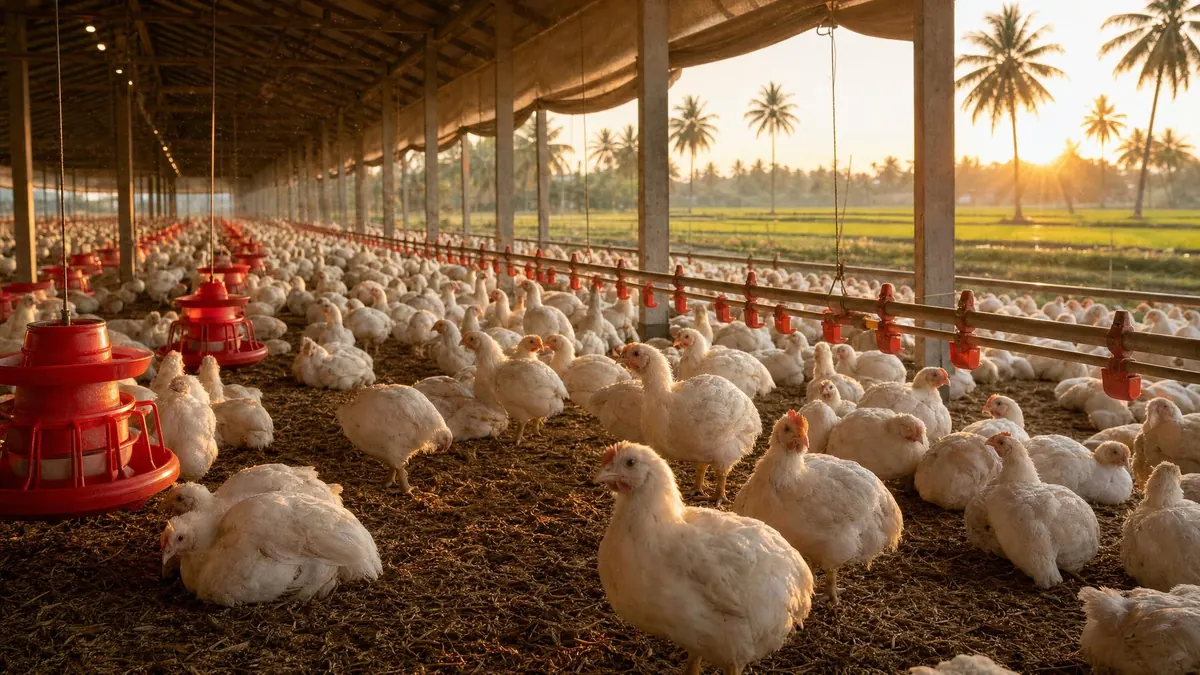
Ammonia and wet litter in poultry and pig houses: where they come from, what to adjust
Where wet litter and ammonia come from, what they cost, then what to do about them: management first, then the feed.
In short
Ammonia in livestock houses is the gas given off by manure as its nitrogen breaks down: uric acid in poultry droppings on the litter, urea in pig urine once it meets the faeces. It rises with moisture, heat and poor air exchange; in poultry, litter moisture is the first factor to bring under control. It is managed first through water, ventilation and litter, then through the feed.
- Species
- Poultry reared on litter; pigs, on straw or on slats
- Where it comes from
- Nitrogen in manure, broken down by microorganisms
- What makes it worse
- Wet litter, heat, poor ventilation, above all in winter
- Published benchmark
- Below 20 ppm at bird level, in broilers
- First lever
- Management: nipple drinkers and water pressure, ventilation, litter
The problem
Wet litter: where does it come from and what can be adjusted?
Litter takes on water every day of the flock: from the droppings first, then from whatever escapes the drinkers. It stays dry as long as ventilation removes as much water as comes in. Once the balance tips, it loads up with water, cakes, ferments and smells.
Most of the excess water comes from the water line: leaking drinkers, nipples set too low, pressure too high for the age of the birds, spilt water. Then from the air: ventilation turned down in winter to save on heating, moisture the house no longer removes. Too high a stocking density, or animals crowding on part of the floor, concentrates moisture in patches.
In hot weather, animals drink more, and the extra water ends up in their droppings and then in the litter. The diet plays a part too: excess salt or minerals make birds drink more, and poor-quality fat or some cereals, such as wheat, barley or rye, give wetter droppings.
Cake forms first under the water lines, around the feeders and near the exhaust fans. It is simpler and cheaper to stop it forming than to dry out litter that has already caked: fix the cause, then dry what remains. That is the order of the levers.
Watery droppings across a whole flock, with no leak and no ventilation fault, point to a digestive upset: that is a matter for the veterinarian before it is a litter problem.
The gas
What causes ammonia in poultry houses and pig barns
In poultry, ammonia starts in the litter. Bacteria and fungi break down the uric acid in the droppings into ammonia and carbon dioxide. The wetter and warmer the litter, and the higher its pH, the faster this goes: above about 25 % moisture, ammonia production increases.
In pig barns, it comes mainly from urine. The urea it contains is broken down by an enzyme, urease, supplied by the faeces: as soon as urine and faeces meet, on the slats, on the floors, on soiled animals and in the pit, ammonia forms. Fast air moving over the slurry increases the amount released.
In both cases, the starting point is dietary nitrogen: whatever the animal does not retain goes back out in its manure. That is why the feed has a part to play, after management.
Ammonia is measured at animal level, where they breathe: a colorimetric tube on a hand pump gives a reading on the spot, a diffusion tube left for a few hours gives an average. The published values are in the benchmarks.
Benchmarks
Ammonia levels in poultry houses and litter moisture: the published benchmarks
Values from university extension publications, for broilers, cited at the foot of the page. They vary with the house, the litter and the climate.
| Benchmark | Published value | What to adjust |
|---|---|---|
| Litter moisture | 20 to 30 %: litter neither too dry nor too wet; above about 25 %, ammonia production increases | The water line, ventilation, litter depth |
| Cake | 40 % moisture or more, under the water lines, around the feeders and near the exhaust fans | Leaks and water pressure; ventilation, stepped up as soon as cake appears |
| Relative humidity of the air | 50 to 70 %; 75 % or more for an extended period gives damp, caked litter | Minimum ventilation, cold weather included |
| Ammonia in the air | Below 20 ppm, at bird level | Litter moisture and ventilation; measure where the birds breathe |
| Litter depth | At least 3 inches (about 7.5 cm) at all times; 4 to 6 inches (about 10 to 15 cm) appears ideal | Level litter, so feeders and drinkers stay at the right height |
General management benchmarks, cited with their source. They do not replace your breed’s management guide or the advice of your technician.
The wet litter problem in poultry: what it costs
Losses that show up at the processing plant and in the results, flock after flock.
Irritating air
Ammonia irritates animals and the people who work in the house alike, and heavily loaded air weighs on flock performance. Clearing it means more ventilation, which costs heating fuel in cold weather.
Marked feet
Footpad dermatitis is a lesion on the sole of the foot in broilers and turkeys: wet litter alone can ulcerate the footpad, and ammonia dissolved in the litter attacks it. It is scored at the processing plant and used as a criterion in animal welfare audits.
Downgrades
Foot lesions, breast blisters and bruises, soiled feathers: carcasses are downgraded at the processing plant, and paws lose their sale value.
A flock that eats less
A bird with sore feet goes to the feeder and the drinker less often: growth and feed conversion suffer.
Odour and neighbours
Litter odour has at times led to nuisance complaints from neighbours, and the ammonia given off by houses is an environmental concern.
Time spent
Cake to break up or remove, litter to top up, a house that takes longer to dry before the next flock: wet litter is also paid for in working hours.
No figures here: the loss depends on the species, the house and the season. It shows in your footpad scores and processing results, flock after flock.
Reducing ammonia in poultry houses and pig barns: management first, then feed
The water line and ventilation are the causes that weigh most: set them right before adding any product. Feed comes next; a litter conditioner goes on top where moisture builds up anyway.
No product
Management first
No product makes up for a leaking water line or an under-ventilated house.
Nipple drinkers and water pressure
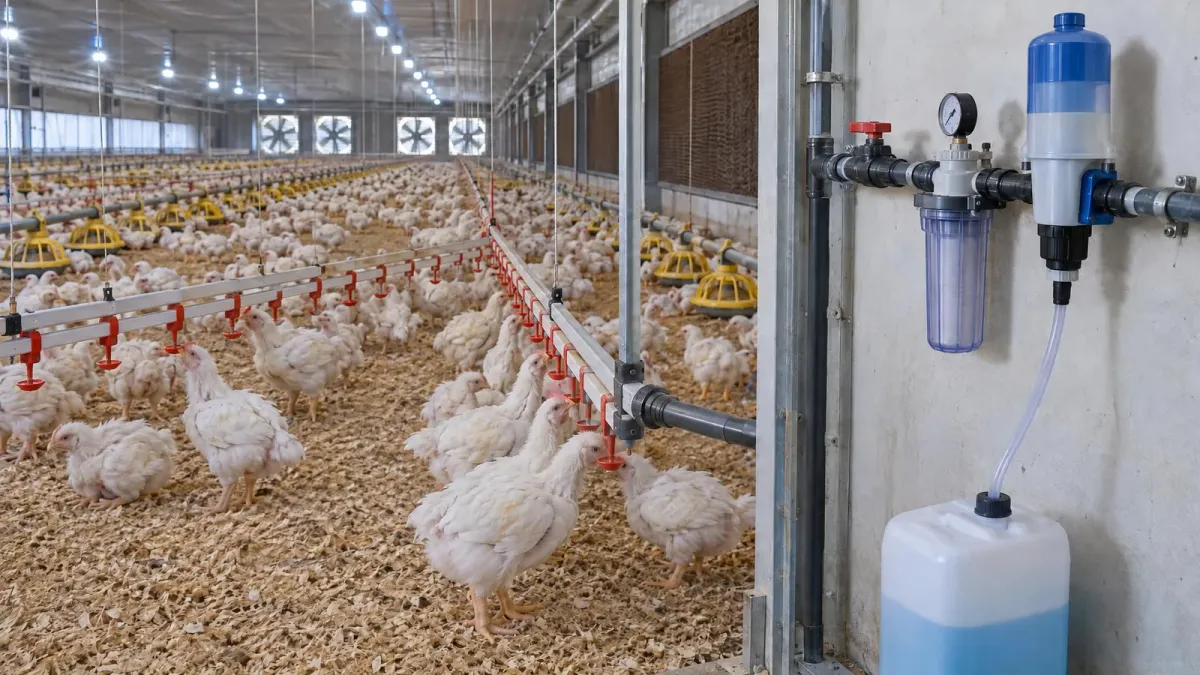
Height and pressure set for the age of the birds, and adjusted as they grow; leaks repaired at once; lines level along their whole length. Water that is not drunk ends up in the litter.
Ventilation, even in cold weather
Minimum ventilation held from the first days, then raised as the flock grows: it is what removes the water from the droppings. Turning it down in winter to save on heating quickly drives up moisture and ammonia. Circulation fans help dry the litter surface.
Litter and bedding
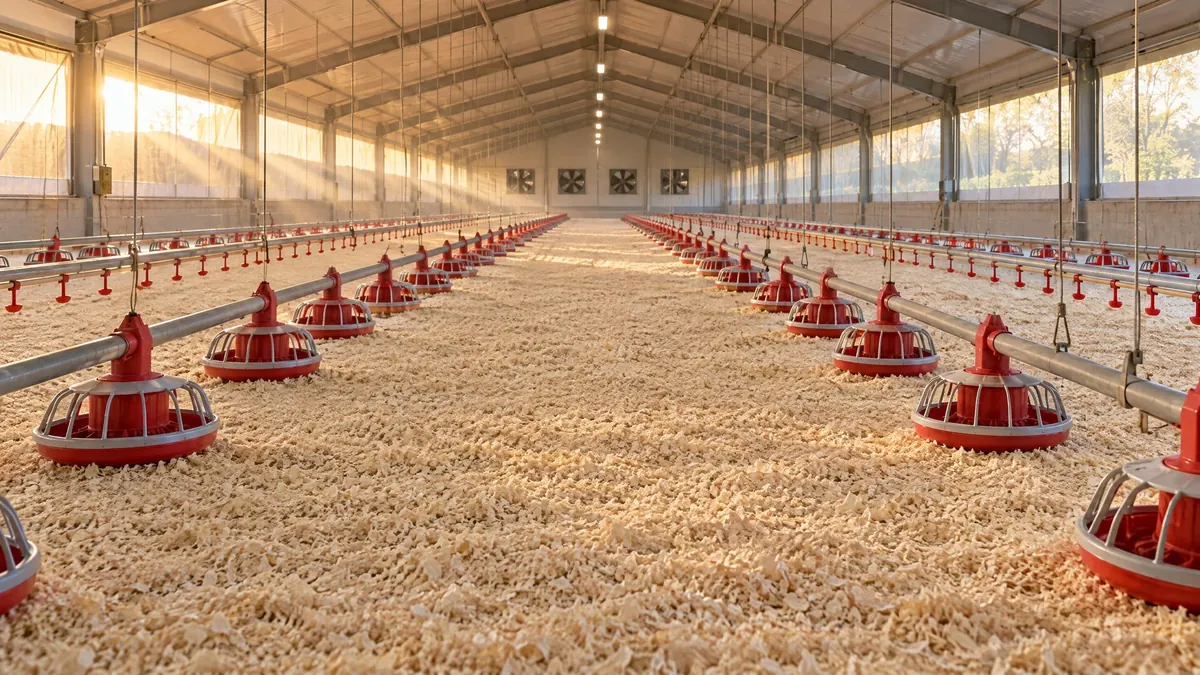
Enough depth and level litter; cake broken up, worked or removed as soon as it forms; fresh straw where moisture builds up. Litter kept from one flock to the next must dry out before the next birds arrive.
Stocking density and distribution
A stocking density set on what the house can ventilate, and animals spread over the whole floor: where they crowd, the litter gets wet and cakes.
In pig barns, clean and dry surfaces
Ammonia rises from manure-covered surfaces: pens, lying areas and pigs kept clean and dry, and air that does not sweep across the slurry. Behind the sow and in lying areas, the straw is renewed.
Feed Solutions
Through the feed
Dietary nitrogen
Less surplus nitrogen in the feed means less nitrogen in the manure. Balancing amino acids rather than total protein, and changing the formula from one stage to the next, cuts the nitrogen excreted. A formulation setting, with no product.
A diet that does not drive extra drinking
Check salt and minerals in the feed as well as in the water: one mixing error is enough to make birds drink more. Fat quality matters, and a formula high in wheat, barley or rye is worked out with the formulator.
Less ammonia and odour in the house
Linkamo combines Yucca schidigera extract, from a plant rich in saponins and phenolic compounds, with a ferment, as a fine semolina that goes in once, at the mixer. It goes into pig and poultry feed, for less ammonia and odour in the house. It complements dry litter and a well-ventilated house; it does not replace them.
On the litter
When moisture builds up anyway: the litter conditioner
Even in a well-run house, some areas stay wetter: under the water lines, in lying areas, behind the sow. That is where a litter conditioner is used, on top of good management.
Linkadry is a drying powder of mineral and plant origin, with flavouring substances and Yucca schidigera extract. Spread in a thin layer on litter or floors, it takes up moisture at the surface and holds odour, where animals lie and walk. It works on the litter, not on the animal.
It comes in two versions. Linkadry S, a white powder of mineral and plant origin, is used in poultry, in pig units behind the sow and in the farrowing area, in cattle housing and in sheep houses. Linkadry Caps also releases encapsulated essential oils, gradually. The choice depends on the species, the litter and what you are after first: moisture, or odour in the house as well.
Between flocks, the house is cleaned and disinfected separately, with products authorised for that purpose; the water line is also prepared between flocks.
The Linker platforms involved
One in the feed, one on the litter, both on top of management already in place. Each has its own page: form, use, documents.
| Platform | Where it works | When |
|---|---|---|
| linkamoYucca extract · feed | In the feed, added at the mixer or through the premix | At every stage, from sows to finishers, and in poultry |
linkadryLitter conditioner · houseTrial on the productField trial on an 800-sow farm: first colostrum intake within 5 minutes, against 20 for control piglets.ConditionsFarrowing unit, suckling piglets; 2017 trial. | On litter and floors: under the water lines, in lying areas, behind the sow | During the flock, repeated according to the state of the litter |
The rate is on each platform’s page when it is published; otherwise ask for it, with the species, the stage, the litter and the season.
Sources
- Managing Litter Moisture in Broiler Houses with Built-Up Litter (external site)Mississippi State University Extension · Publication 2744, T. Tabler, J. Wells and W. Zhai · accessed
- Broiler Litter: Odor and Moisture Concerns (external site)Mississippi State University Extension · Publication 3515, T. Tabler, Y. Liang, J. Moon and J. Wells · accessed
- Good Litter Management Improves Broiler Performance, Health, and Welfare (external site)Mississippi State University Extension · Publication 3657, T. Tabler, Y. Liang, J. R. Moyle, S. L. Weimer, J. Moon and J. Wells · accessed
- Why Broiler Growers Should Be Concerned about Paw Quality (external site)Mississippi State University Extension · Publication 2859, T. Tabler, M. Farnell and J. Wells · accessed
- Causes and Prevention of Wet Litter in Broiler Houses (external site)University of Florida, IFAS Extension · VM099, G. D. Butcher and R. D. Miles · accessed
- The multidimensional causal factors of ’wet litter’ in chicken-meat production (external site)Science of the Total Environment · Dunlop et al., 2016, vol. 562, pp. 766-776; record at the University of New England · accessed
- Poultry Production Manual, chapter 14, introduction (external site)University of Kentucky, Department of Animal and Food Sciences · accessed
- Controlling Ammonia Gas in Swine Buildings (external site)Purdue University Extension · IAQ-1, A. Heber, D. Jones and A. Sutton · accessed
- A Determination and Comparison of Urease Activity in Feces and Fresh Manure from Pig and Cattle in Relation to Ammonia Production and pH Changes (external site)PLoS One · Dai and Karring, 2014, vol. 9 (11), e110402 · accessed
- Poultry Houses and Ammonia: Pull Tubes and Diffusion Tubes (external site)Penn State Extension · video, G. Lorenzoni, D. Hofstetter and E. E. Fabian (Wheeler) · accessed
Sources checked on .
General management and biology benchmarks, cited with their source. They do not replace your breed’s management guide, your technician’s advice or your veterinarian’s opinion.
Frequently asked questions
What causes ammonia in a poultry house?
Microorganisms in the litter breaking down the uric acid in droppings. The wetter and warmer the litter, the faster it goes, which is why water and air come first (how it forms).
What ammonia level should a poultry house aim for?
For broilers, the published benchmark is below 20 ppm, measured at bird level. The other values are in the benchmark table.
How to keep poultry litter dry?
By getting water and air right first: nipple drinkers at the right height, no leaks, and ventilation kept up even when it is cold. Litter depth, stocking density and the diet do the rest (the levers).
Does footpad dermatitis in broilers come from the litter?
Largely: litter moisture is a major factor, along with stocking density, ventilation and drinker settings. An established lesion is a matter for the veterinarian.
Does Linkadry work on footpad dermatitis?
No. Linkadry works on litter moisture and odour, not on the lesion or on the animal; it comes on top of management that keeps the litter dry.
Can feed reduce ammonia in the house?
It contributes, once water and ventilation are right: a diet without surplus nitrogen excretes less of it, and Linkamo, in pig and poultry feed, is aimed at less ammonia and odour (through the feed).
Where does ammonia in pig barns come from?
Mostly from urine: its urea is broken down by an enzyme from the faeces wherever the two meet, on slats, floors and in the pit (how it forms).
Why does litter get wetter in hot weather?
Because animals drink more, and that water ends up in the litter: ventilation has to remove more of it. Heat itself is managed separately: heat stress.
Talk about your house
On the farm
Tell us the species, the litter, the season and where moisture builds up: a technician goes through the water line, ventilation and litter with you, then where a litter conditioner fits.
Talk about your house →Request the Linkadry data sheet →At the feed mill
Dietary nitrogen and the place of Linkamo are set with your formulator, stage by stage.
Talk to a formulator →Or directly: +33 2 30 91 59 15 · contact@linkernutrients.com
Further reading
- House hygiene and litter →
What Farm Solutions brings to the house and the litter.
- Heat stress →
When heat makes animals drink more and the litter gets wet.
- Chick brooding, first week →
The water line and the litter, from placement onwards.
- Farm Solutions →
Everything used on the farm: drinking water and the house.