
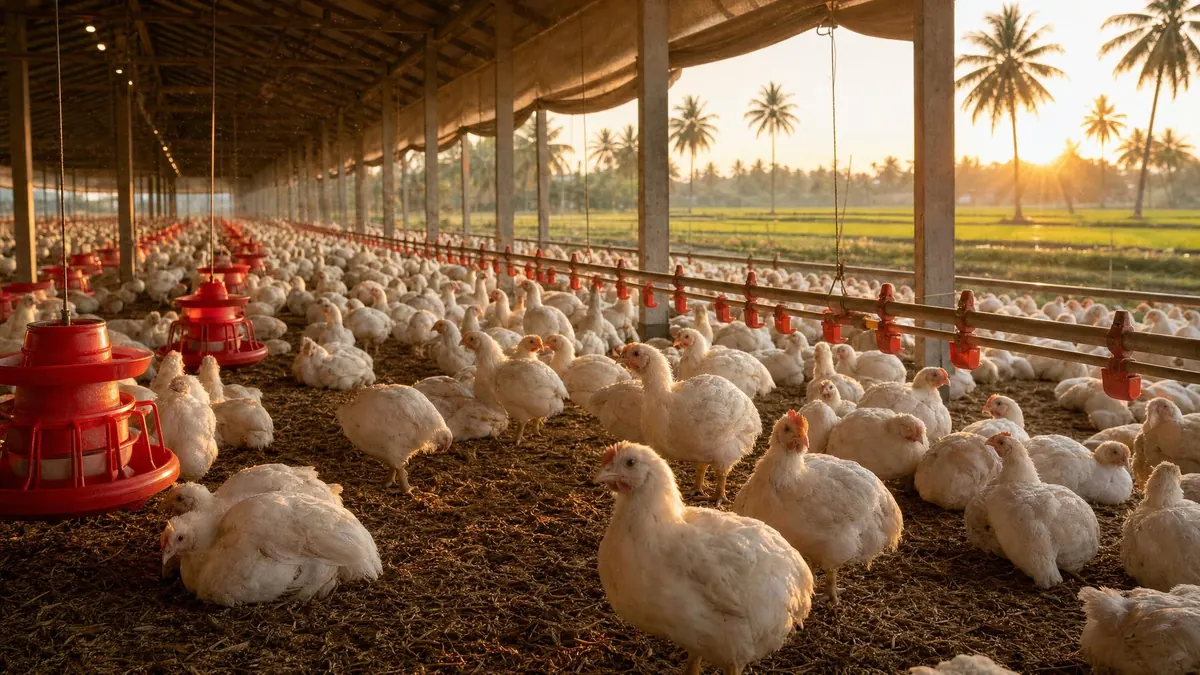
Gut health in pigs and poultry: what the feed can do
What makes for good digestion in pigs and poultry, what an imbalance costs, and the levers: management first, then the feed.
In short
In pigs and poultry, gut health means a digestive tract that digests the feed, absorbs its nutrients and acts as a barrier, with a stable gut flora. It is decided first in the feed: its digestibility, its buffering capacity, its fibre, and what it leaves undigested for the flora. It is managed through husbandry and through the formula; digestive disorders, once they appear, are a matter for the vet.
- Species
- Pigs and poultry
- What is at stake
- Stomach acidity, protein digestion, the gut lining, fibre, water
- What you see
- Feed conversion, flock or batch uniformity, faeces, litter
- Sensitive moments
- Weaning, brooding, feed changes, heat
- First lever
- Management: water, environment, transitions, regular meals
The principle
What makes for good digestion, from stomach to gut
Gut health is not one thing. It is five conditions that hold each other up: when one gives way, the others follow.
- An acid stomach.Pepsin, the enzyme that starts protein digestion, only becomes active in an acid environment. In the suckling piglet, lactic acid from the sow’s milk did part of the work; after weaning, the stomach still secretes little acid while dry feed needs a lot of it. In poultry, the proventriculus secretes the acid and the gizzard grinds and mixes.
- Protein digested early.Protein digested in the stomach and small intestine feeds the animal. Protein that escapes them reaches the large intestine, where the flora ferments it. That fermentation produces ammonia, amines and other compounds you do not want in excess against the gut lining.
- An intact gut lining.The lining absorbs nutrients and forms the barrier between gut contents and the animal. Its cells renew constantly, and butyric acid is their main energy source. An animal that stops eating for a few hours also starves its gut lining, which feeds partly on what passes through the intestine.
- The right fibre.Not all fibre is equal. Moderate insoluble fibre keeps feed longer in the upper tract and works the gizzard in poultry. Soluble fibre makes gut contents viscous and slows passage. In the caeca and the large intestine, the flora ferments part of the fibre into short-chain fatty acids.
- Water, all the time.Digestion happens in a liquid medium. An animal that drinks poorly eats poorly, and what leaves the gut, faeces or droppings, says a lot about what went on inside.
What tips the balance
- Age
- The weaned piglet and the chick have a digestive tract that is still developing.
- Change
- A new feed, pen, group or house: intake drops, then comes back as one large meal.
- The formula
- Too much protein, high buffering capacity, the wrong fibre: the feed asks more than the gut can give.
- The environment
- Heat, cold, water that is hard to reach: the animal eats less regularly.
The problem
Gut health: how the balance is lost without a sound
A digestive imbalance rarely starts with a clear sign. The stomach acidifies a little less, some protein gets through, the flora of the large intestine has more to ferment, the gut lining works less well. Nothing shows at the feeder: the animals eat and grow, but get less out of their feed.
Research in pigs is clear on this: gut health can deteriorate without any declared disease. After weaning, simply eating little deprives the intestine of nutrients, and the structure of its lining changes. In poultry as in pigs, a high-protein diet is associated with wetter faeces: it is one of the routes to wet litter.
That is why gut health is managed in the formula, before the problem shows. When digestive disorders appear, liquid faeces, dull animals, rising losses, the question changes: diagnosis and what to do next are a matter for the vet. What the farm checks first, and what water and feed can support at that point, is covered in diarrhoea on the farm.
An additive is only worth something if it works where the problem is, and its form decides where that is. The real job is knowing which of these five points is giving way on your farm.
What a digestive imbalance costs
Scattered losses, rarely added up because they show in different places.
Feed conversion
A nutrient that is not digested is paid for in the feed and lost in the faeces. Feed conversion slips while the formula has not changed.
Uniformity
The animals that digest least well fall behind. An uneven batch complicates feeding, sorting and selling, and lengthens the cycle.
Litter
Wetter droppings wet the litter. Wet litter gives off more ammonia and damages feet: see ammonia in livestock houses.
Faeces and labour
Loose faeces, pens and floors to clean more often, animals to watch more closely, and more visits.
The most expensive feed
Starter and weaner feeds are the most expensive of the animal’s life. Poorly digested, they are paid for twice.
No figures here: the loss depends on species, age, formula and housing. It is measured on your own batches. Where growth is lost between the formula and the animal: see growth and feed conversion.
How to improve gut health: management first, then the feed
No additive makes up for water that is hard to reach or an abrupt feed change. Management comes first; the feed then works, point by point, on what happens in the digestive tract.
No product
Management first
What is set in the house, before any additive.
Clean water, easy to find
Drinkers at the right height, flow checked, lines cleaned between batches, water analysed: see drinking water quality.
Slow transitions
A feed change spread over several days, the same note from one feed to the next, no feed change on the day of a transfer or weaning.
Regular meals
Feeder access for every animal, fresh feed, no empty pans: an animal that fasts and then gorges digests poorly.
A stable environment
Neither cold nor heat at animal level, dry litter, ventilation set correctly: what keeps animals eating regularly also keeps them digesting well.
Sensitive moments, prepared
Piglet weaning has its own page: piglet weaning. So does brooding: the first seven days.
Feed Solutions
Through the feed
The formula first, with no product; then one platform per point to fix, chosen rather than stacked.
A formula the gut can follow
Digestible protein, at a level suited to age and balanced with amino acids; low buffering capacity in young-animal feeds; fibre chosen for its type rather than its level. A formulation adjustment, before any additive.
A stomach that acidifies
An acidifier dosed on the buffering capacity of the feed helps the stomach reach the pH that pepsin needs. In pigs, benzoic acid works in its undissociated form, active at stomach pH.
Energy for the gut lining
Butyric acid feeds the cells of the gut lining. The whole point is getting it to where the lining uses it: a plain salt releases it early, a coated salt further along, tributyrin in the small intestine. The comparison is made in tributyrin vs sodium butyrate.
Better emulsified fat
In young animals, fat emulsification limits fat digestion. A lysophospholipid emulsifier gives lipase more surface to work on.
A gut flora that stays balanced
Monoglycerides whose action does not depend on pH, lactic acid bacteria inactivated or live, tannins for sensitive phases: to be chosen by feed and stage, not stacked.

How to choose
Nine digestion platforms: where each works, and when
They do not work at the same point in the digestive tract and they do not simply add up. The starting point is the question you are asking about your formula.
| Platform | Where it works | When |
|---|---|---|
linkacidAcidifier · feedLaboratory testLaboratory measurement: 100 g of Linkacid Premium LP deliver 380 mmol of acidifying capacity at pH 4, a figure used to set the rate against the feed’s buffering capacity.Conditions100 g of product in 200 mL of water at 37 °C, titration with sodium hydroxide; measured in 2022. | In the feed and in the stomach | A young-animal feed rich in protein and minerals, dosed on its buffering capacity |
linkazoicBenzoic acid · feedTrial on the productStudy published in 2024 in weaned piglets: with coated benzoic acid, dry matter digestibility rose from 88.2% to 90.5%.Conditions32 piglets in individual cages, 21 days; trial rate of 3 kg/t, above the use rate of the grade. | In the stomach; further along in its coated form | Pig feeds: piglets, growing-finishing pigs, sows |
linkaselButyrate · feedTrial on the productIn a broiler trial (42 days), Linkasel’s coated calcium butyrate improved feed conversion from 1.83 to 1.76.Conditions2 groups of 6 replicates, 150 birds per group; 1.2 then 0.6 then 0.3 kg/t depending on the phase. | Stomach and upper intestine for a plain salt; further along for a coated salt | When the gut lining is the priority, in poultry as in pigs |
linkatribTributyrin · feedPublication on the ingredientIn post-peak laying hens, a published university study reports a 3.1% thicker eggshell with tributyrin at 500 g/t.Conditions384 hens, 8 replicates of 24 per group, 16 weeks; significant difference (P = 0.01). | In the small intestine, where lipase releases the butyrate | Butyrate further along, with no coating to protect through pelleting |
linkalysoEmulsifier · feedTrial on the productIn tilapia, over 60 days at 0.3 kg/t: feed conversion ratio of 1.42, against 1.82 for the control (university trial published in 2021).ConditionsNile tilapia of about 70 g at the start, three replicates per rate; 4 rates compared. | In the small intestine, on the fat in the diet | A high-fat diet, in young animals above all |
linkalphaMonoglycerides · feedPublication on the ingredientIn vitro, monolaurin is four times more active than free lauric acid on a Gram-positive bacterial strain (2009 publication).ConditionsInhibitory concentrations measured in culture, on pure monolaurin and lauric acid. | In contact with the flora, whatever the pH | Alongside an acidifier, where pH limits what acids can do |
linkabiomePostbiotic · feedPartner dataIn broilers, from day 7 to day 49, at 1 kg/t: weight gain 10.7% above the control (university trial).ConditionsTwo diets compared; significant difference (P < 0.01); no effect in the first week. | In contact with the gut lining and the flora | Pelleted feed or feed stored for long periods, for all species |
| linkafloreProbiotic · feed | In contact with the gut lining and the flora | Piglet feed around weaning, when the process allows a live probiotic |
linkatanTannins · feedTrial on the productOn farm, in 200 weaned piglets followed for 32 days at 1.5 kg/t: +34 g of daily gain versus the control.ConditionsTwo diets, 5 pens of 20 piglets each; P = 0.05. | In the intestine, where tannins bind to proteins | A sensitive phase, weaning, brooding or a feed change, at a measured rate to keep palatability |
Where to start? With water and management, then the formula; then stomach acidity, then the gut lining and the flora. Two or three well-tuned levers are worth more than six stacked: we look at your formula and your stage, and tell you which one to start with, and which one to stop. All the platforms in the category: digestion and performance. The rate is on each platform’s page when it is published; otherwise ask us.
By species
Pig gut health, poultry gut health: the same logic, different organs
In pigs, everything turns on the stomach and on weaning. The piglet leaves a milk it digested perfectly for a dry feed, rich in plant protein and minerals, that its stomach struggles to acidify. This is when the formula, buffering capacity and protein digestibility matter most. Later, in growing and finishing, digestion is established: the issue becomes feed conversion, and steady intake when the heat rises.
In poultry, the gizzard takes over part of the stomach’s work: it grinds, mixes and holds the feed while the proventriculus acidifies it. A working gizzard, thanks to feed structure and well-chosen insoluble fibre, improves digestion further down. The caeca, at the end of the intestine, ferment what is left. Poultry gut health shows in the litter: wet droppings soak it, and the whole house feels it.
In both cases, gut health is decided first at the mill, in the formula, then in the house, through water and management. Additives then work on one precise point: acidity, energy for the gut lining, fat, or the flora.
Sources
- Gastrointestinal tract (gut) health in the young pig (external site)Animal Nutrition · Pluske, Turpin and Kim, 2018, vol. 4 (2), pp. 187-196 · accessed
- A review of the effects of dietary organic acids fed to swine (external site)Journal of Animal Science and Biotechnology · Suiryanrayna and Ramana, 2015, vol. 6, article 45 · accessed
- Protein fermentation in the gut; implications for intestinal dysfunction in humans, pigs, and poultry (external site)American Journal of Physiology, Gastrointestinal and Liver Physiology · Gilbert et al., 2018, vol. 315 (2) · accessed
- Impact of Fermentable Protein, by Feeding High Protein Diets, on Microbial Composition, Microbial Catabolic Activity, Gut Health and beyond in Pigs (external site)Microorganisms · Zhang et al., 2020, vol. 8 (11), article 1735 · accessed
- Dietary fiber in poultry nutrition and their effects on nutrient utilization, performance, gut health, and on the environment: a review (external site)Journal of Animal Science and Biotechnology · Jha and Mishra, 2021, vol. 12, article 51 · accessed
Sources checked on .
These publications are cited to explain digestive physiology, not in support of a product. Measured results for each platform are on its page, when published.
Frequently asked questions
What does gut health mean in pigs and poultry?
A digestive tract that digests, absorbs and acts as a barrier, with a stable flora: see what makes for good digestion.
Why does stomach acidity matter so much in piglets?
Because protein digestion starts with pepsin, which only works in an acid environment, and at weaning the stomach does not yet produce enough acid. The detail is in piglet weaning.
What happens to poorly digested protein?
It ferments in the large intestine. Digestible protein at a sensible level is better than an excess: see how the balance is lost.
Is fibre good or bad for poultry digestion?
It depends on the type: moderate insoluble fibre works the gizzard; soluble fibre makes gut contents viscous. See pigs and poultry.
Can an additive sort out diarrhoea?
No. A bout of diarrhoea calls for a diagnosis that only the vet can make. Feed and water support digestion within the farm’s programme: see diarrhoea on the farm.
Should you combine an acidifier, a butyrate and a probiotic?
Not as a rule: their effects do not simply add up. We start from your formula and your stage to choose, see the table.
Review how well your feeds are digested
At the feed mill
Send us your formula, the species and stage, and what you see: feed conversion, uniformity, faeces, litter. We tell you which point is giving way, which lever to start with, and which one to stop.
Talk to a formulator →Propose a trial on your feed →You distribute our ranges
Sheets, arguments and documents to present the digestion platforms to your customers.
Request the documents →Or directly: +33 2 30 91 59 15 · contact@linkernutrients.com
Further reading
- Digestion and performance →
The nine platforms in the category, and where each lever works.
- Piglet weaning →
The moment when pig digestion is most fragile.
- Tributyrin vs sodium butyrate →
Two forms of butyrate, criterion by criterion.
- Diarrhoea on the farm →
What to check, what the vet decides, what water and feed can support.
- Growth and feed conversion →
Where performance is lost between the formula and the animal.