
Weaning piglets without zinc oxide: the levers that work together
What zinc oxide used to do, what changed in Europe, and the combination of levers that takes over at weaning.
In short
Weaning without zinc oxide means taking the piglet from milk to dry feed without the pharmacological level of zinc oxide that used to be added to the feed for the two weeks after weaning. In the European Union, that use ended in June 2022 at the latest. A combination of levers takes over: farm management, the formulation of the starter feed, chosen additives and drinking water.
- Species
- Piglets, at weaning and in the nursery
- Reference text
- European Commission decision of 26 June 2017
- In Europe
- Pharmacological levels ended in June 2022 at the latest
- What remains
- Zinc as a trace element, at nutritional levels
The problem
Zinc oxide for piglets: what the pharmacological level used to do
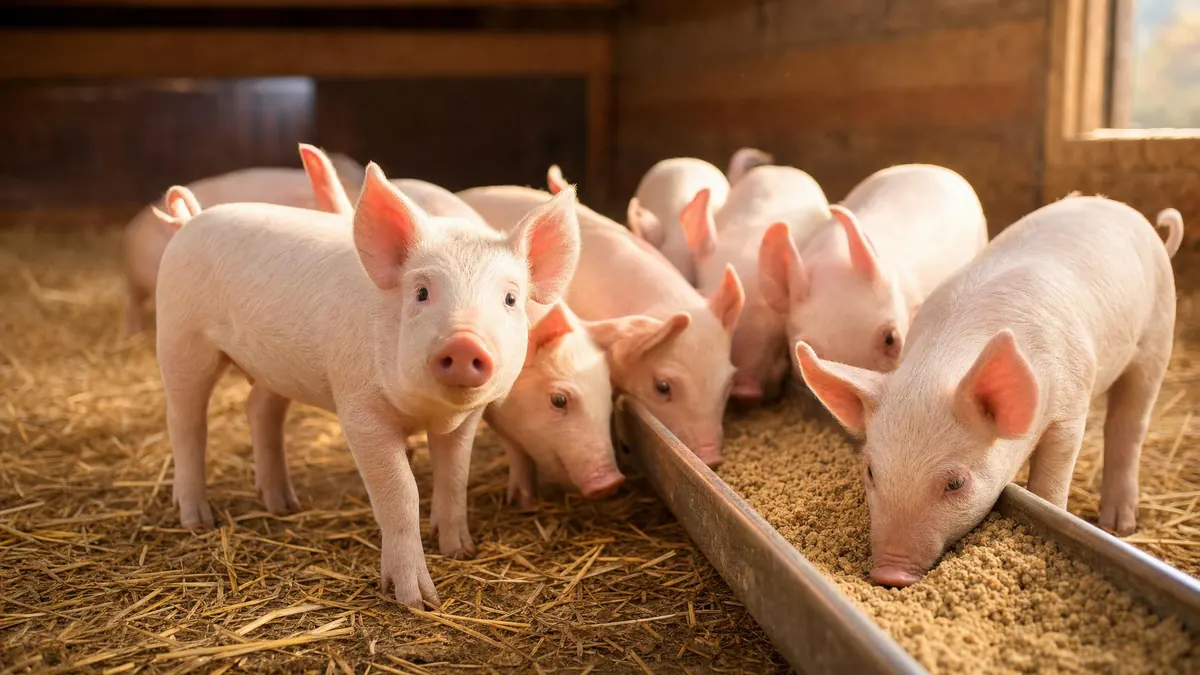
At pharmacological levels, zinc oxide was given in the feed for the first two weeks after weaning, on veterinary prescription. This is the period when the piglet eats little and digests poorly. It was one of the most common answers to post-weaning diarrhoea.
Its action went beyond bacteria: reviews describe it as moderate on that point. It worked first on the gut lining. Better-preserved villi, cells more tightly joined to each other, a less permeable lining, inflammation kept in check. On top of that came better appetite and more active digestive enzymes.
That is the whole difficulty. One ingredient covered several functions at once, at the moment the piglet is most fragile. What happens at weaning itself, from the stomach to the gut lining, is explained on the piglet weaning page.
Regulation
Zinc oxide in piglet feed: what changed in Europe
In 2016, the Netherlands and France referred veterinary products containing zinc oxide, given orally to pigs, to the European agency EMA. Its veterinary committee gave its opinion on 16 March 2017. The benefit on piglet diarrhoea did not outweigh the risks for the environment: no effective way had been found to limit the build-up of zinc. The committee also noted a risk of co-selection for antimicrobial resistance, which it judged could not yet be quantified.
The European Commission followed that opinion with a decision dated 26 June 2017: no new authorisations, and existing ones withdrawn. Member States could defer the withdrawal by up to five years, that is until June 2022. Since summer 2022, pharmacological zinc oxide is no longer given to piglets in the European Union.
Zinc itself stays in the diet. It is an essential trace element, supplied through the feed at nutritional levels. Implementing Regulation (EU) 2016/1095 lowered its maximum contents in feed, for environmental reasons, on the basis of an opinion of the European authority EFSA dated 8 April 2014. For piglets and sows, it sets 150 mg of total zinc per kilo of complete feed. That level is far from a pharmacological one, and the same effects are not expected from it.
What the European rule says applies in Europe. Elsewhere, rules differ from country to country and change over time: check them with your veterinarian and the national authorities. The zinc oxide section of the weaning page gives the essentials in a few lines.
The approach
Without zinc oxide: a combination of levers takes over
Zinc oxide worked in several places at once. Each of the levers studied since works in one place: stomach acidity, the protein that reaches the intestine, energy for the gut lining, the balance of the flora, appetite. Reviews that compare them reach the same conclusion. None holds its whole place on its own; a combined strategy takes over, bringing together management, formulation and hygiene.
That strategy is built farm by farm, with the veterinarian, the nutritionist and the farmer. It gives the most on a well-run farm, where herd health, biosecurity and colostrum intake are under control.
Our place is in the feed and in the water. Reviewing the starter feed formula, choosing two or three levers that complement each other, and following the result pen by pen. Our team draws on its in-house expertise and on a network of partners and experts to do so.
Feed and water strategies for weaning without zinc oxide: lever by lever
Management first: it carries everything else. Then the starter feed formula and the additives that complete it, and drinking water when the piglet eats little.
No product
Management first
These settings weigh more once zinc oxide is no longer there to cover a gap.
An older, heavier piglet at weaning
The older and heavier it is, the readier its stomach and gut lining are. Weaning age is a management choice and, in some countries, a regulatory one.
Colostrum, then creep feed
A piglet that took its colostrum well and tasted dry feed before weaning starts eating again sooner afterwards.
A clean, dry, warm room
Room washed, disinfected, dried and pre-heated before entry; temperature read at piglet level, with no draughts.
Water, feeder space and transitions
Drinker flow checked before entry, enough feeder space, groups sorted by weight, feed changes spread over several days.
Feed Solutions
Through the feed
Less protein, better digested
A protein level reduced for the age, balanced with amino acids, and highly digestible sources: less undigested protein reaches the intestine. A formulation setting, with no product.
A low-buffering feed, then acidified
Buffering capacity is measured, then brought down through the formula, on minerals and protein sources. The acidifier is then dosed on what remains. Benzoic acid works in its undissociated form, active at the pH of the pig’s stomach.
Chosen fibres
Insoluble fibres shorten the time digesta spends in the gut; fibres fermented by the flora yield short-chain fatty acids. Their source and level are set in the formula, with no product.
A feed the piglet eats
A piglet that eats little receives nothing the formula provides. A milky profile, and the same note from one feed to the next, help intake pick up again.
Energy for the gut lining
The gut lining was zinc oxide’s first target. Butyrate is an energy source for its cells: as a salt, plain or coated, depending on where it needs to arrive, or as tributyrin, released by lipase in the small intestine.
The balance of the flora
Monoglycerides whose action does not depend on pH, tannins that bind to proteins, inactivated or live lactobacilli: levers to choose according to the feed and how it is made.
Farm Solutions
Through the drinking water
In the first days, the piglet eats little but keeps drinking: water carries a supply to the nursery room alone.
Acidified water, set on the farm’s water
pH brought down and held to the last drinker, with a rate set on the water’s alkalinity.
A short supply when intake drops
Vitamins, amino acids and electrolytes through the water, for a few days around weaning.
A digestive tract that adapts
An inactivated yeast and acids, in short, repeated courses, on the batch that needs them.
How to choose
Twelve platforms, two routes: where each one works, and when
Each one works in a precise place. The table shows those places and when each one has its place; each has its own page.
| Platform | Where it works | When |
|---|---|---|
linkacidAcidifier · feedLaboratory testLaboratory measurement: 100 g of Linkacid Premium LP deliver 380 mmol of acidifying capacity at pH 4, a figure used to set the rate against the feed’s buffering capacity.Conditions100 g of product in 200 mL of water at 37 °C, titration with sodium hydroxide; measured in 2022. | In the feed, then in the piglet’s stomach | When buffering capacity stays high after the formula has been adjusted |
linkazoicBenzoic acid · feedTrial on the productStudy published in 2024 in weaned piglets: with coated benzoic acid, dry matter digestibility rose from 88.2% to 90.5%.Conditions32 piglets in individual cages, 21 days; trial rate of 3 kg/t, above the use rate of the grade. | In the stomach, in its undissociated form | In pig feeds, from the starter feed onwards |
linkaselButyrate · feedTrial on the productIn a broiler trial (42 days), Linkasel’s coated calcium butyrate improved feed conversion from 1.83 to 1.76.Conditions2 groups of 6 replicates, 150 birds per group; 1.2 then 0.6 then 0.3 kg/t depending on the phase. | From stomach to intestine, depending on the form, plain or coated | When the gut lining is the priority |
linkatribTributyrin · feedPublication on the ingredientIn post-peak laying hens, a published university study reports a 3.1% thicker eggshell with tributyrin at 500 g/t.Conditions384 hens, 8 replicates of 24 per group, 16 weeks; significant difference (P = 0.01). | In the small intestine, through the action of lipase | To carry butyrate further in a pelleted feed |
linkalphaMonoglycerides · feedPublication on the ingredientIn vitro, monolaurin is four times more active than free lauric acid on a Gram-positive bacterial strain (2009 publication).ConditionsInhibitory concentrations measured in culture, on pure monolaurin and lauric acid. | Along the digestive tract, whatever the pH | Alongside an acidifier |
linkatanTannins · feedTrial on the productOn farm, in 200 weaned piglets followed for 32 days at 1.5 kg/t: +34 g of daily gain versus the control.ConditionsTwo diets, 5 pens of 20 piglets each; P = 0.05. | In the intestine, where the tannins are hydrolysed | Over the short weaning phase, at a rate set with us |
linkabiomePostbiotic · feedPartner dataIn broilers, from day 7 to day 49, at 1 kg/t: weight gain 10.7% above the control (university trial).ConditionsTwo diets compared; significant difference (P < 0.01); no effect in the first week. | In contact with the intestinal mucosa and the flora | In a pelleted feed or one stored for a long time |
| linkafloreProbiotic · feed | In the piglet’s intestine, with live lactobacilli | When manufacturing conditions, validated with us, allow it |
| linkastyFlavours · feed | At the nose and on the palate, before the first mouthful | From creep feed to the next feed, with the same note |
| linkacid Prime LWater acidifier · drinking water | In the water line of the nursery room | Through the nursery phase, with a rate set on the water’s alkalinity |
| linkastimVitamins, amino acids and electrolytes · drinking water | In the water line, on the room concerned only | The few days when the piglet drinks but eats little |
| linkamuneInactivated yeast and acids · drinking water | In the water line, batch by batch | In short, repeated courses around weaning |
Where to start? With management, then the formula, then an acidifier dosed on buffering capacity; the other levers are chosen next, on what you observe. Butyrate or tributyrin: the comparison is made in tributyrin vs sodium butyrate. Each platform’s rate is on its page once published; otherwise ask for it, with weaning age, the formula and your objective.
The approach
Moving away from zinc oxide: five steps
An approach to follow with the farm’s veterinarian and nutritionist.
- Review management.Weaning age and weight, room temperature, water flow, feeder space: what can be set without a product is set first.
- Review the starter feed.Protein level and digestibility, buffering capacity, fibre: the formula shows where the stomach and intestine will be under most pressure.
- Choose two or three levers.An acidifier dosed on buffering capacity, then whatever answers your priority: the gut lining, the flora or appetite.
- Plan the water.One water line per room allows a short supply in the nursery without touching the feed.
- Follow pen by pen.Intake, batch uniformity, faecal consistency, care given: the result shows in your batches, and the programme is adjusted.
Evidence
What research has measured
Measured results can be read on the page of each platform, once published, with their conditions. References for the publications cited are listed in the sources; details are available on request.
Sources
- Commission Implementing Regulation (EU) 2016/1095 of 6 July 2016 concerning the authorisation of zinc compounds, including zinc oxide, as feed additives for all animal species (external site)EUR-Lex · OJ L 182, 7.7.2016, p. 7
- Removing zinc oxide from pig diets (external site)AHDB (United Kingdom) · accessed
- Inert fibres as an alternative to zinc oxide in pig diets (external site)AHDB (United Kingdom) · accessed
- Towards Zero Zinc Oxide: Feeding Strategies to Manage Post-Weaning Diarrhea in Piglets (external site)Animals · Bonetti, Tugnoli, Piva and Grilli, 2021, vol. 11 (3), 642 · accessed
- Evaluation of dietary acid-binding capacity level on nursery pig growth performance and fecal dry matter (external site)Journal of Animal Science · Stas et al., 2025, vol. 103, skaf039 · accessed
Sources checked on .
Regulation 2016/1095 was read on 15 October 2026 in the repository of the Publications Office of the European Union, which feeds EUR-Lex, in its published version and in its consolidated version of 25 September 2022. The zinc oxide referral is cited from the page the European agency EMA devotes to it (“Zinc oxide - referral”), read on 15 October 2026. This page summarises texts; it is not legal advice.
Frequently asked questions
Why did pharmacological zinc oxide end in Europe?
For environmental reasons first, with a risk of co-selection for resistance: the dates and texts are in what changed in Europe.
Can zinc still be added to piglet feed?
Yes, as a trace element, at nutritional levels and within the maximum contents set by feed additive rules: see what changed in Europe.
Which additive takes the place of zinc oxide?
None on its own. A combination of levers takes over, explained in a combination of levers takes over.
Is an acidifier enough to wean without zinc oxide?
No. It is often the first additive, dosed on the buffering capacity of a feed that has already been adjusted, but it covers only part of the problem: see the levers through feed.
Does weaning later help?
Yes, an older, heavier piglet has a readier stomach and gut lining. It is a management choice, covered in the levers by management.
What about post-weaning diarrhoea?
That is for the veterinarian: diagnosis, finding the cause and care. Feed and water set the conditions of weaning; what favours it is described on the piglet weaning page.
Preparing to wean without zinc oxide
At the feed mill
Send us your starter feed formula, weaning age and weight, and what you see in the nursery. We look at where the gap lies, and which two or three levers cover it.
Review your weaner feed →Propose a nursery trial →On the farm
Tell us the room, the farm’s water and the period: we build the drinking water programme for the nursery with you.
Get a programme →Or directly: +33 2 30 91 59 15 · contact@linkernutrients.com
Further reading
- Piglet weaning →
What changes at weaning, from the stomach to the gut lining, and the levers through feed and water.
- Gut health →
What makes a digestive tract that digests well, and what the feed can adjust.
- Digestion and performance →
Acids, butyrates, monoglycerides, postbiotic, tannins: where each lever works.
- Tributyrin vs sodium butyrate →
Two forms of butyrate, compared criterion by criterion.