
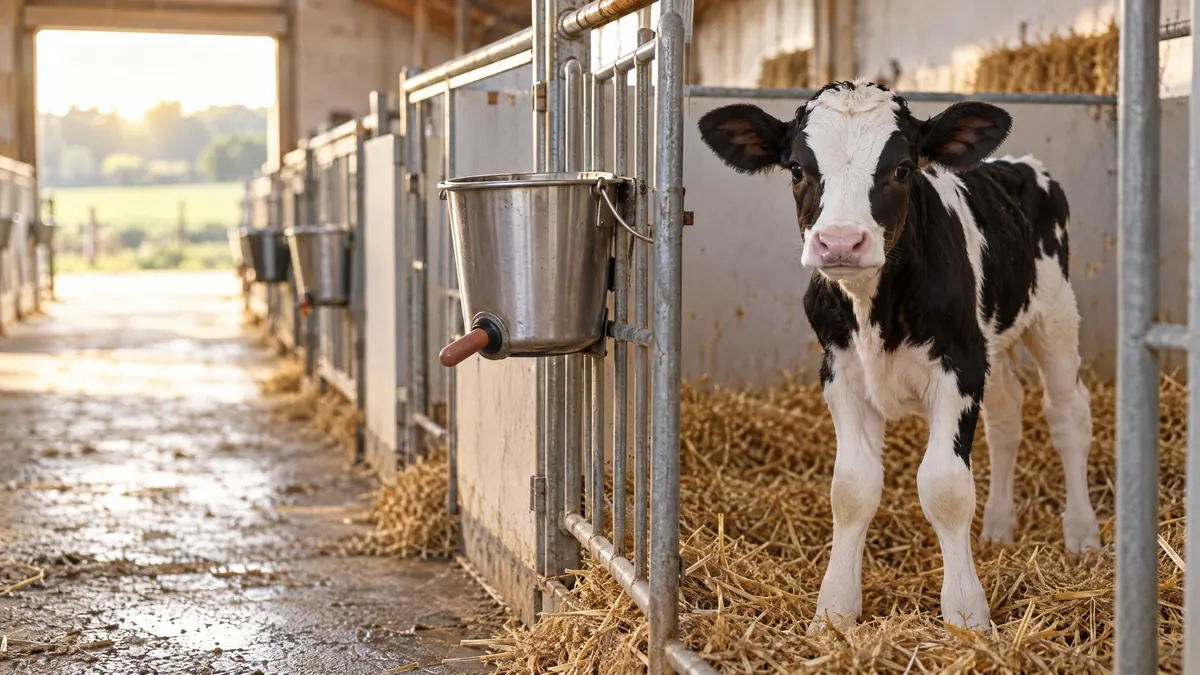
Calf rearing, from birth to weaning: colostrum, rumen and weaning
Colostrum, free water and milk, rumen start-up, weaning: the levers in order, and the products that have a place in them.
In short
Calf rearing from birth to weaning takes the calf from colostrum to milk, then to starter feed and water, until the rumen can digest without milk. It rests on first-hours colostrum, free water, a regular milk programme, a starter eaten early and weaning set on intake rather than age. EU law requires colostrum within six hours.
- Period
- Birth to weaning, often at 8 to 12 weeks for dairy heifers
- First meal
- Bovine colostrum as soon as possible, within six hours at the latest
- The pivot
- The rumen, which must be ready when the milk stops
- First lever
- Management: colostrum, water, regularity, hygiene
The problem
The first three weeks weigh the most
In the 2014 US national study of dairy heifers, a calf that does not reach weaning is lost at 24.4 days on average. Most of the risk therefore sits in the first three weeks, and that is where the basics are set: colostrum, milk, water, pen hygiene.
What is at stake does not stop at weaning. A heifer that grows well before weaning is associated with more milk in first lactation: in two herds followed by Cornell University, 850 to 1,113 kg more milk per kilogram of daily gain, and 1,550 kg in a 2013 meta-analysis. Management after weaning counts just as much: pre-weaning gain is one factor among others.
In Southeast Asia, heat adds to it. Water intake rises with temperature, and in 32 smallholder dairy farms in Vietnam, 96% of lactating cows were under moderate to severe heat stress in the afternoon: heat also weighs on calves, through water and through colostrum quality.
A calf that is lying down, no longer suckling or has sunken eyes is a case for the veterinarian, without delay. This page covers management, feed and water.
The first hours
How much colostrum for a calf, and when?
The calf is born without circulating antibodies: everything depends on first-hours colostrum. Absorption is best in the first four hours, falls fast after twelve hours and stops around twenty-four. A December 2025 systematic review gives 8.5 to 10% of body weight at the first meal, about 3 to 4 L for a Holstein calf (the European Food Safety Authority, EFSA, uses 12%), in the first or second hour and no later than six hours, then a second meal of about 2 L of colostrum or transition milk within 8 to 12 hours.
European Directive 2008/119/EC requires bovine colostrum as soon as possible after birth, and in any case within the first six hours of life.
Quality is read with a Brix refractometer. From about 22% Brix, colostrum generally holds at least 50 g/L of IgG, the antibodies; the threshold varies a little with breed, from 20 to 22% depending on the study. Colostrum below the threshold is topped up or replaced. It is collected, stored and fed with clean equipment: its bacterial load matters as much as its richness.
Passive immune transfer is checked on the calf, with a blood sample between one and seven days: a serum Brix of at least 9.4% puts the calf in the “excellent” category, which more than 40% of calves should reach. In 2025, across 108 dairy farms in six EU countries, only 35.3% of calves did (30.5% in France). Colostrum volume and its Brix are the two factors that count.
The first days
Free water for newborn calves, and a regular milk programme
Milk is not drinking water: it goes straight to the abomasum through the oesophageal groove, whereas drunk water goes first to the rumen, where fermentation begins. A calf without free water eats less starter: in a classic 1984 trial, weight gain fell by 38% and starter intake by 31% without water ad libitum. Heifers given water from birth already drink water on top of their milk over the first 16 days, and weigh more at five months than those given water from day 17 (Iowa, 2019).
Directive 2008/119/EC provides fresh water in sufficient quantity for every calf over two weeks of age, and at all times in very hot weather. EFSA recommends water in an open surface, not through a bottle or a teat. Heat changes intake: in the 2019 trial, water intake rose by 0.068 kg a day per degree, and by 0.141 kg a day per degree when milk was reduced at weaning. In the tropics, this is a key point.
On milk, EFSA recommends for calves under four weeks an allowance of 20% of body weight a day, 9 L for a 45 kg calf, and finds the old practice of about 10% insufficient, especially in cold weather. How to apply this opinion is debated in the industry. A step-down programme outperformed a constant one in a 2007 trial; regular temperature, concentration and feeding times matter as much as quantity.
The start-up
Calf starter intake and rumen development
At birth the rumen is small and does not work. Without early intake of solid feed, it is not ready at weaning.
- Milk bypasses it.It goes straight to the abomasum: the rumen has nothing to ferment until the calf eats solid feed.
- Solid feed puts it to work.Its fermentation produces volatile fatty acids, mostly butyrate and propionate, which make the papillae of the rumen wall grow.
- The starter must be eaten early.It must be palatable and fresh, a firm pellet with few fines, with water within reach.
- A little forage completes it.A 2025 meta-analysis puts the optimum around 9% of dry matter: forage raises rumen pH and rumination.
What gets the starter eaten
- Palatability
- A sensory profile the calf recognises, from one batch to the next.
- Presentation
- A firm pellet, few fines, fed fresh.
- Water
- A calf that cannot find water eats less starter.
- Milk
- More milk, less starter, until the programme steps down.
Weaning
Weaning dairy calves gradually, on intake rather than age
Abrupt weaning checks growth; gradual weaning gives the calf time to raise its starter intake, and the rumen time to adapt. EFSA notes that it can begin at 4 to 6 weeks, and that dairy heifers are often weaned at 8 to 12 weeks.
The criterion that counts is intake. A University of New Hampshire extension rule of thumb: not before six weeks, when the calf eats 0.9 to 1.4 kg of starter a day, starting to cut milk 10 to 14 days before the planned date. Adjust to breed and milk programme.
Weaning stress often stacks with others: regrouping, transport, a change of building, vaccination. Spreading them out helps the calf keep its appetite.
What a poor start costs
Losses that show on the calves, on the future cow and on the farmer’s time.
Colostrum too late or too little
In the US, observed pre-weaning mortality is 7.4% in calves under 10 g/L of serum IgG, against 1.5 to 2.5% above 18 g/L. A 2016 European meta-analysis also puts a cost on this insufficient transfer, calf by calf, in the economics of a dairy farm.
Days of growth
A calf that grows poorly before weaning leaves later or lighter. Daily gain before weaning is associated with first-lactation yield.
Starter paid for, badly eaten
A starter that is unpalatable, stale or without water within reach is not eaten: the rumen is not ready, and weaning costs a growth check.
Labour
Calves to watch closely, pens to redo, meals to adjust: the farmer’s time adds to the farm’s.
Figures from the literature, cited at the foot of the page: they describe US and European farms, not yours. On your farm, measure colostrum Brix, birth and weaning weights, and starter intake.
The calf, from birth to weaning: management first, then feed
No product makes up for colostrum given too late. Management sets most of it; the calf feed is worked out with the feed mill.
No product
Management first
These adjustments come before adding anything.
Colostrum, fast, enough, clean
3 to 4 L for a Holstein calf in the first hours, a measured Brix, clean equipment, and a blood check of transfer on a few calves.
Fresh water in an open surface, from the first days
A clean bucket within reach, emptied and refilled every day, all the more in hot weather.
A regular milk programme
Same temperature, same concentration, same times; a sufficient allowance, then stepped down before weaning.
A clean, dry, draught-free pen
Dry, generous bedding, ventilation without draughts, buckets and teats washed between calves. EFSA recommends pairs or small groups from the first week, then stable groups; these recommendations remain debated.
Weaning set on intake
Neither before six weeks nor before 0.9 to 1.4 kg of starter a day, with milk reduced over 10 to 14 days, and regrouping, transport or vaccination spread apart.
Feed Solutions
Through the feed
Starter feed is the rumen’s first tool: it is set with the feed mill, in formula, presentation and freshness.
A starter the calf eats early
Linkasty is a milk-profile flavour, in powder form, for calf feed. It helps keep a constant sensory profile of the feed from one batch to the next, so the calf recognises it and eats it.
Energy for the cells of the gut
Linkasel is sodium or calcium butyrate, plain or coated. Butyrate is the main energy source of the cells lining the intestine. Published trials in milk replacer and starter are mixed: the effect depends on age, route and rearing conditions, and the form is chosen with the feed mill.
A firm pellet, few fines, fresh
A matter of manufacture and storage: a pellet that crumbles or ages is eaten less, whatever its flavour.
A little forage in the ration
Around 9% of dry matter: a formulation setting, no product.

How to choose
Five Linker platforms: where each has its place
Two through the feed, three for the milk, the ration and the pen. Each has its own page: form, use, documents.
| Platform | Its role here | Where it works | When |
|---|---|---|---|
| linkastyFlavours · feed | At the nose and the palate, before the first bite | In calf feed, from starter to weaning, with the same note from one batch to the next | |
linkaselButyrate · feedTrial on the productIn a broiler trial (42 days), Linkasel’s coated calcium butyrate improved feed conversion from 1.83 to 1.76.Conditions2 groups of 6 replicates, 150 birds per group; 1.2 then 0.6 then 0.3 kg/t depending on the phase. | In the feed, reaching the gut depending on the form, plain or coated | When energy for the intestinal wall is the priority; form and grade set with the feed mill | |
| linkapectinElectrolytes and pectins · house | A powder of plant fibres with supplementary electrolytes, compatible with milk, for the young animal. | In warm water or warm milk, at the meal | On the days when the young calf is sensitive, or at a transition; milk is kept and water stays free |
| linkapatchClay, yeasts and a bitter plant · house | An oral powder based on clay, with yeasts, that supports the return to intake in heifers and calves. | By mouth, with the meal | A few days, at a change of ration |
linkadryLitter conditioner · houseTrial on the productField trial on an 800-sow farm: first colostrum intake within 5 minutes, against 20 for control piglets.ConditionsFarrowing unit, suckling piglets; 2017 trial. | A litter drier, mineral and plant-based: a drier pen is easier to manage. | Spread on the bedding, at calf level | Throughout the stay in the pen |
The rate and directions for each platform are on its page when published; otherwise they are given on request, with the calf’s age, the ration and the goal. The offer by stage, from calf to dairy cow, is on the cattle page, and the other ruminant solutions are under Ruminant solutions.
Evidence
What research has measured
Results measured on the platforms are on their pages, when published, with their conditions. References for the publications cited on this page are in the sources; the detail is available on request.
Sources
- Welfare of calves (external site)EFSA, Panel on Animal Health and Welfare · EFSA Journal 21(3):7896, 2023
- Council Directive 2008/119/EC of 18 December 2008 laying down minimum standards for the protection of calves (external site)EUR-Lex · OJ L 10, 15.1.2009, Annex I, points 13 and 15
- Factors associated with an excellent transfer of passive immunity: multisite, cross-sectional study conducted in different European countries on dairy cattle (external site)Frontiers in Veterinary Science · Fernandez-Novo et al., 2025, vol. 12
- Good Veterinary Practices for Managing the Colostral Period in Dairy Calves to Improve Their Immune Competence: A Systematic Review (external site)Veterinary Sciences · Stancheva and Penev, December 2025, vol. 12 (12)
- Colostrum Management for Dairy Calves (external site)Veterinary Clinics of North America: Food Animal Practice · Godden, Lombard and Woolums, 2019, vol. 35 (3)
- Evaluation of the Brix refractometer to estimate immunoglobulin G concentration in bovine colostrum (external site)Journal of Dairy Science · Quigley et al., 2013
- Ad libitum water intake by neonatal calves and its relationship to calf starter intake, weight gain, feces score, and season (external site)Journal of Dairy Science · Kertz, Reutzel and Mahoney, 1984, vol. 67 (12)
- Drinking water intake of newborn dairy calves and its effects on feed intake, growth performance, health status, and nutrient digestibility (external site)Journal of Dairy Science · Wickramasinghe, Kramer and Appuhamy, 2019, vol. 102 (1)
- Pre- and postweaning performance of Holstein female calves fed milk through step-down and conventional methods (external site)Journal of Dairy Science · Khan et al., 2007, vol. 90
- Weaning Dairy Calves (external site)University of New Hampshire Extension
- Comprehensive Evaluation of Forage Provision on the Serum Biochemical Indicators, Behavior and Health of Dairy Calves (external site)Journal of Agricultural and Food Chemistry · Xiao et al., 2025, vol. 73 (11)
- Invited review: Use of butyrate to promote gastrointestinal tract development in calves (external site)Journal of Dairy Science · Górka et al., 2018, vol. 101 (6)
- Preweaning milk replacer intake and effects on long-term productivity of dairy calves (external site)Journal of Dairy Science · Soberon et al., 2012, vol. 95 (2)
- Lactation Biology Symposium: The effect of nutrient intake from milk or milk replacer of preweaned dairy calves on lactation milk yield as adults: a meta-analysis of current data (external site)Journal of Animal Science · Soberon and Van Amburgh, 2013
- Failure of Passive Immune Transfer in Calves: A Meta-Analysis on the Consequences and Assessment of the Economic Impact (external site)PLoS One · Raboisson, Trillat and Cahuzac, 2016, vol. 11 (3)
- Assessment of Performance and Some Welfare Indicators of Cows in Vietnamese Smallholder Dairy Farms (external site)Animals · 2021, vol. 11 (3), 674
Sources checked on .
Directive 2008/119/EC was re-read on 24 October 2026 in the repository of the Publications Office of the European Union, which feeds EUR-Lex. Paywalled reviews were read at abstract level. This page summarises texts and publications; it is neither legal nor veterinary advice.
Frequently asked questions
How much colostrum for a calf, and when?
About 3 to 4 L for a Holstein calf, in the first hours and no later than six hours: see how much colostrum for a calf.
How do I know if colostrum is good quality?
With a Brix refractometer, from about 22%: the threshold and the check on the calf are in how much colostrum for a calf.
Do calves need water before two weeks of age?
Yes, from the first days, in an open surface: see free water for newborn calves.
Why does starter intake matter so much?
Because its fermentation makes the rumen papillae grow: see calf starter intake.
When should a calf be weaned?
On starter intake rather than age alone: see weaning dairy calves gradually.
What are a flavour and butyrate for in calf feed?
The flavour keeps the same sensory profile from one batch to the next, and butyrate is an energy source for gut cells: see through the feed.
Does pre-weaning growth change the future cow’s yield?
It is associated with it, without explaining it alone: see the first three weeks.
Talk about your calves
On the farm
Tell us the calves’ age, the milk programme, the starter feed and the age at weaning: a technician looks with you at where the start is decided, within the management set with your veterinarian.
Talk about your calf rearing →See the offer for cattle →At the feed mill
Send us the formula of your starter or milk-replacer feed, its presentation and its intake: we look with you at palatability and at the place of a butyrate.
Talk to a formulator →Or directly: +33 2 30 91 59 15 · contact@linkernutrients.com
Further reading
- Additives for cattle →
From calf to dairy cow, stage by stage.
- Ruminant solutions →
The Linker platforms for ruminants.
- Feed the animals leave →
Palatability, and the same note from one batch to the next.
- Heat stress →
Water, feed and management when the heat rises.