
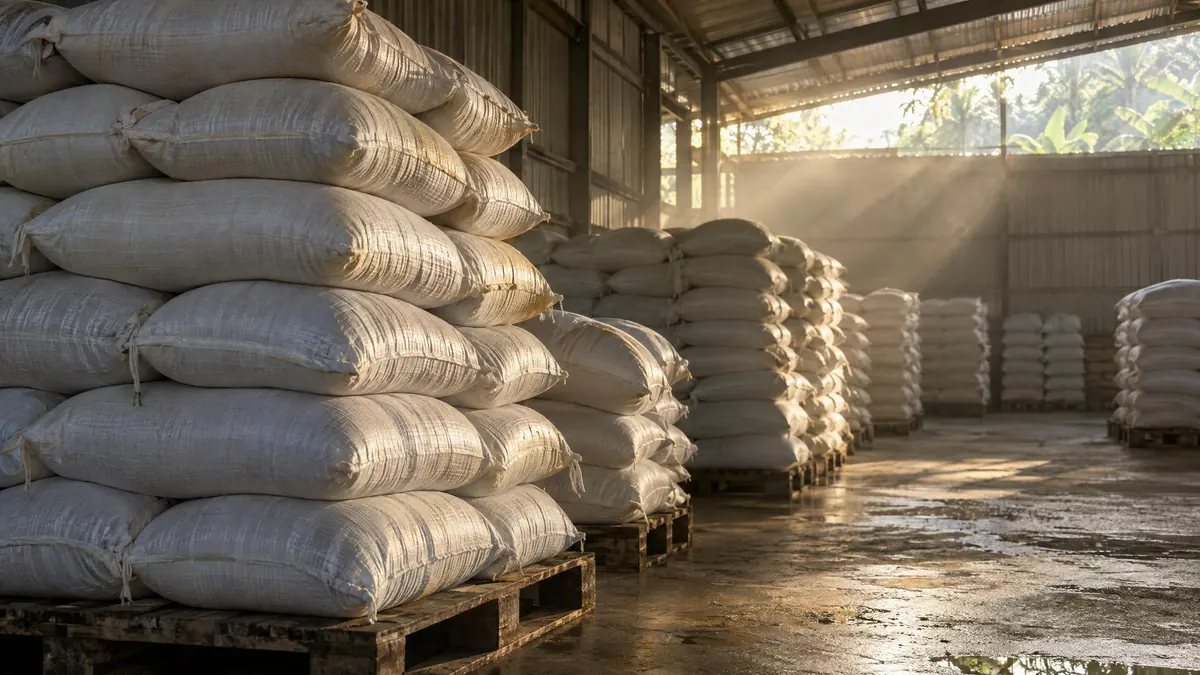
Mouldy feed in storage: where the risk comes from, and how to preserve feed
Why feed goes mouldy, where it picks up water, what it costs, then the mill’s levers: management first, the feed second.
In short
Mouldy feed (moldy feed in US spelling) is compound feed or a raw material on which moulds and yeasts have grown during storage: in a bin, a silo, a truck, a bag or a feeder. They need available water, heat and time. The feed loses nutritional value and palatability, and some storage moulds can produce mycotoxins in it. The risk is managed first through storage practice, then with a mould inhibitor.
- What triggers it
- Available water (water activity), heat, time
- Where
- Raw-material bins, feed silos, trucks, bags, feeders
- What it costs
- Nutritional value, palatability, mycotoxins formed in storage
- Benchmark
- Storage moulds grow from a water activity of 0.70 (FAO)
- First lever
- Feed that is dry, cool and does not wait long
The problem
Water activity vs moisture content: why feed goes mouldy in storage
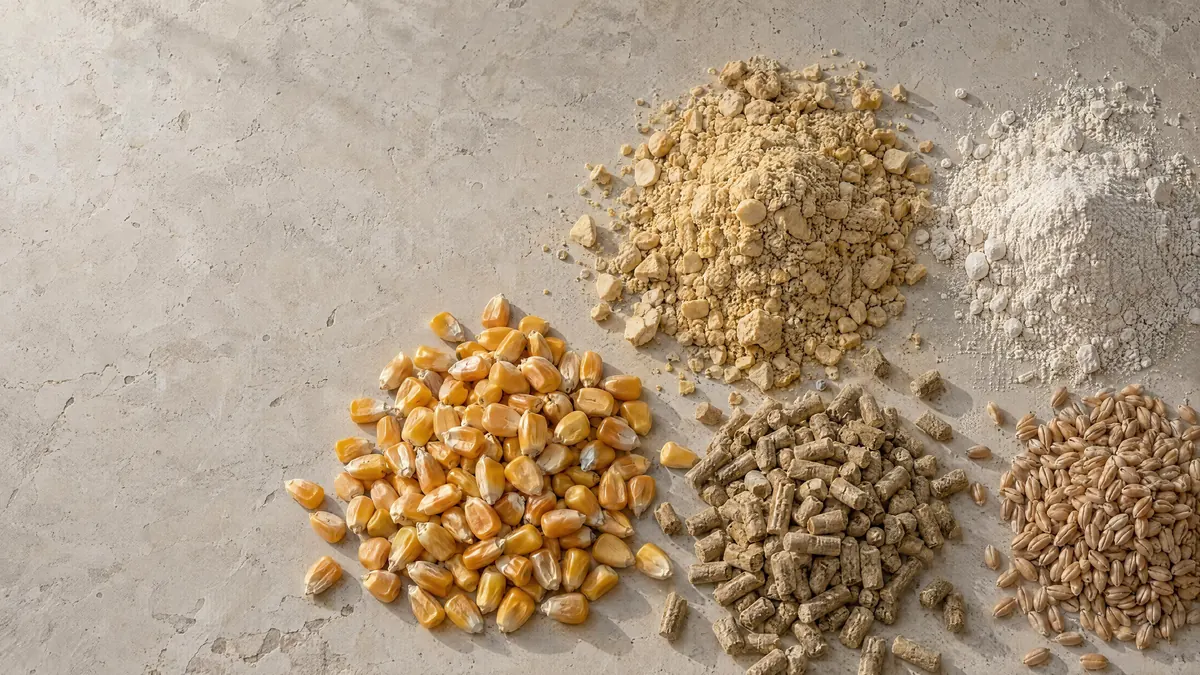
A mould does not need wet feed: it needs available water. That is what water activity (aw) measures, on a scale from 0 to 1. Moisture content tells you how much water a grain holds; water activity tells you how much of it micro-organisms can actually use. The FAO benchmark: storage moulds grow from a water activity of 0.70, while field moulds need more.
Heat shifts that threshold. At the same moisture, warmer grain makes more water available to moulds: a lot that keeps for months when cool spoils much faster when warm, and a hot, humid climate shortens every storage period.
Time does the rest. A mould that gets going consumes the feed and gives off heat and water; the zone next to it warms up, gets wetter, and the growth spreads. The longer feed waits, the more time this chain has to take hold.
Water comes in through three doors. With the raw material: a lot harvested or dried too wet, a mixed lot, broken kernels that give moulds a way in. With processing: pellets are formed with water from the steam, which cooling has to take out again. And with storage itself, when water in the bulk moves towards cold zones and settles there: that is condensation.
Dry feed cannot be judged by eye: only measuring moisture and water activity tells you.
Where water comes back
Condensation in silos and trucks: where feed picks up water again
From intake to the farm, six places where water comes back. Read the table step by step, with your own line in mind.
| Step | What happens | What to check |
|---|---|---|
| Raw-material intake | A lot that is too wet, or mixed: a few wet trucks are enough to wet a whole bin. Broken kernels and dust give moulds a way in. | Moisture on every truck, water activity on lots at risk; a written rule to dry, segregate, use first or reject |
| Storage bins | A metal wall conducts heat: temperature differences build up in the bulk, water migrates and can condense on the grain surface. A zone that goes mouldy heats up, gets wetter and spreads to the next. | Grain temperature at several points; aeration to cool it; a watertight roof and hatches |
| Pellet press and cooler | Pellets leave the press hot and carrying water from the steam. If cooling is too slow, that water goes into the silo with them. | Pellet temperature and moisture at the cooler outlet |
| Finished-feed silos | Day-night temperature swings make water condense on the walls and under the roof. A silo bottom that is never emptied goes mouldy, then passes into the next batch. | Regular full emptying and cleaning; first in, first out |
| Trucks | A damp or poorly cleaned body, a wet sheet, leftovers from the previous load: dry feed can pick up water there. | A dry, swept body before every load; a covered load |
| Farm silos and feeders | A silo that is never emptied to the bottom, crusts in the feeders, bags set straight on the floor. | A silo emptied and cleaned between deliveries; bags on pallets; deliveries matched to consumption |
Based on the Codex Alimentarius code of practice on good animal feeding and the FAO manuals listed in the sources.
What mouldy feed costs
Four losses, which show up neither at the same time nor in the same place.
Nutritional value
Moulds feed on the protein, carbohydrates and fat in the feed. What they consume is lost to the animal, and mouldy feed is less digestible: its energy drops, starting with the energy from fat.
Palatability
A musty smell, lumps, feed that heats up: animals eat less of it. Intake drops, and growth or milk output with it, just when the feed was meant to support them.
Mycotoxins formed in storage
Some storage moulds produce mycotoxins, aflatoxins and ochratoxin A above all, in a lot that carried none at intake. They can be there with no visible mould: see mouldy feed and mycotoxins.
The lot and the line
A mouldy lot is set aside, tested and often discarded. Lumps block silos and augers, the line stops for cleaning, and the farmer’s complaint arrives after delivery.
No figure here: the loss depends on the feed, the climate and the storage time. It is measured on your own lots.
How to preserve feed: management first, then the feed
A mould inhibitor extends storage that is well managed. It cannot rescue a lot that is too wet or a silo that is never cleaned.
No product
Management first
At the mill, from the raw-material truck to the farm silo: what is settled before any additive.
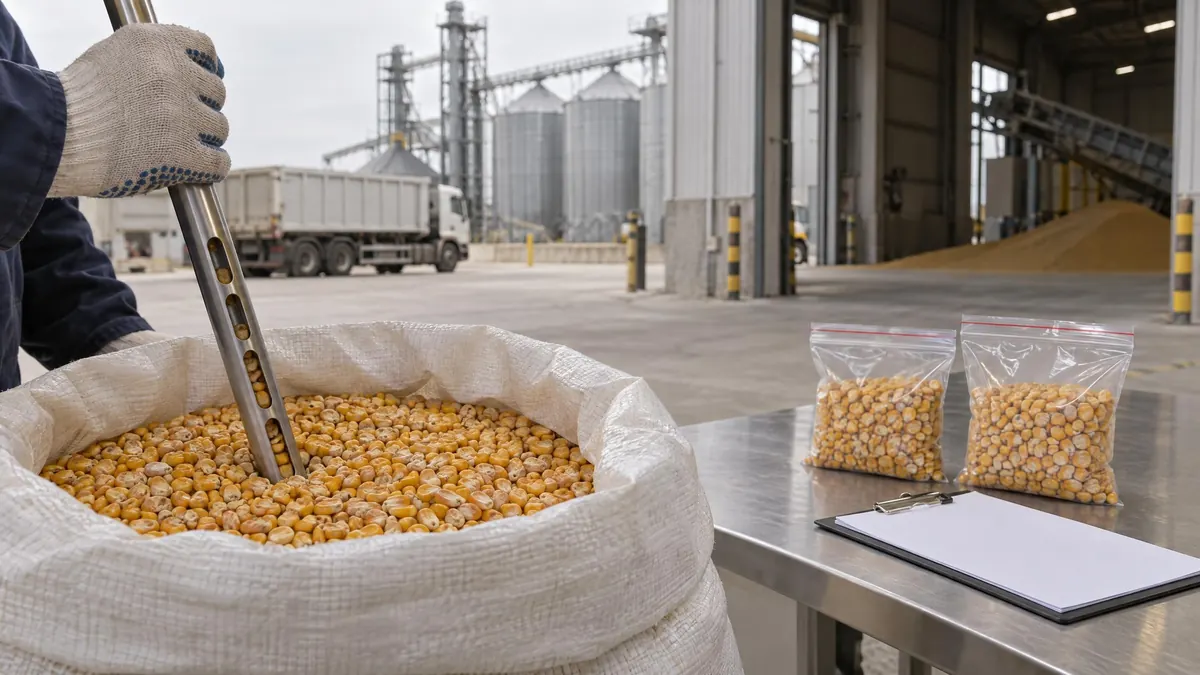
Measure moisture at intake
Moisture truck by truck, water activity on lots at risk. A written rule says what happens to a wet lot: it is dried, stored separately, used first or rejected.
Cool before storing
Pellets should leave the cooler cool and dry enough that their water does not end up in the silo. In bins, aeration cools the grain and slows moulds down; grain temperature is followed at several points.
Keep silos and trucks dry and clean
Watertight roofs, hatches and seals; bins and silos emptied completely, then cleaned at regular intervals; dry, swept truck bodies and covered loads. On the farm, the silo is emptied to the bottom between deliveries and bags stay off the floor.
Rotate stock
First in, first out, for raw materials as for finished feed. Feed should be delivered and eaten quickly: storage time is agreed with the farmer, based on consumption and climate.
Feed Solutions
Through the feed
When storage has to last, or the climate leaves no margin: a mould inhibitor, dosed on the feed.
Hold back moulds and yeasts while feed waits
A mould inhibitor combines organic acids and their salts. In their active form they enter the mould cell and block its metabolism. The rate follows the feed, not the animal: moisture, water activity, pH and the time to cover.
As a powder, at intake or at the mixer
Linkamold goes onto wet raw material at intake, before long storage, or into compound feed at the mixer. Free acids act at once; salts, with no odour and no corrosion, hold the duration. The grade is chosen on the line, the climate and the time to cover.
As a liquid, for water added at the mixer
Adding water at the mixer only makes sense if that water stays protected from moulds until it reaches the feeder. Linkamold Ultra L is diluted in the added water and sprayed at the mixer; the spray bar is set to the line throughput, which is the job of Linker Flow.
Mouldy feed and mycotoxins: what forms in storage, what comes from the field
Mouldy feed is not always loaded with mycotoxins, and contaminated feed is not always mouldy. There are two origins. Field toxins are in the grain before harvest: no storage, however good, will take them out. Storage moulds can form others, in the silo, when water, heat and time come together.
Storage management and a mould inhibitor act on the moulds in the feed; neither removes a toxin that has already formed. For field toxins, how to test for them and how to manage them, see field or storage on the Mycotoxins page; for choosing between the two tools, mould inhibitor or mycotoxin binder.
The Linker platform involved
One Feed Solutions platform, as powder or liquid. Its page gives the grades, use and documents.
| Platform | Where it works | When |
|---|---|---|
linkamoldMould inhibitor · feedLaboratory testIn inoculated feed stored for 90 days at 25 °C, the inoculated moulds were brought down to non-detectable levels, while the control exceeded 10⁸ CFU/g.ConditionsLaboratory test on mash feed, closed jars; two doses, 1.5 and 3 kg/t; counts at 60 and 90 days. | On raw material at intake, or in the feed at the mixer | Before long storage, in hot and humid climates, or when water is added at the mixer |
The rate is on the platform page when it is published; otherwise ask for it, with the moisture, water activity and pH of the feed and the time to cover. The other risks to feed are gathered in feed safety and preservation.
Sources
- Code of Practice on Good Animal Feeding (CXC 54-2004), in the Codex list of codes of practice (external site)Codex Alimentarius (FAO and WHO) · CAC/RCP 54-2004, adopted 2004, amended 2008, paragraphs 37, 38 and 42 · accessed
- Good Practices for the Feed Industry, section 3: production, processing, storage, transport and distribution of feed and feed ingredients (external site)FAO and IFIF · FAO Animal Production and Health Manual No. 9, 2010 · accessed
- On-farm mycotoxin control in food and feed grain (external site)FAO · P. Golob, Good practices for animal feed and livestock, training manual 1, 2007 · accessed
- Grain storage techniques: biodeterioration (external site)FAO · D.L. Proctor (ed.), FAO Agricultural Services Bulletin No. 109, 1994, chapter 2 · accessed
- Grain storage techniques: factors influencing the choice of bulk store (external site)FAO · FAO Agricultural Services Bulletin No. 109, 1994, chapter 7 · accessed
- Grain storage techniques: aeration (external site)FAO · FAO Agricultural Services Bulletin No. 109, 1994, chapter 7 · accessed
- Storage problems of feedstuffs (external site)FAO and UNDP · K.W. Chow, in Fish Feed Technology, ADCP/REP/80/11, 1980, chapter 13 · accessed
- Harvest and storage management of wheat (external site)FAO · T.S. Payne, in Bread Wheat: Improvement and Production, FAO Plant Production and Protection Series No. 30, 2002 · accessed
Benchmarks drawn from Codex Alimentarius and FAO texts. Storage times and thresholds are set on your own feed, climate and installation.
Frequently asked questions
Can mouldy feed be fed to cattle or chickens?
No, not feed that is visibly mouldy: set it aside, find where the water came from, and have it analysed, mycotoxins included. See what it costs.
What is the difference between moisture content and water activity?
Moisture content is how much water the feed holds; water activity is how much of that water moulds can use. See why feed goes mouldy.
At what water activity does feed start to go mouldy?
According to the FAO, storage moulds grow from a water activity of 0.70. At the same moisture, the risk rises with temperature.
Why does feed go mouldy against a silo wall?
Because the wall follows outside temperature swings: water in the bulk migrates and condenses where it is colder. See silos and trucks.
How long can feed be stored?
There is no single answer: it depends on moisture, temperature and climate. The FAO manual advises livestock keepers to buy no more than ten days of feed at a time, and less in very hot, humid climates.
Powder or liquid: which mould inhibitor should I choose?
Powder goes onto raw material or into the mixer; the liquid, Linkamold Ultra L, protects water added at the mixer. See the levers through the feed.
Does a mould inhibitor remove mycotoxins?
No. It holds back moulds in the feed; it does not remove a toxin that has already formed. See mouldy feed and mycotoxins.
Review your storage conditions
You store raw materials or feed
Moisture, water activity, storage time, climate, the points on your line where water comes back: we look at them with you, then talk grade and rate.
Review your storage conditions →Request the Linkamold data sheet →You add water at the mixer
Line throughput, added water, cooling, moisture in the bag: let us talk about Linkamold Ultra L and how it is sprayed.
Talk about water added at the mixer →See the Linkamold page →Or directly: +33 2 30 91 59 15 · contact@linkernutrients.com