
Growth and feed conversion: where performance is lost
How to calculate and compare FCR, where performance is lost between formula and animal, and the levers: management, then feed.
In short
The feed conversion ratio (FCR) is the amount of feed a batch of animals eats, divided by the weight it gains over the same period: kilos of feed per kilo of gain. The lower it is, the better the feed is converted. It is read alongside growth rate and batch uniformity, and only compared at similar age, weight and calculation method. Between the formula and the animal, it adds up every loss.
- The calculation
- Feed eaten divided by weight gain, over the same period
- Its inverse
- Feed efficiency: weight gain divided by feed eaten
- Read with
- Average daily gain and batch uniformity
- Species
- Poultry, pigs, fish and shrimp
- First lever
- Management: water, climate, stocking density, access to feed
The problem
A formula that is right on paper, and growth lost along the way
The formulator works in energy and digestible amino acids, using the values in the matrix. The animal grows on what it eats, digests and absorbs. From that, it subtracts what it spends on maintenance, on keeping warm or cool, and on coping with whatever disturbs it.
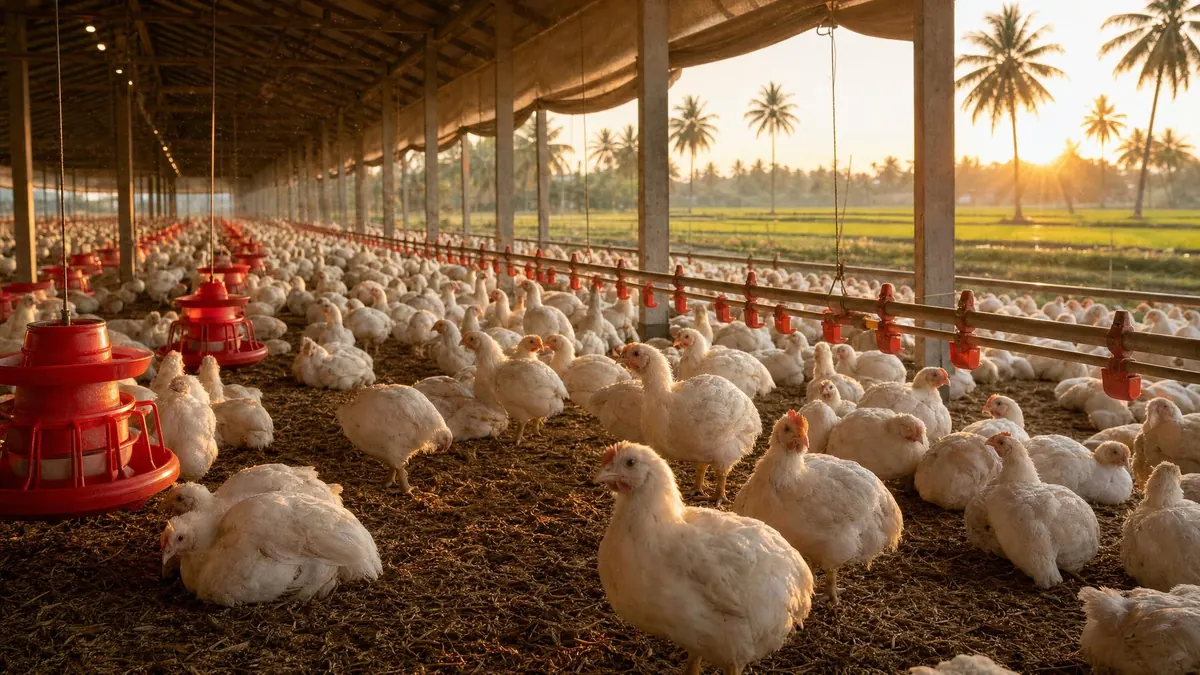
In between, performance leaks away in small amounts. A batch of raw material poorer than the matrix. Fat that is poorly emulsified, protein that is poorly digested. Feed eaten less, or wasted. Oxidised fat. A gut under pressure. A house that is too hot, water that runs short.
None of these leaks shows on its own. The feed conversion ratio gathers them all: that is why it is the figure everyone follows, and why, on its own, it does not say where to look.
A worsening FCR is a signal, not a diagnosis. When it comes with other signs, the veterinarian’s view comes first.
Calculate and compare
How to calculate feed conversion ratio, and compare it fairly
The calculation is a single division. What skews it is what goes on each side.
- Set the period.A start date and an end date, the same for feed and for weight. A starter FCR, a finisher FCR and a whole-cycle FCR do not say the same thing.
- Count all the feed.Feed eaten is the opening stock, plus deliveries, minus the closing stock. Wasted feed counts too: it weighs on the FCR without feeding anyone.
- Weigh the gain.Final weight minus starting weight, for the whole batch, including animals sold or removed along the way.
- State how losses are counted.Animals that died or were culled during the period ate without finishing their growth. A corrected FCR counts them, a raw FCR does not. The EFSA guidance on the efficacy of feed additives asks for the correction method to be reported.
- Compare like with like.FCR rises with age and weight: a heavier animal spends a larger share of its feed on maintenance. Two batches are compared at the same age and weight, with the same sex, the same feed sequence and the same calculation method.
What most often skews the reading
- Waste
- A badly set feeder or crumbling pellets: the feed is counted, not eaten.
- The bin
- A stock guessed by eye at the start or end of the period shifts the whole calculation.
- Weighing
- A few animals taken from one spot do not represent the batch.
- The convention
- Raw or corrected, FCR or feed efficiency, which period: check before comparing two figures.
Batch uniformity
Flock and batch uniformity: the average does not tell the whole story
A good average weight can hide a spread-out batch: some animals ahead, others behind. Yet the feeding programme is built for an age and a weight, and the processing plant works best with animals of similar weight. The smallest ones compete for feeders and drinkers, and fall further behind.
Uniformity is measured on a sample weighed animal by animal, taken from several places in the house. A 2026 review of broiler flock uniformity describes two ways to express it: the coefficient of variation, that is the standard deviation of the weights divided by the mean weight, times 100, where lower means more uniform; or the share of animals within plus or minus 10% of the mean weight.
The causes often lie in management: uneven access to feed and water (poorly spread drinkers, feeders set too high), differences in temperature and humidity from one end of the house to the other, males and females reared together. A feed that is less readily eaten also hits the smallest and most wary animals first: see feed palatability.
From formula to animal
Where performance is lost, step by step
Seven places where paid-for feed does not turn into growth, and what to check first for each.
| Step | What is lost | What to check first |
|---|---|---|
| Raw materials | The formula works on matrix values. The real batch can drift from them from one harvest or origin to the next: protein, fat, moisture, fibre. | Analysis at intake, and a matrix kept up to date batch by batch. Mycotoxins are monitored separately. |
| Fat digestibility | Fat is the most concentrated energy source in the diet, and often one of the most expensive. Poorly emulsified, part of it passes through unabsorbed, especially in young animals and with saturated fats. | The type and quality of the fat, the animals’ age, then emulsification: see the levers through feed. |
| Protein digestibility | In young animals, the stomach does not yet acidify enough: pepsin works poorly, and part of the protein reaches the intestine undigested. | The buffering capacity of the feed and the quality of protein sources, then acidification. |
| Feed intake and palatability | What is not eaten does not feed. When intake falls, the share used for maintenance grows, and growth slows. | The feed, its freshness and presentation: see feed palatability. |
| Oxidation | Oxidised fat supplies less energy than the formula counts on, and vitamins oxidise with it. | Fats and vitamins protected from oxidation: see fat oxidation. |
| Gut health | A gut under pressure absorbs less well, and uses part of what the feed supplies for itself. | Management, feed transitions and the veterinarian’s view: see gut health. |
| Management | Water running short, heat or cold, stale air, stocking density, feeder space: the animal eats less, or spends on adapting what it would have put into growth. | The house and the water first: see the levers by management and heat stress. |
Losses add up: a slightly poorer raw material, slightly less digested fat and slightly short water together make an FCR that drifts.
What a drifting FCR costs
A loss that only shows at the end of the cycle, when the feed has already been paid for.
Feed
It is the heaviest item in the cost of rearing animals. Every kilo of gain that takes more feed is paid for, across the whole cycle.
Nutrients paid for and lost
Energy and protein counted in the formula, but not absorbed, were bought for nothing.
Time
Slower growth means reaching slaughter weight later: more days in the house, more feed, more work.
Uneven batches
A spread-out batch is harder to sort, manage and sell, and the feeding programme no longer suits every animal.
Excretion
What is not digested ends up in the manure, with the nitrogen and phosphorus it contains.
No figures here: the loss depends on species, stage, formula and feed price. It shows in your own FCR figures, cycle after cycle, always calculated the same way.
Feed conversion ratio, lever by lever: management first, then feed
No additive makes up for water running short or a house that is too hot. Feed comes next: making sure what the formula supplies is eaten, digested and absorbed.
No product
Management first
On the farm, before any additive: what makes the animal eat, drink and grow.
Water first
Flow checked on every line, enough drinkers at the right height, clean, cool water. Feed intake follows water intake.
The right climate
A temperature suited to age, ventilation that renews the air without draughts, little ammonia. Too hot, the animal eats less; too cold, it spends energy keeping warm.
Room at the feeder and the drinker
A suitable stocking density, and enough space for every animal to reach feed and water. In pigs, EFSA notes that reduced space allowance compromises growth.
Less waste
Feeders set correctly, pellets that hold together, few fines. Feed that falls into the litter still counts in the FCR.
Weigh and track
Regular weighing of a sample taken from several places, and an FCR calculated cycle after cycle, always the same way. It is the basis for judging everything else.
Feed Solutions
Through the feed
Once management is in place: getting out of the same formula what it paid for.
Get more energy out of fat
To be digested, fat must first be emulsified into fine droplets for lipase to work on. A lysophospholipid emulsifies better than lecithin: more surface offered to lipase, and fatty acids, fat-soluble vitamins and pigments that are better absorbed. Young animals, whose bile salts and lipase are still limited, need it most. The energy comes from the diet: the emulsifier helps the animal make use of it.
Protect fat before it is eaten
Oxidised fat has lost part of its energy before it reaches the trough. An antioxidant, added in the premix or at the mixer, protects the fats and vitamins in the feed: see fat oxidation.
Help young animals digest protein
An acidifier brings feed to the right pH, and helps the stomach reach the pH at which pepsin activates; its dose is set on the buffering capacity of the feed. Medium-chain fatty acid monoglycerides complement acids: their action does not depend on pH.
Feed the gut wall
Butyrate is the main energy source for the cells of the gut wall, which absorb what the feed supplies. It comes as a salt, plain or coated, or as tributyrin, released in the small intestine: see butyrate or tributyrin. A postbiotic, based on inactivated lactobacilli, contributes to the balance of the microbiota, and withstands pelleting.
Spare methionine and choline
Betaine has two jobs. As a methyl donor, it leaves the diet’s methionine and choline free for their other roles; as an osmolyte, it helps cells hold their water when the heat rises. How much choline it can replace is calculated on your matrix, species by species.
Each platform is judged on your formula: two batches managed the same way, the same diet, and measurements of growth, feed conversion and, where possible, digestibility. We build that protocol with you. Measured results are on each platform’s page, when published, with their conditions.
The Linker platforms involved
Eight Feed Solutions platforms, each in its place, from the premix to the gut wall. Each has its own page: grades, use, documents.
| Platform | Where it works | When |
|---|---|---|
linkalysoEmulsifier · feedTrial on the productIn tilapia, over 60 days at 0.3 kg/t: feed conversion ratio of 1.42, against 1.82 for the control (university trial published in 2021).ConditionsNile tilapia of about 70 g at the start, three replicates per rate; 4 rates compared. | In the intestine, on the fat droplets of the diet | Diets high in added fat, saturated fats, young animals |
linkatioxAntioxidant · feedLaboratory testIn a trial on our ethoxyquin-free antioxidant formulas (Rancimat test on lard), the induction period extended 39% more than with ethoxyquin alone, at the same dose.Conditions100 °C under air flow; 200 ppm of antioxidants; formula tested in liquid form. | In the premix or at the mixer; on the fat, case by case | When the premix or the feed is made |
linkacidAcidifier · feedLaboratory testLaboratory measurement: 100 g of Linkacid Premium LP deliver 380 mmol of acidifying capacity at pH 4, a figure used to set the rate against the feed’s buffering capacity.Conditions100 g of product in 200 mL of water at 37 °C, titration with sodium hydroxide; measured in 2022. | In the feed, then in the stomach | Weaning and starter feeds, formulas with high buffering capacity |
linkalphaMonoglycerides · feedPublication on the ingredientIn vitro, monolaurin is four times more active than free lauric acid on a Gram-positive bacterial strain (2009 publication).ConditionsInhibitory concentrations measured in culture, on pure monolaurin and lauric acid. | Along the digestive tract, at acid or neutral pH | Alongside acidifiers, in poultry, pig and aquaculture feed programmes |
linkaselButyrate · feedTrial on the productIn a broiler trial (42 days), Linkasel’s coated calcium butyrate improved feed conversion from 1.83 to 1.76.Conditions2 groups of 6 replicates, 150 birds per group; 1.2 then 0.6 then 0.3 kg/t depending on the phase. | In the stomach and upper intestine; further along in coated form | Around weaning and the starter phase |
linkatribTributyrin · feedPublication on the ingredientIn post-peak laying hens, a published university study reports a 3.1% thicker eggshell with tributyrin at 500 g/t.Conditions384 hens, 8 replicates of 24 per group, 16 weeks; significant difference (P = 0.01). | In the small intestine, through the action of lipase | Transition and starter feeds, pelleted feeds |
linkabiomePostbiotic · feedPartner dataIn broilers, from day 7 to day 49, at 1 kg/t: weight gain 10.7% above the control (university trial).ConditionsTwo diets compared; significant difference (P < 0.01); no effect in the first week. | In contact with the intestinal lining | Starter phase, weaning, feed changes; pelleted and stored feeds |
| linkataineBetaine · feed | In the formula, as a methyl donor; in the cells, as an osmolyte | Formulas where methionine and choline weigh on cost; summer feeds |
The dose is on each platform’s page when it is published; otherwise ask for it, with the species, stage, formula and its fat content. The digestion levers are brought together in Digestion and performance.
Sources
- Guidance on the assessment of the efficacy of feed additives (external site)EFSA Panel on Additives and Products or Substances used in Animal Feed (FEEDAP) · EFSA Journal 2018, 16(5), e05274 · accessed
- Factors Affecting Flock Uniformity in Broiler Production: Individual, Environmental, and Management Characteristics (external site)Animals (MDPI) · Choi et al., 2026, vol. 16, no. 2, article 185 · accessed
- Welfare of pigs on farm (external site)EFSA Panel on Animal Health and Welfare (AHAW) · EFSA Journal 2022, 20(8), e07421 · accessed
This page explains; it does not replace your veterinarian’s advice. All three texts were consulted on PubMed Central.
Frequently asked questions
How do you calculate feed conversion ratio?
Divide the feed eaten by the weight gained, for the same batch and over the same period. What skews the calculation is covered in how to calculate it.
What is the difference between feed conversion ratio and feed efficiency?
One is the inverse of the other: FCR divides feed by gain, feed efficiency divides gain by feed. Check the convention before comparing two figures.
Why does feed conversion ratio rise with age?
Because a heavier animal spends a larger share of what it eats on maintenance. Two batches are therefore compared at the same weight.
How do you measure flock uniformity?
With the coefficient of variation of body weights, on a sample weighed animal by animal: see batch uniformity.
Can an additive make up for poor management?
No. Water, climate, stocking density and feeder space come before any additive: see the levers by management.
How do you judge the value of an additive on feed conversion?
On your own formula, through a well-designed trial whose protocol we set up with you: see the note under the levers.
Does a worsening FCR point to a health problem?
Sometimes. FCR shows there is a loss, not where it is; when it comes with other signs, diagnosis is a matter for the veterinarian.
Let’s talk about your feed conversion
You formulate or make the feed
Species, stage, formula, fats used, FCR from recent cycles: we look with you at where performance is lost, and what comes down to management or to feed.
Talk to a formulator →Request the Linkalyso data sheet →You want to measure on your own batches
Two batches, the same diet, the same calculation: we build with you a trial that answers your question, on your formula.
Build a trial with us →Or directly: +33 2 30 91 59 15 · contact@linkernutrients.com
Further reading
- Feed palatability →
Why intake drops when the formula is right, and the levers to bring it back.
- Fat oxidation →
How rancidity advances unseen, and how to slow it down.
- Gut health →
What gut health covers, and where feed fits in.
- Digestion and performance →
Acids, butyrates, emulsifier, postbiotic: each lever in its place.