
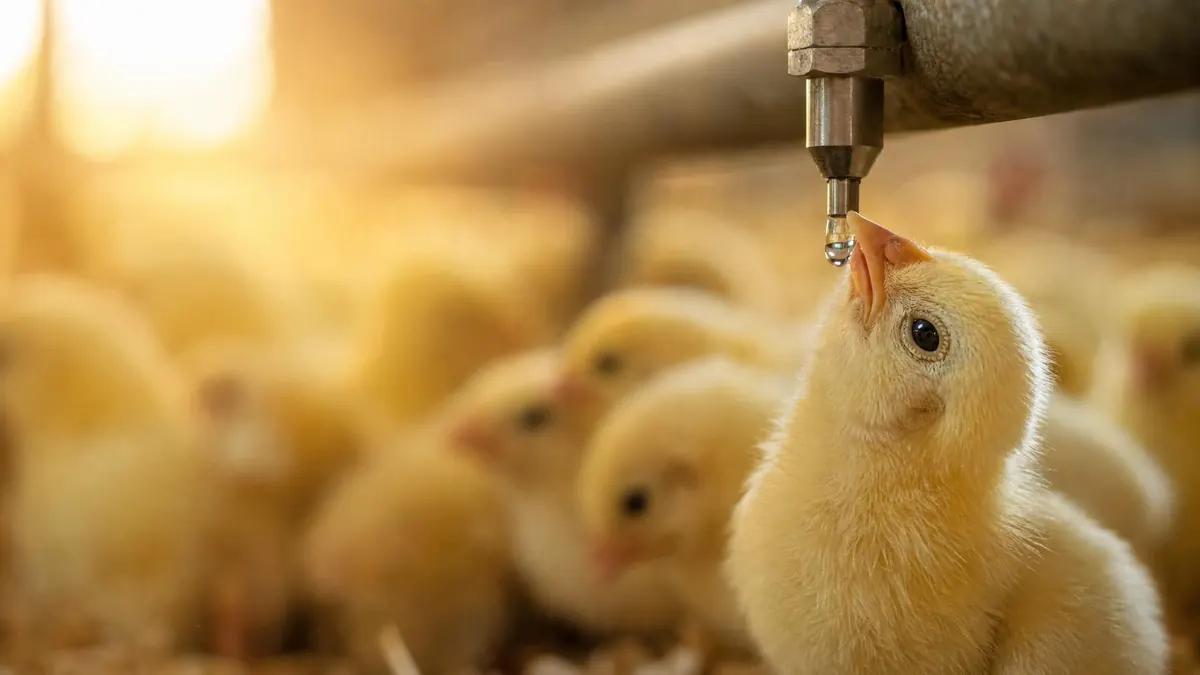
Diarrhoea on the farm: what to check, and what water and feed can support
Reading the sign, checking water, feed and environment, calling the vet, then what the drinking water can carry.
In short
Diarrhoea on the farm is a change in a flock’s or a herd’s droppings: looser, more frequent faeces in pigs, wet droppings in poultry. It is a sign, not a diagnosis: salty water, a feed change, heat or a disease can all produce it. The farmer checks water, feed and environment; the diagnosis belongs to the veterinarian.
- Species
- Poultry and pigs, at any age; young animals first
- What you see
- Wet droppings and wet litter; soft or liquid faeces in the pen
- Check first
- Water (quality, temperature, flow), feed, environment and litter
- The diagnosis
- It belongs to the veterinarian, always
- What water can carry
- Water at the right pH, short supplements when the animals eat less
The problem
Wet droppings or diarrhoea: read the sign before acting
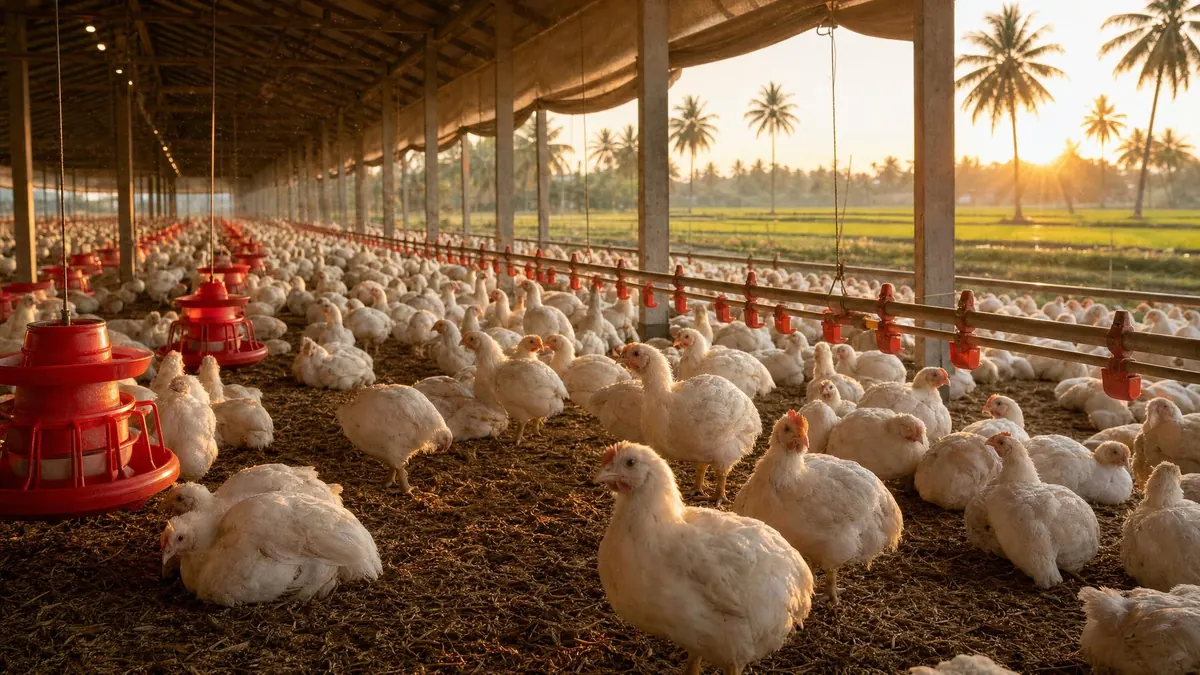
In poultry, wet droppings are not always diarrhoea. A bird that drinks more passes more water: in hot weather, with water high in salts, or on a diet with too much salt. The litter gets wet without the gut being involved. Diarrhoea, on the other hand, comes from disturbed digestion: nutrition, a raw material, mouldy feed or a disease can all be behind it.
In pigs, you read faecal consistency in the pen. A simple scale used in research has four classes: firm and shaped, soft and shaped, loose, watery. The last two count as diarrhoea. Scoring each pen every day gives a more reliable record than an impression in passing.
Before changing anything, four questions: how many animals, how old, since when, and what has changed? Diarrhoea on the farm rarely comes out of nowhere: a new feed delivery, a new borehole, a heatwave, a transfer, weaning. The water meter, read every day at the same time, is often the first to show what has moved.
The answers serve twice: the farmer, for what to check, and the veterinarian, who needs them for the diagnosis.
Dull animals, animals eating or drinking less, or abnormal faeces across several pens or a whole flock: call the veterinarian first, before any change of programme.
On the farm
Wet droppings in poultry, loose faeces in pigs: what the farmer checks first
Water first, then feed, then environment and litter. The figures come from university extension publications, listed at the end of the page.
| What to check | What to look at | Published benchmark |
|---|---|---|
| Water: its quality | An analysis at the source and at the end of the line: dissolved salts, sulphates, magnesium. Excess sulphates have a laxative effect; too much sodium and chloride makes animals drink more. | Pigs and cattle: at 3,000 to 5,000 mg/l of dissolved salts, young animals may have loose faeces (North Dakota). The other benchmarks: drinking water quality. |
| Water: its temperature | The water temperature at the last nipple, especially in hot weather: water warms up along the lines. | Poultry: birds will drink water close to freezing, but may go thirsty rather than drink water only slightly warmer than their body (Mississippi). |
| Water: its flow | Flow at the nipple or drinker, at the start and end of the line; pressure; blocked filters and nipples. An animal that drinks poorly eats poorly. | Broilers: about 7 ml per minute per week of age, plus 20 ml (Mississippi). Weaned pigs: 1 to 2 cups per minute, roughly a quarter to half a litre (South Dakota). |
| Feed: what has changed | The date of the last delivery, the formula, the batch, the presentation (mash, crumbs, pellets). An abrupt switch from one feed to the next often shows in the droppings. | Wheat, barley and rye often give wetter droppings; so does rancid fat; a mixing error can add too much salt (Florida). |
| Feed: its condition | Smell, colour, lumps, feed caked at the bottom of bins and hoppers. Mouldy feed irritates the digestive tract. | Bins and feed equipment cleaned, caked or mouldy feed removed (Florida). See also mycotoxins. |
| Environment and litter | Temperature at animal level, draughts, ventilation; leaks and spilt water. In hot weather animals drink more and wet the litter. | Wet litter is managed through the water line and the air: ammonia and wet litter. |
General management benchmarks, quoted with their source. They do not replace your breed or genetics guide, your laboratory’s advice or your technician’s.
The diagnosis
What belongs to the veterinarian: the diagnosis, always
Diarrhoea is a sign; only the veterinarian can establish its cause. The vet examines the animals, orders tests where needed, and decides how the flock or herd is to be managed. The farm’s checks do not replace this diagnosis: they prepare it, and they rule out what can be put right on the farm.
What is useful to tell the vet: since when, how many animals and how old, the faecal score or the state of the litter, water use over the last few days, what has changed in feed, water or building, and the water analysis if there is one. If samples are needed, the vet says which ones and how to take them.
The vet also decides what goes into the water during this period, and in what order: a live vaccine, for example, is given in water of its own, with no other product. A drinking water programme fits within the vet’s plan, never ahead of it.
In piglets, diarrhoea after weaning has its own window and its own factors: they are explained on the piglet weaning page.
What wet droppings and loose faeces cost
Losses that show on the litter, at the processing plant and in the flock’s results.
The litter
Wet droppings soak the litter, which cakes and ferments: more work, more straw or shavings, and a house that takes longer to dry between flocks. Ammonia rises with moisture.
The feet
Wet litter alone can ulcerate the skin of a broiler’s footpads: footpad dermatitis is scored at the processing plant and counts in animal welfare audits.
Growth
An animal that digests poorly gets less from its feed, and feed intake follows water intake: a flock that drinks less eats less. A bird with sore feet goes to the feeder less often.
Uniformity
Not every animal is affected at the same time or in the same way: the flock spreads out, and animals that fall behind often stay behind until they leave.
Pens and air
In pigs, liquid faeces soil pens, animals and lying areas: hygiene takes more time, and the air in the room gets heavier.
No figures here: the loss depends on species, age, cause and duration. It shows in your footpad scores, your weighings and your flock results.
How to manage diarrhoea on the farm: management first, then drinking water
The veterinarian’s diagnosis and good management come before any product. Drinking water supports the animals through the period; feed is worked out with the formulator.
No product
Management first
What can be put right on the farm is put right before anything is added to the water.
The veterinarian, as soon as the sign settles in
The vet makes the diagnosis and decides what to do. The farmer brings the answers to the four questions: how many, how old, since when, what has changed.
Water that is checked, cool and plentiful
A water analysis at the source and at the end of the line, clean lines, water that does not warm up in the house, flow and pressure set for the animals’ age. The water meter is read every day.
Gradual feed transitions
A change of formula or presentation made in steps, with the date written in the farm record: that is the date you will look for if the droppings change.
Environment and litter
The right temperature at animal level, without draughts; ventilation that removes the water from the droppings; leaks repaired and litter renewed where it gets wet.
Hygiene between batches
Pens, houses and water lines cleaned and disinfected between batches, with products meant for the job and time to dry before the next animals arrive.
Farm Solutions
Through the drinking water
Water at the right pH, held to the end of the line
Linkacid Prime L is a liquid acidifier that lowers and stabilises the pH of drinking water. Its rate is set on your water’s alkalinity, and the pH is checked at the last nipple.
Short supplements when the animals eat less
Linkastim is a liquid premix of vitamins, amino acids and electrolytes, for a few days when the animal eats less but still drinks. The electrolytes support the body’s water balance.
Inactivated yeast and acids, over a few days
Linkamune combines an inactivated yeast, supplied whole with its wall rich in beta-glucans and mannans, with acids, in a suspension for drinking water. It is given to one flock or room over the few days when the digestive tract has to adapt: placement, transition, weaning, transport.
Feed Solutions
Through the feed
A formula that does not make animals drink too much
Salt and minerals are checked in the feed as well as in the water. A formula rich in wheat, barley or rye, or a fat of doubtful quality, is worked out with the formulator.
Digestion that gets off to a good start
Feed additives that support digestion are chosen with the feed mill, stage by stage: they are explained on the gut health page.
The Linker platforms involved
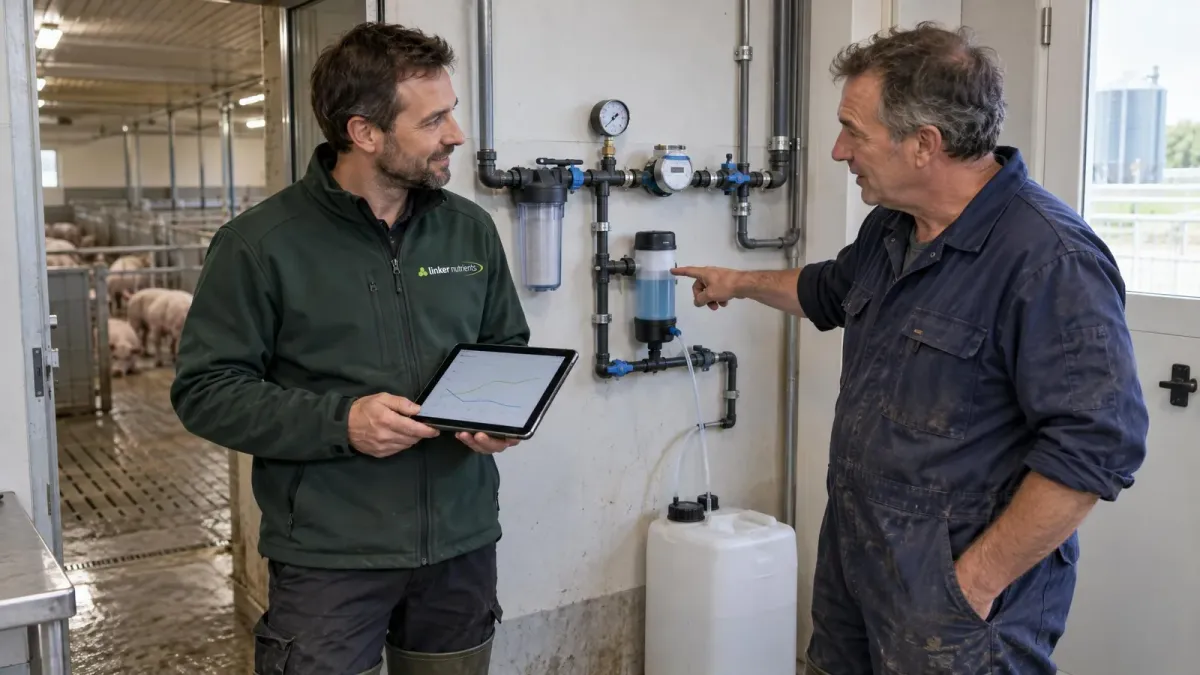
Three drinking water platforms, used in the farm’s programme once the water has been checked and the vet consulted. Each has its own page: form, use, documents.
| Platform | Where it works | When |
|---|---|---|
| linkacid Prime LWater acidifier · drinking water | In the water line, from the stock solution tank to the last nipple | Continuously, with animals present, once the water is analysed and the pump set |
| linkastimVitamins, amino acids and electrolytes · drinking water | In the drinking water, through the dosing pump or the tank | Over a few days when the animals eat less, then stopped |
| linkamuneInactivated yeast and acids · drinking water | In the drinking water, as a suspension to shake, through the dosing pump | Over a few days, at the periods when the digestive tract has to adapt |
Never in the same water as a live vaccine; with another product in the water, check compatibility. The rate is on each platform’s page when published; otherwise ask us, with the species, age, period and water analysis. The other supplements are in the Drinking water category.
Sources
- Causes and Prevention of Wet Litter in Broiler Houses (external site)University of Florida, IFAS Extension · VM99, G. D. Butcher and R. D. Miles · accessed
- Water Quality and Quantity Influence Flock Performance (external site)Mississippi State University Extension · Publication 2869 (POD-06-21), T. Tabler, J. Wells, Y. Liang, J. R. Moyle and F. D. Clark · accessed
- Water-Related Factors in Broiler Production (external site)Mississippi State University Extension · Publication 2742 (POD-10-21), T. Tabler, J. Wells and W. Zhai · accessed
- Why Broiler Growers Should Be Concerned about Paw Quality (external site)Mississippi State University Extension · Publication 2859, T. Tabler, M. Farnell and J. Wells · accessed
- Livestock Water Quality (external site)NDSU Extension (North Dakota State University) · AS1764, January 2026, M. A. Meehan, J. Galbreath and M. Mostrom · accessed
- Considerations of Water for Sustainable Swine Production (external site)SDSU Extension (South Dakota State University) · R. Samuel, updated 3 March 2025; flow converted from US units and rounded · accessed
- Evaluation of farmers’ diagnostic performance for detection of diarrhoea in nursery pigs using digital pictures of faecal pools (external site)Acta Veterinaria Scandinavica · K. S. Pedersen and A. M. Strunz, 2013, vol. 55, article 72 (four-class faecal consistency scale) · accessed
Sources checked on .
General management benchmarks, quoted with their source. They do not replace your breed guide, your technician’s advice or your veterinarian’s diagnosis.
Frequently asked questions
Wet droppings or diarrhoea: how do you tell the difference?
Wet droppings can come from extra water, drunk in the heat or because of salt; diarrhoea comes from disturbed digestion. The detail is in reading the sign.
Who diagnoses diarrhoea on the farm?
The veterinarian, always. The farmer prepares what the vet needs: what is useful to tell the vet.
Which water checks matter when faeces turn loose?
Quality, temperature and flow, at the source as well as at the end of the line: the benchmarks are in the table of checks.
Can a feed change cause wet droppings?
Yes: an abrupt transition, a formula rich in wheat, barley or rye, or a salt error often shows in the droppings. Write the date of every delivery in the farm record.
Does Linkamune work on diarrhoea?
No. Linkamune supplies an inactivated yeast and acids through the water, during periods when the digestive tract has to adapt; the cause of diarrhoea and how to manage it belong to the veterinarian.
What can drinking water carry during this period?
Water at the right pH and short supplements, within the plan set by the veterinarian: see through water.
What about diarrhoea in piglets after weaning?
It has its own window and factors, explained on the piglet weaning page; its diagnosis belongs to the veterinarian.
Describe what you see
On the farm
Tell us the species, the age, what you see and since when, water use and your water analysis: a technician goes through the water, the line and the place of a drinking water programme with you, within the plan set by your veterinarian.
Describe what you see →Have your water analysis read →At the feed mill
Feed transitions, raw materials and digestion additives are set with your formulator, stage by stage.
Talk to a formulator →Or directly: +33 2 30 91 59 15 · contact@linkernutrients.com
Further reading
- Drinking water quality →
What to analyse, which benchmarks, and how to read a water analysis.
- Ammonia and wet litter →
Where the water in the litter comes from, and what to adjust first.
- Piglet weaning →
The nursery window, lever by lever.
- Gut health →
What feed can do for digestion.
- Drinking water →
Everything Farm Solutions brings through the water line.