
Heat stress in poultry and pigs: what the house, feed and water can do
What changes in the animal, what to do route by route, then the calendar: before, during and after the heatwave.
In short
Heat stress is the state of a farm animal that can no longer shed its heat: the temperature and humidity of the house exceed what its breathing can offset. Poultry and pigs, which sweat little or not at all, eat less, drink more and spend their energy on cooling rather than on producing. It is managed first through the house, then through feed and drinking water.
- Species
- Poultry and pigs, which sweat little or not at all; dairy cows
- Signs
- Panting, wings held away from the body, animals lying apart, feed intake down, water intake up
- Period
- Hot season and heatwaves; all year round in the tropics
- What makes it worse
- Air humidity, stocking density, heavy animals, warm nights
- First lever
- Management: ventilation, cool water, feeding times
The problem
What changes in the animal when the heat rises
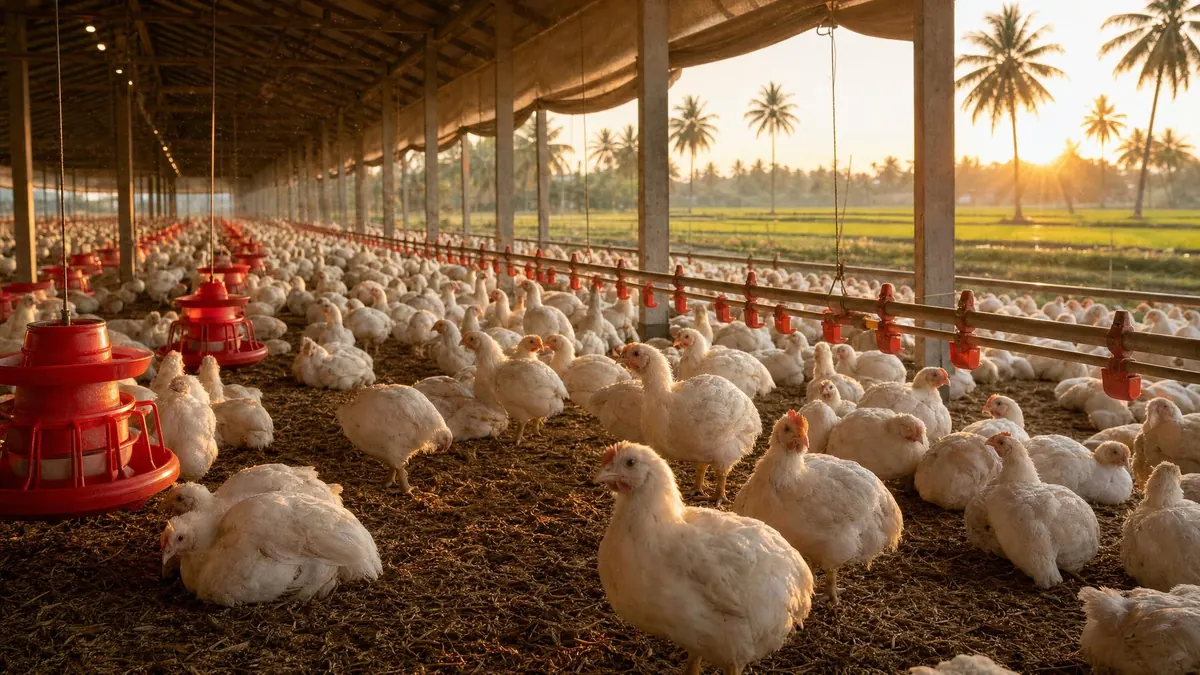
Poultry and pigs shed heat mostly through breathing: birds do not sweat, pigs hardly do. When the air is hot and humid, that route saturates. The animal pants, moves away from the others, and looks for cool walls and floors.
It eats less, because digestion produces heat. Lower feed intake reduces the supply of energy, amino acids, minerals and vitamins just as needs go up. It drinks more: water becomes the supply route that still holds.
Panting has a cost. By breathing out more carbon dioxide, the animal shifts the acid-base balance of its blood, and blood levels of sodium and potassium fall. The digestive tract suffers too: what is still eaten is digested less well.
There is no single threshold. The same thermometer reading does not mean the same thing depending on air humidity, which slows evaporation, and on age and weight: a heavy broiler at the end of the cycle or a lactating sow suffers long before a young animal. A heat stress index that combines temperature and humidity gives a marker; the behaviour of the animals remains the best signal, above all when nights no longer cool the house.
A prostrate animal that no longer drinks or gets up is an emergency: it calls for immediate management and the veterinarian, not an additive.
By species
Heat stress in broilers, layers, pigs and sows: what changes
The signs look alike; what is at stake does not.
| Animal | What you see | What is at stake | What to set first |
|---|---|---|---|
| Broilers | Panting, wings held away from the body, birds crowding along the walls, litter getting wet | Growth in the last weeks: the heavier the bird, the more heat it produces and the less it sheds | Air speed at bird level, stocking density at the end of the cycle, feed withdrawn in the hottest hours |
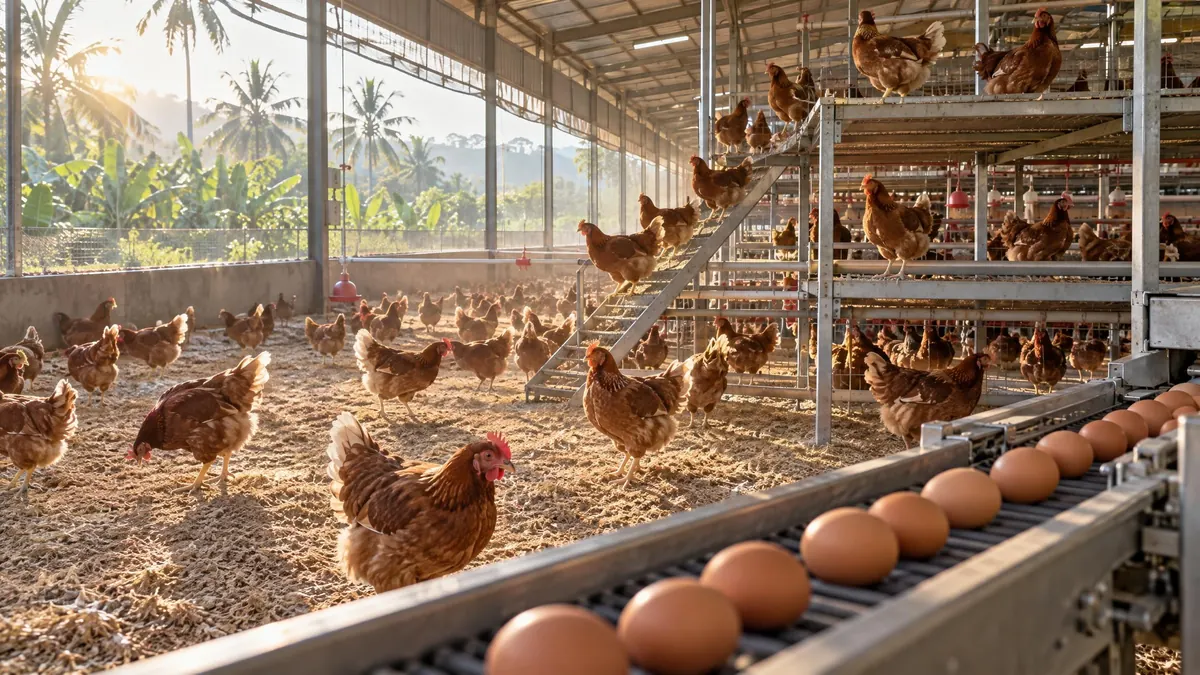
| Laying hens and breeders | Feed intake and egg production down, smaller eggs, thinner shells | The eggshell: by panting, the hen breathes out the carbon dioxide from which the shell’s carbonate is made | Ventilation, cool water, feeding early in the morning and in the evening |
| Growing and finishing pigs | Fast breathing, pigs lying apart on wet floor, shorter meals | Feed intake, and with it growth and days to slaughter; the heaviest fall behind first | Drinker flow, ventilation, misting, meals in the cool hours |
| Sows | A sow that pants, eats less and seldom stands | In farrowing, milk: the sow wants cool when her piglets want warmth. In gestation, the periods around service and farrowing are the most sensitive | Cool the sow without cooling the creep area, water freely available, split meals |
| Piglets | Under the sow, they stay near the creep area; once weaned, they drink more | Their first enemy is cold: in hot weather, access to water is what counts | Water points and flow rates, heating only where it is needed |
What heat costs
Nothing dramatic on the first day: losses that add up, cycle after cycle.
Lower feed intake
Less feed eaten, so less growth, milk or eggs: it is the first loss, and the most regular.
A poorer feed conversion
Energy spent on cooling does not go into production, and the feed that is eaten is digested less well.
Quality that slips
More fragile shells in layers, less even flocks in broilers, pigs slower to finish.
Days lost
A batch that leaves later or lighter shifts the schedule of the farm and of the abattoir.
Animals lost
In the hardest heatwaves, among the heaviest animals: the house and the water decide that, not an additive.
No figures here: the loss depends on the species, the house and the length of the episode. It is measured on your own results, batch by batch.
How to manage heat stress: the house first, then feed and water
Management comes before any additive. Feed and water complete what the house does not settle.
No product
Management first
Summer management starts with the house: no product makes up for poor ventilation.
Ventilation and cooling
Air speed at animal level, clear air inlets, fans and alarms checked before the season. Evaporative cooling helps as long as the air is not already saturated with humidity.
Cool water, freely available
Flow checked on every line, enough drinkers, lines flushed in the hot hours to renew warm water. Water quality matters more when more of it is drunk.
Shift the meals
Feed early in the morning and in the evening, and withdraw feed before the hottest hours in poultry: the animal digests when it is cool.
Lighten the load, do not disturb
Lower stocking density where possible, bring a departure forward, and do not handle, vaccinate or transport in the hot hours.
Feed Solutions
Through the feed
Water balance in the cell
Betaine is an osmolyte: it builds up in the cell and holds its water balance there, without getting in the way of enzymes. It goes into the summer formula, continuously, not on the day of the heatwave.
A feed that still gets eaten
When appetite drops, every meal counts: a constant flavour profile helps the animal recognise its feed, from one formula to the next.
A denser diet, cooler to digest
Less intake, same needs: concentrate the diet, give more room to fats, avoid excess protein by adjusting amino acids. A formulation setting, with no product.
The electrolyte balance of the formula
Sodium, potassium and chloride are reasoned together: their balance in the feed matters more when the animal pants. To review with the formulator before the season.
Farm Solutions
Through the drinking water
Water is drunk when feed is no longer eaten: it is the route that stays open, and the one you stop once the heatwave has passed.
Electrolytes and vitamins, around the episode
The animal still drinks when it eats less: vitamins, amino acids and electrolytes go through the water, from the day before the heatwave to the days that follow.
Water at the right pH
When water intake climbs, its pH and alkalinity matter more: acidification is set on the farm’s water and checked at the end of the line.
Respiratory comfort
Flavouring substances in the water, in a form that stays dispersed, started the day before a forecast heatwave, for a few days.
Minerals, in poultry
Phosphorus and calcium in a set ratio, through the water, when mineral demand outruns what the feed still supplies.
The calendar
Before, during and after the heatwave
What matters is put in place beforehand. On the day, what is left is the water and the house.
| When | In the house | Through the feed | Through the drinking water |
|---|---|---|---|
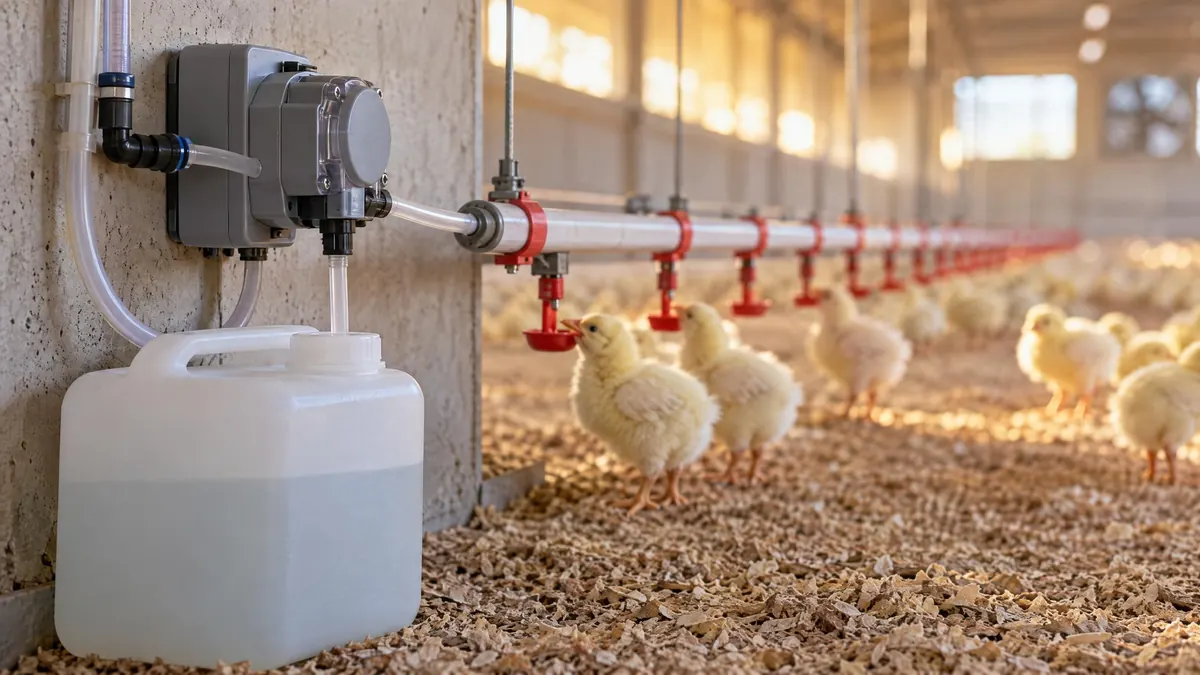
| Before the season | Fans, air inlets, misting, alarms and generator checked; water lines cleaned, flow rates measured, water analysed | Summer formula agreed with the formulator: density, amino acids, electrolyte balance, betaine, a constant flavour | Dosing pump calibrated; pH and alkalinity known, acidification set on the farm’s water |
| The day before a forecast heatwave | Stocking density lightened where possible, departures brought forward, feeding times shifted | Nothing changes the day before: the summer feed is already in the bin | Linkastim and Linkaresp start; stock solution prepared the same day |
| During the heatwave | Ventilation at maximum, lines flushed and water cool, feed given in the cool hours, no handling | Feed is eaten at night and early in the morning: it has to be fresh and palatable | Courses continue; water intake is followed on the meter, and it sets the amount to put in the tank |
| After the heatwave | Gradual return to the usual times; litter and house put back in order | Feed intake recovers within a few days; the summer formula stays as long as the season lasts | Courses run on for a few days, then stop; in poultry, minerals through the water (Linkaphos) while demand stays high |
Never in the same water as a live vaccine, and never two products together without checking that they are compatible. Rates and durations are on each platform’s page, or on request.
Ruminants
Heat stress in dairy cows: what changes in the ration?
Dairy cows suffer from heat earlier than poultry or pigs: rumen fermentation and milk production give off a lot of heat. They eat less, ruminate less, stay standing and breathe fast; milk yield falls, and its composition with it.
Management comes first here too: shade, fans and sprinklers, clean water freely available at several points, the ration fed in the cool hours. In the ration, energy is concentrated without giving up the fibre that keeps the cow ruminating, and the minerals lost in sweat and saliva are watched.
Betaine is studied there as a methyl donor and as an osmolyte, with a reservation specific to ruminants: unprotected, part of it is broken down in the rumen. Linkataine is used in cattle feed, and its rate is reasoned on the whole ration.
The Linker platforms involved
Two through the feed, four through the water. Each has its own page: form, grades, use.
| Platform | When |
|---|---|
| linkataineBetaine · feed | Throughout the hot season |
| linkastyFlavours · feed | Throughout the hot season |
| linkastimVitamins, amino acids and electrolytes · drinking water | From the day before the heatwave to the days that follow |
| linkacid Prime LWater acidifier · drinking water | Continuously, with the animals present |
linkarespFlavouring substances · drinking waterTrial on the productField trial, summer 2020, on more than 120,000 broilers: +2.3% slaughter weight.Conditions6 houses, 3 control and 3 with Linkaresp in drinking water; three series of applications from day 21; slaughter at day 42. | From the day before a heatwave, for a few days |
| linkaphosPhosphorus and calcium · drinking water | In poultry, when mineral demand outruns what the feed supplies |
The rate is on each platform’s page when it is published; otherwise ask for it, with the species, the stage and the goal.
Evidence
What research has measured
Measured results can be read on the page of each platform, once published, with their conditions. The references of the publications cited are in the sources; details are available on request.
Sources
- Physiological responses of broiler chickens to heat stress and dietary electrolyte balance (sodium plus potassium minus chloride, milliequivalents per kilogram) (external site)Poultry Science · Borges et al., 2004, vol. 83 (9), pp. 1551-1558 · accessed
- Osmoregulatory function of betaine in alleviating heat stress in poultry (external site)Journal of Animal Physiology and Animal Nutrition · Ratriyanto and Mosenthin, 2018, vol. 102 (6), pp. 1634-1650 · accessed
- Effects of emulsifier, betaine, and L-carnitine on growth performance, immune response, gut morphology, and nutrient digestibility in broiler chickens exposed to cyclic heat stress (external site)British Poultry Science · Yousefi et al., 2023, vol. 64 (3), pp. 384-397 · accessed
Sources checked on .
Frequently asked questions
At what temperature does heat stress start?
There is no single threshold: it depends on the species, age, weight and above all on air humidity, which limits evaporation. This is why people work with a heat stress index that combines temperature and humidity, and with the markers in the breed’s management guide. The field signal remains behaviour: panting, wings held away from the body, animals lying along the walls.
What are the signs of heat stress in poultry and in pigs?
In poultry: open beak and panting, wings held away from the body, birds crowding near the air inlets, feed left uneaten, then egg production and shell quality down. In pigs: fast breathing, animals lying apart on wet areas, shorter meals. In both, water intake goes up.
Heatwave, heat stroke in chickens: what should you do?
Air and water first: ventilation at maximum, cool, flushed water, no disturbance, feed withdrawn in the hottest hours. Prostrate birds are an emergency, to be seen with the veterinarian. The rest is decided beforehand: a checked house, a summer formula and a water programme ready before the heatwave.
Electrolytes and vitamin C for chickens in hot weather: when should they be given?
Through the drinking water, from the day before a forecast heatwave to the days that follow. Electrolytes, sodium, potassium and chloride first, hold the water balance and the acid-base balance, which panting shifts. Vitamin C, which poultry make themselves, is one of the vitamins most often supplied in hot weather. These short courses go through the drinking water.
Is betaine worth using in hot weather?
Betaine is an osmolyte: it builds up in the cell and holds its water balance there, which heat puts under strain. It has its place in the summer formula, continuously, not on the day of the heatwave; it makes up neither for poor ventilation nor for a lack of water. That is the role of Linkataine in feed.
Can an additive replace ventilation?
No. House management comes first: ventilation, cool water, feeding times. Feed and water complete what the house does not settle.
Prepare for the hot season
On the farm
Tell us the species, the house and the period: you receive a drinking-water programme, before, during and after the heatwave.
Receive a programme →At the feed mill
The summer formula is prepared in spring: let us look at it with your formulator.
Talk to a formulator →Or directly: +33 2 30 91 59 15 · contact@linkernutrients.com
Further reading
- Drinking water →
Supplements dosed in the water, and what makes a programme work.
- Flavours and sweeteners →
Keeping feed palatable when appetite drops.
- Chick brooding, first week →
The first days, when everything depends on water and temperature.