
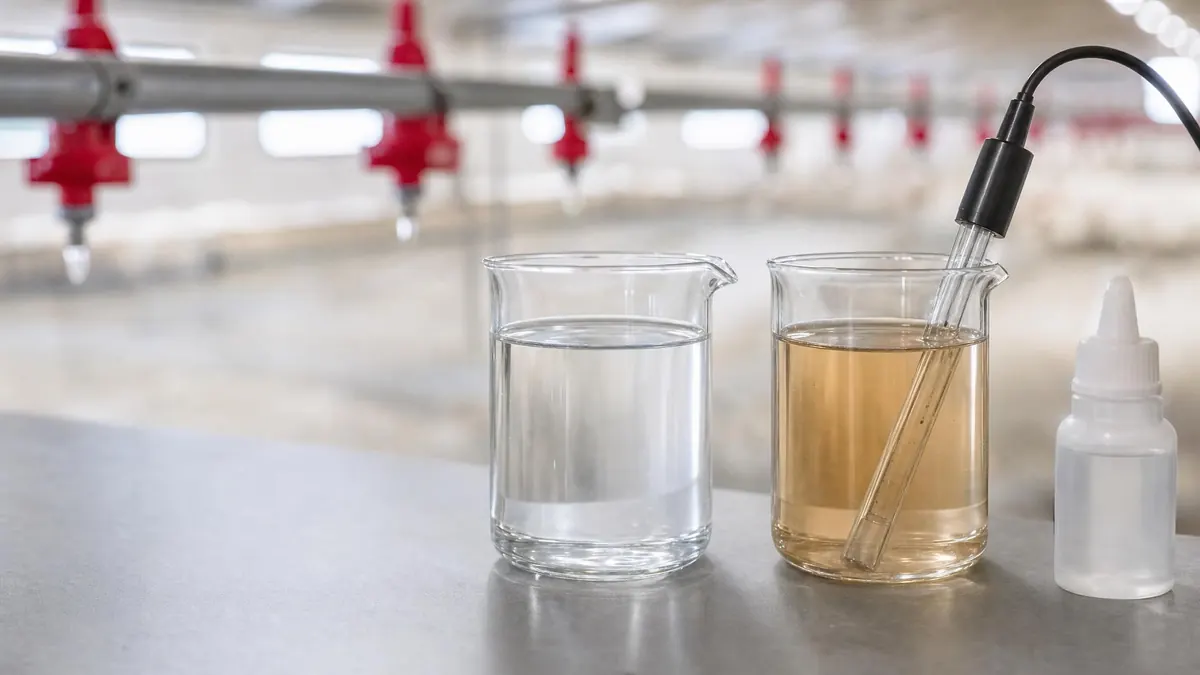
Drinking-water quality for poultry and pigs: what to test and how to read it
What to ask the laboratory for, where and when to sample, the published benchmarks, and what the dosing pump needs from the water.
In short
Drinking-water quality, on poultry and pig farms, means what the water the animals drink actually contains, as measured by an analysis: pH and alkalinity, hardness, iron and manganese, nitrates, dissolved salts, total bacterial count. It is judged at the source and at the end of the line. It matters to the animal, which has to keep drinking, to the drinking equipment, and to everything dosed through the water.
- Species
- Poultry and pigs
- What to test
- pH, alkalinity, hardness, iron, manganese, nitrates, dissolved salts, bacterial count
- Where to sample
- At the source, then at the last drinker
- When
- At least once a year, and whenever the water changes
- Benchmarks
- University extension guides, listed at the foot of the page
Why test drinking water for poultry and pigs?
A bird or a pig drinks more each day than it eats, and an animal that drinks less eats less. Water is the first feed on the farm, and often the least analysed.
Its make-up depends on the ground and on the supply: borehole, well or mains. It changes from season to season, after heavy rain or during a drought, with nothing to see in the house. Clear water with no smell or taste is not necessarily safe water.
Poor water quality for poultry and pigs often shows on the equipment first: scale, iron deposits, leaking nipples, wet litter under the lines. And everything dosed through the water travels in it: a dose from the pump is only as good as the water that carries it.
Water quality parameters for poultry and pigs: what to test, which benchmarks
Benchmarks published by three US university extension services (Georgia, Mississippi, North Dakota), listed below. They are cautious maximums: several come from human drinking-water standards, and few were set from poultry research.
| Parameter | What it tells you | Published benchmark | Above it, what to look at |
|---|---|---|---|
| pH | How acidic the water is, on a scale of 0 to 14; 7 is neutral. | Broilers: 6.0 to 6.8 preferred, 4 to 8 tolerated (Georgia). Acceptable limits: 5 to 8 (Mississippi). | Above 8, birds may drink less, and chlorine works poorly. Below 5, metal corrodes. |
| Alkalinity | The water’s capacity to resist an acid: carbonates and bicarbonates, as calcium carbonate equivalent. | 100 mg/L on average, 300 mg/L at most (Mississippi). | It takes a lot of acid to bring the pH down, and the water can taste bitter. |
| Hardness | Dissolved calcium and magnesium, as calcium carbonate equivalent. | 110 mg/L at most (Georgia). Soft up to 75 mg/L, somewhat hard 76 to 150, hard 151 to 300, very hard above that (Mississippi). | Scale: narrower pipes, nipples that are hard to trigger or that leak. |
| Iron | Water that stains and turns rust-coloured. | 0.3 mg/L at most (Georgia, Mississippi). | Particles, and the reddish-brown slime of iron bacteria: blocked or leaking nipples. The equipment suffers before the animal does. |
| Manganese | Behaves like iron. | 0.05 mg/L at most (Georgia, Mississippi). | A black, grainy residue on filters and in drinkers, slower to remove than iron. |
| Nitrates | A sign of seepage: fertiliser, manure, organic matter. | 25 mg/L at most (Georgia, Mississippi). | Run a bacterial analysis, and check the borehole or well. |
| Total dissolved solids (TDS) | All the salts in the water: calcium, magnesium, sodium, chlorides, sulphates. | Poultry: under 1,000 mg/L, no burden; 1,000 to 2,999, satisfactory, droppings sometimes wetter (Mississippi). Pigs: under 3,000 mg/L, usually satisfactory; not to be used from 7,000 to 10,000 (North Dakota). | Wet droppings and wet litter: ask for the breakdown of salts, sodium, chlorides and sulphates. |
| Total bacterial count | The number of culturable bacteria, all types together, in CFU (colony-forming units). | Published guides do not agree on a threshold: read the value with the laboratory, which gives its method and its unit. | Compare the source and the end of the line: a clean source and a loaded line point to the line. |
The guides use mg/L or ppm, which amount to the same thing for water. Some laboratory reports give hardness and alkalinity in other units: check the unit before comparing.
Poultry water testing: where and when to take a sample
An analysis is only as good as the point where the water was taken. Sample at two points: the gap between them is what tells you most. At the source (borehole, well or mains inlet), before any injection: this is the starting water, the one that sets the pH and the rate of an acidifier. At the end of the line, at the last nipple or the last bowl: this is the water the animals drink. The same applies on pig farms, room by room.
Between the two, the water can change markedly, especially when it is warm and moves slowly through the pipes. A clean source and a loaded end of line point to the line, not the borehole.
Minerals and bacteria are not sampled the same way: ask the laboratory for its bottles and instructions before you sample. A bacterial sample travels cold, not frozen, and reaches the laboratory the next day; a mineral sample does not need to be kept cold.
When to sample:
- At least once a year, to follow the supply over time.
- Whenever the water changes: a new borehole, a switch from mains to well water, and after heavy rain or a drought.
- Between flocks: at the end of the flock, before the lines are cleaned, then before the next placement, with the lines cleaned and flushed. The difference shows whether the cleaning worked. For poultry, this is the water the chicks will find at brooding.
- When water intake or performance drops and nothing in management explains it.
How to read a water analysis
Check the unit. The guides use mg/L or ppm; hardness and alkalinity are given as calcium carbonate equivalent, or in other units on some reports. A value converted wrongly leads to the wrong conclusion.
Read a threshold as a benchmark. Most published thresholds for poultry drinking water come from human drinking-water standards. With iron and manganese, the equipment suffers well before the animal: leaking nipples, blocked filters and foggers.
Read the values together. A pH above 7 with more than 60 mg/L of calcium or magnesium points to scale in the lines. pH alone does not tell you how much acid it will take: alkalinity does. Nitrates call for a bacterial test.
Compare. The source and the end of the line on the day of the analysis; then this analysis and the previous ones. Water that changes with the seasons is read over several reports, not one.
Do it with someone. An analysis is read with the species, the age of the animals, the equipment and what goes through the water. Send us yours: we read it with you and tell you first what can be set right through management.
Poultry water pH: which range, and how to measure it?
Poultry accept slightly acidic water better than alkaline water. Published benchmarks vary from one guide to another: 6.0 to 6.8 preferred for broilers and 4 to 8 tolerated, according to the University of Georgia; 6.2 to 6.8 for chickens, according to Mississippi State University. Above 8, birds may drink less.
For pigs, the guides consulted give no range of their own. North Dakota State University notes, for livestock in general, that highly alkaline water may upset digestion and reduce water and feed intake.
Drinking-water pH is measured with a calibrated pH meter or a test strip, at two points: at the source, before any injection, and at the last drinker, with the line running. A reading at the pump tells you what was injected; a reading at the end of the line tells you what the animals drink.
When water is acidified, the target pH is agreed with your technician, according to species, age and your water. Too low, and the water becomes less palatable and harsh on equipment: a programme that cuts water intake has missed its point. The rate is then set on alkalinity: titrate the water once with the product, set the pump, check at the end of the line. That is the method behind Linkacid Prime L.
Biofilm, scale, iron: what the line does to the water
In a warm house, micro-organisms multiply quickly in the pipes. They form a biofilm: a sticky layer made of many kinds of bacteria and other organisms, lining the inside of lines, regulators and nipples. It protects itself with a thick coating that chlorine and acids struggle to get through.
Biofilm is not alone. The calcium and magnesium of hard water leave scale, iron and manganese leave particles, iron bacteria a reddish-brown slime. All of them narrow the pipes, block nipples or make them leak, and take up part of what you dose.
Lines are cleaned between flocks, with a product and a contact time meant for that job: an acidifier at maintenance rate does not clean a fouled line. The water that then runs through the clean line is judged at the end of the line, by analysis.
What the dosing pump and liquid supplements need from the water
The dosing pump injects a set share of the water flowing through: the day’s water intake sets the amount of product, and the stock solution is made up with the farm’s own water. What that water contains therefore counts twice, in the tank and in the line.
Some products react with the water, depending on its hardness, iron or chlorine, or with each other: they can precipitate or cancel each other out. Compatibility is checked before use, in writing. These rules apply to Linkacid Prime L as much as to the liquid supplements in the Drinking water category: vitamins, minerals, amino acids.
Six conditions, in order:
- Known water: pH, alkalinity, hardness and iron at the source, before setting anything.
- A clean tank, and a stock solution made up to the volume the pump will draw.
- A checked pump: a mis-set dosing pump delivers a fraction of the dose for the whole application. Check it against the water meter.
- A clean line: deposits take up part of what you dose.
- Nothing that does not belong together: an acidifier and a chlorine product are never mixed in the same tank; no product goes into the same water as a live vaccine (flush the line, vaccinate, then resume).
- A reading at the end of the line, with the line running: that is the water the animals drink, and they have to keep drinking it.
How much do poultry and pigs drink? Water consumption benchmarks
Poultry. Broilers drink about 1.6 to 2 times the weight of feed they eat. Intake rises with age and with heat: it can double, or even triple, during heat stress. It also follows the lighting, with one peak after lights on and another before lights off.
Pigs. Daily water needs range from under 2 litres for a newly weaned pig to more than 5.5 litres for a grow-finish pig on nipple drinkers; about 15 litres for a gestating sow and 23 litres for a lactating sow. Drinker flow matters as much: a quarter to half a litre per minute for weaned pigs, close to a litre for the breeding herd.
The water meter. Read every day at the same time, it is the flock’s first indicator: water consumption should rise steadily from placement to depopulation. A one-day dip is no cause for concern; a drop that lasts needs looking into: line height, air locks, pressure, blocked filters or nipples, a change in lighting, feed, whatever is going through the water. Two meters, for the front and back of the house, show whether the birds are evenly spread.
Where each Linker platform fits
They come after known water and a clean line, never instead of them. Each has its own page: form, use, documents.
| Platform | Its role here | Where it works | When |
|---|---|---|---|
| linkacid Prime LWater acidifier · drinking water | A liquid acidifier that lowers and holds the pH of drinking water; its rate is set on the alkalinity of your water. | In the water line, from the stock-solution tank to the last drinker | Continuously, with the animals present, once the water is analysed and the pump set |
linkadryLitter conditioner · houseTrial on the productField trial on an 800-sow farm: first colostrum intake within 5 minutes, against 20 for control piglets.ConditionsFarrowing unit, suckling piglets; 2017 trial. | A litter conditioner, on top, where moisture builds up anyway when nipples leak. | On the litter, under the water lines | During the flock, once the leak is fixed |
The other platforms in the Drinking water category go through the same pump and need the same known water. The rate is on each platform’s page when it is published; otherwise ask for it, with the species, the age and your water analysis.
Sources
- Poultry Drinking Water Primer (external site)University of Georgia Extension · Bulletin 1301, C. W. Ritz and B. D. Fairchild, revised 14 April 2015 (table 2: maximum acceptable levels) · accessed
- Water Quality Critical to Broiler Performance (external site)Mississippi State University Extension · Publication 2754 (POD-09-24), T. Tabler, J. Wells and W. Zhai (table 1: poultry water quality standards; table 2: dissolved solids, after the National Research Council) · accessed
- Water Quality and Quantity Influence Flock Performance (external site)Mississippi State University Extension · Publication 2869 (POD-06-21), T. Tabler et al. · accessed
- Livestock Water Quality (external site)NDSU Extension (North Dakota State University) · AS1764, January 2026, M. A. Meehan, J. Galbreath and M. Mostrom (table 1: dissolved solids) · accessed
- Considerations of Water for Sustainable Swine Production (external site)SDSU Extension (South Dakota State University) · R. Samuel, updated 3 March 2025; volumes and flow rates converted from US units and rounded · accessed
- Assessment of microbial quality in poultry drinking water on farms in Austria (external site)Frontiers in Veterinary Science · A. Mustedanagic et al., 2023, vol. 10, doi:10.3389/fvets.2023.1254442 (introduction: differences between source and end of line) · accessed
Sources checked on .
General benchmarks, quoted with their source. They replace neither your laboratory’s opinion, nor your technician’s advice, nor your veterinarian’s.
Frequently asked questions
What is the ideal pH for poultry drinking water?
There is no single value. The university guides cited here give 6.0 to 6.8 for broilers, or 6.2 to 6.8 for chickens, with 5 to 8 as acceptable limits. For acidified water, the target pH is agreed with your technician: see poultry water pH.
How often should farm drinking water be tested?
At least once a year, and whenever something changes: a new borehole, a switch from mains to well water, heavy rain or drought. Between flocks, an analysis before and after line cleaning shows whether the cleaning worked.
Where should the water sample be taken?
At the source, before any injection, and at the last nipple or bowl, with the line running. The source tells you the starting water, the end of the line what the animals drink; the gap between them tells you the state of the pipes.
Does water hardness matter for poultry and pigs?
Rarely for the animal, often for the equipment. Calcium and magnesium leave scale, which narrows pipes and makes nipples leak. Hard water also uses up more acid before its pH moves.
Can chickens drink softened water?
With care. A softener swaps calcium and magnesium for sodium, and poultry are sensitive to excess sodium: it is usually not recommended for drinking water. If one is fitted, check sodium on every analysis.
Is a bacterial analysis of the water needed?
Yes: at the first analysis, then when nitrates are high, after line cleaning, or when the end of the line is a concern. It gives the total bacterial count, to compare between the source and the last drinker.
Does a water acidifier clean the line?
No. An acidifier lowers and holds the pH of the water; it removes neither biofilm nor established deposits. Lines are cleaned between flocks, with a product and a contact time meant for that job; acidification then resumes, on a clean line.
How much water does a broiler drink compared with feed?
About 1.6 to 2 times the weight of feed eaten, more in hot weather. The daily water-meter reading tells you better than any benchmark whether your flock is drinking as it should: see water consumption benchmarks.
Have your water analysis read
You run the farm
Send us your analysis, with the species, the age of the animals, the water source and the pump model. A technician reads it with you and tells you what can be set right through management first, then what a product can add.
Have your water analysis read →Request the Linkacid Prime L data sheet →You supervise farms
Technician, veterinarian, integrator or distributor: tell us your country and your species, and we tell you where to find our products.
Where to find our products →Or directly: +33 2 30 91 59 15 · contact@linkernutrients.com