
Linker Nutrients

Feed Solutions · Feed safety and preservation

Mycotoxin binders for feed: three grades, chosen on your analysis.

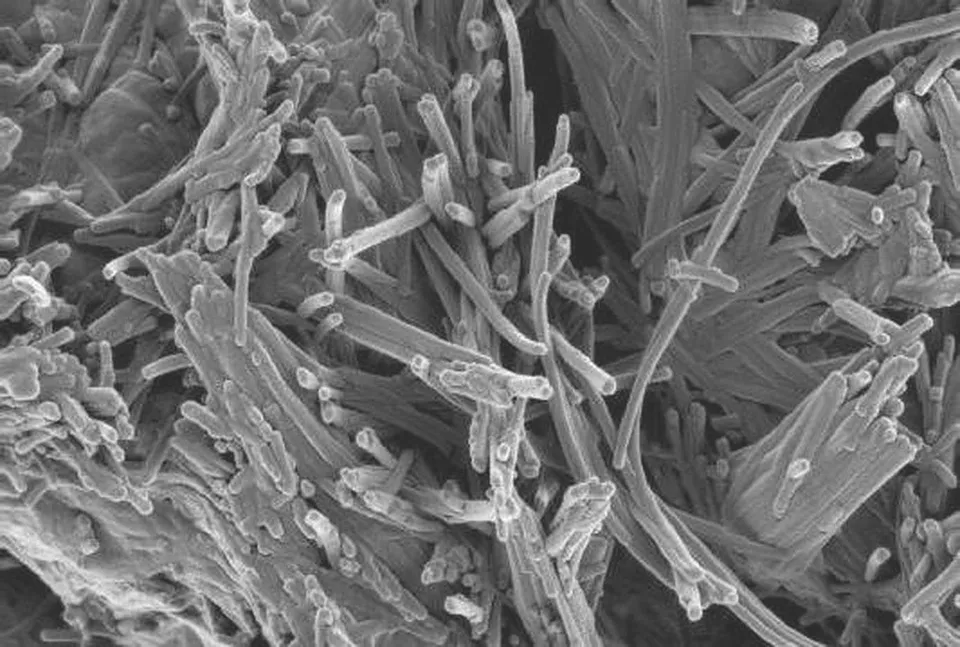
Clay fibres seen under the electron microscope
Linkafix
  • One grade per analysis

    Secure when aflatoxin B1 dominates, Advance for several mycotoxins, Advance AC when DON is in the report.

  • Judged after desorption

    What counts is what stays bound after pH 3 then pH 6.5, not only what is adsorbed.

  • A rate set on the risk

    It follows the analysis, the species, the stage and the length of exposure; at the mill, in the mixer or through the premix.

Linkafix: mycotoxin binders for animal feed, from selected clays

A mycotoxin binder, or toxin binder, is a mineral added to feed whose surface holds part of the mycotoxins the feed carries, so that less of them stays available to the animal. Linkafix is a range of three mineral binders, clays alone or with a complementary adsorbent, chosen on your raw-material analysis, the species and the stage.

Role
Mycotoxin binder
Form
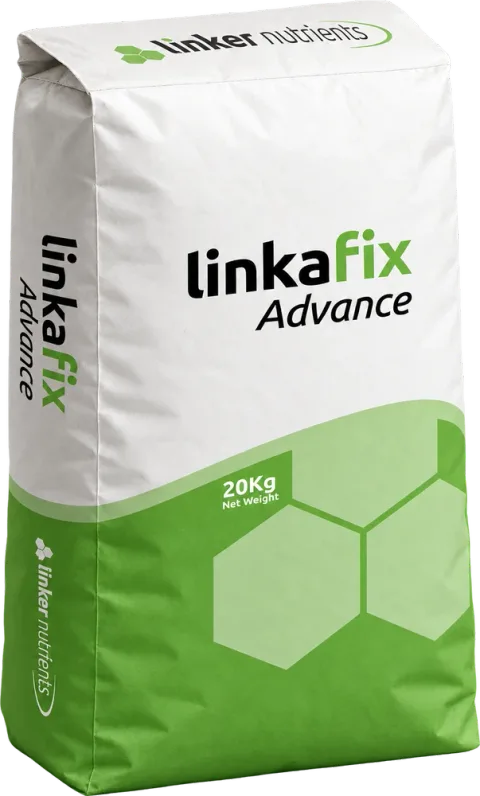
Powder, in 20 kg (Advance) or 25 kg (Secure) bags; Linkafix Advance AC in 20 kg bags
Species
Poultry, pigs, ruminants, aquaculture
Use
At the feed mill, in the mixer or through the premix
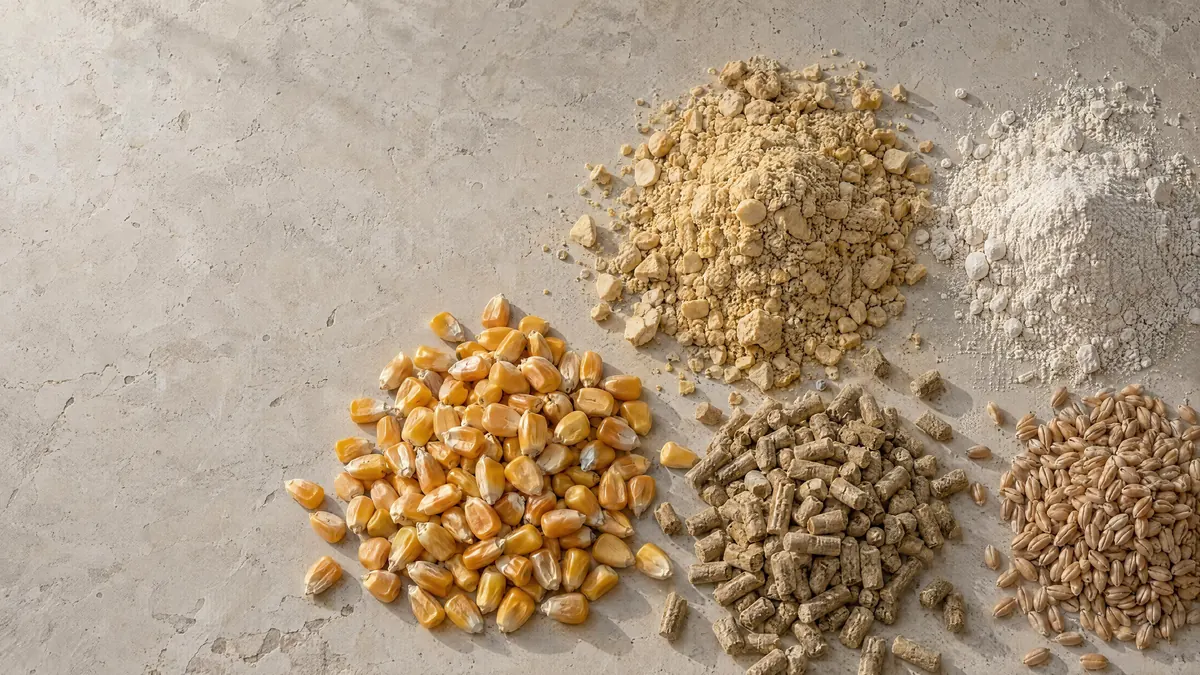
Maize, soybean meal, wheat, meal and feed pellets seen from above on a worktop

The problem

Toxins you cannot see, and that rarely come alone

Mycotoxins in animal feed form in the field or in storage, on maize, cereals and oilseed meals. A heavily contaminated batch can look clean, smell normal and show no mould at all: only an analysis reveals it.

One batch often carries several families at once: aflatoxins, fumonisins, zearalenone, trichothecenes such as DON or T-2 toxin, ochratoxin. Their effects show up first on the farm, on intake, growth or reproduction, and are easily blamed on the season or the genetics.

Holding back mould growth during storage is the job of a mould inhibitor, Linkamold. A mycotoxin that has already formed calls for a binder. The difference is set out on the feed safety and preservation page.

The principle

A binder holds toxins, it does not destroy them

A mycotoxin binder is a mineral added to feed. It only acts on toxins that are already there, and not on all of them in the same way.

  1. It mixes in.Linkafix goes in at the mixer, directly or through the premix, and travels with the feed to the feeder.
  2. It binds.In contact with the feed, then in the digestive tract, the clay surface holds on to part of the mycotoxins.
  3. It carries out.What is bound stays attached to the clay and leaves the animal with it.
  4. Each toxin is its own case.Clays bind aflatoxin B1 very well, Fusarium toxins less well, and DON very little. No binder binds everything.

The rate follows the risk, not only the species

Measured contamination
Which toxins are present and at what levels, read on the raw-material analysis.
Species and stage
Poultry are very sensitive to aflatoxin, sows and gilts to zearalenone, pigs to DON.
Length of exposure
A batch fed for weeks weighs more than a one-off.
Origin and season
Wet harvest, hot storage, imported raw materials: the risk changes from one year to the next.

Linkafix at a glance

1 min 4 s, subtitled in English

Where it applies

A decision at intake, an inclusion at the mixer

  1. 1Raw material intakeSample and analyse: this is where the risk is read
  2. 2Silo storage
  3. 3Grinding
  4. 4MixingLinkafix as powder, in the compound feed or through the premix
  5. 5Pelleting
  6. 6Storage and delivery
  7. 7Feeding on the farm

From the mixer to the feeder, the binder travels with the feed: it acts on the toxins that feed brings.

The grades

Choose your grade

The analysis decides: Linkafix Secure when aflatoxin B1 dominates, Linkafix Advance for several mycotoxins without DON, Linkafix Advance AC when DON is in the analysis. The specifications of each grade are on its data sheet.

GradeUseIndicative rate
linkafix SecureVery fine creamy-brown powder · 25 kg bagThe grade for programmes where aflatoxin is the main risk.All species: 1–5 kg/t; young animals, breeders, ducks, turkeys, fish: 2–5 kg/t; ruminants: 2–8 kg/t; poultry on anticoccidials: 5 kg/t at most
linkafix AdvanceUltrafine light beige-brown powder · 20 kg bagThe grade for analyses that show several mycotoxins at once, at lower inclusion rates.0.5–1 kg/t at low risk, 1–1.5 kg/t at medium risk, 1.5–3 kg/t at high risk; ruminants 1–2 g/kg of dry-matter intake; aquaculture 1–3 kg/t
linkafix Advance ACUltrafine beige-brown powder, slightly darker than Advance · 20 kg bagThe grade for analyses where DON is in the report.0.5–1 kg/t at low risk, 1–1.5 kg/t at medium risk, 1.5–3 kg/t at high risk; ruminants 1–2 g/kg of dry-matter intake; aquaculture 1–3 kg/t

Indicative rates, taken from the grade’s current data sheet, by risk level read on the analysis. Shelf life: 36 months; Linkafix Advance AC: as stated on the bag label.

What has been measured

Each result comes with its conditions; the full details are available on request.

  • Laboratory testLinkafix Advance AC

    With all six mycotoxins in the same solution, Linkafix Advance AC retains 51.9% of DON, against 7.3% for Linkafix Advance alone in the same series.

    % of DON retained
    Linkafix Advance alone7.3
    Linkafix Advance AC51.9
    Conditions
    In vitro test: adsorption at pH 3, then desorption at pH 6.5; aflatoxin B1 at 4,000 ppb, zearalenone, T-2, fumonisin and ochratoxin A at 500 ppb, DON at 1,000 ppb, all together.
    On request
    Detailed results, toxin by toxin
    Ask for the details, result 1 →
  • Laboratory testLinkafix Advance AC

    Across five blind test series, Linkafix Advance AC retains 63.9 to 74.2% of DON, while the products compared stay below 4%.

    Conditions
    In vitro test, coded samples: adsorption at pH 3, then desorption at pH 6.5; DON at 1,000 ppb with zearalenone at 500 ppb; other market products measured in the same series.
    On request
    Results of the five series
    Ask for the details, result 2 →
  • Laboratory testLinkafix Secure

    Measured by an independent laboratory, after pH 3 then pH 6.5: 99.6% of aflatoxin B1 stays bound to Linkafix Secure, desorption deducted.

    Conditions
    In vitro test, three replicates: adsorption at pH 3 (99.8%), then desorption at pH 6.5 (0.2%); aflatoxin B1 at 4,000 ppb; December 2018.
    On request
    Laboratory certificate
    Ask for the details, result 3 →

Trial results available on request.Ask for the trial results →

Mycotoxin binders for poultry, pigs, cattle and fish: what can they do?

Poultry. Broilers, layers, breeders and ducks are sensitive to aflatoxin, which clays bind well. In poultry feed, a toxin binder limits the share of the toxin that stays available to the bird. It does not rescue a heavily contaminated batch, and it does not replace analysis or raw-material sorting.

Pigs. Sows and gilts are sensitive to zearalenone, piglets and growing pigs to DON, which pulls intake down. Clays bind little DON: when it is in the analysis, Linkafix Advance AC is the grade to use, and the answer also lies in raw-material choice and cleaning, which we will discuss with you.

Cattle and other ruminants. The rumen breaks down part of some toxins, not all of them: aflatoxin gets through. For dairy cows and other ruminants, the rate is given per kilogram of dry-matter intake rather than per tonne of feed.

Fish and shrimp. Aquafeeds rich in plant proteins carry the toxins of those plants, DON, zearalenone and fumonisins among them, and aflatoxin when stored in heat and humidity.

Toxin binder rate: how do you choose it?

A binder rate is not read off a species label: it depends on the risk. We set it with you from three things: your raw-material analysis, the species and stage, and how long the feed will be fed.

The Linkafix data sheets give ranges by risk level, low, medium or high, and for ruminants a rate per kilogram of dry-matter intake. They appear in the grade table when the current sheet allows it.

To estimate the risk in your raw materials: assessment tool available to our customers, on request.

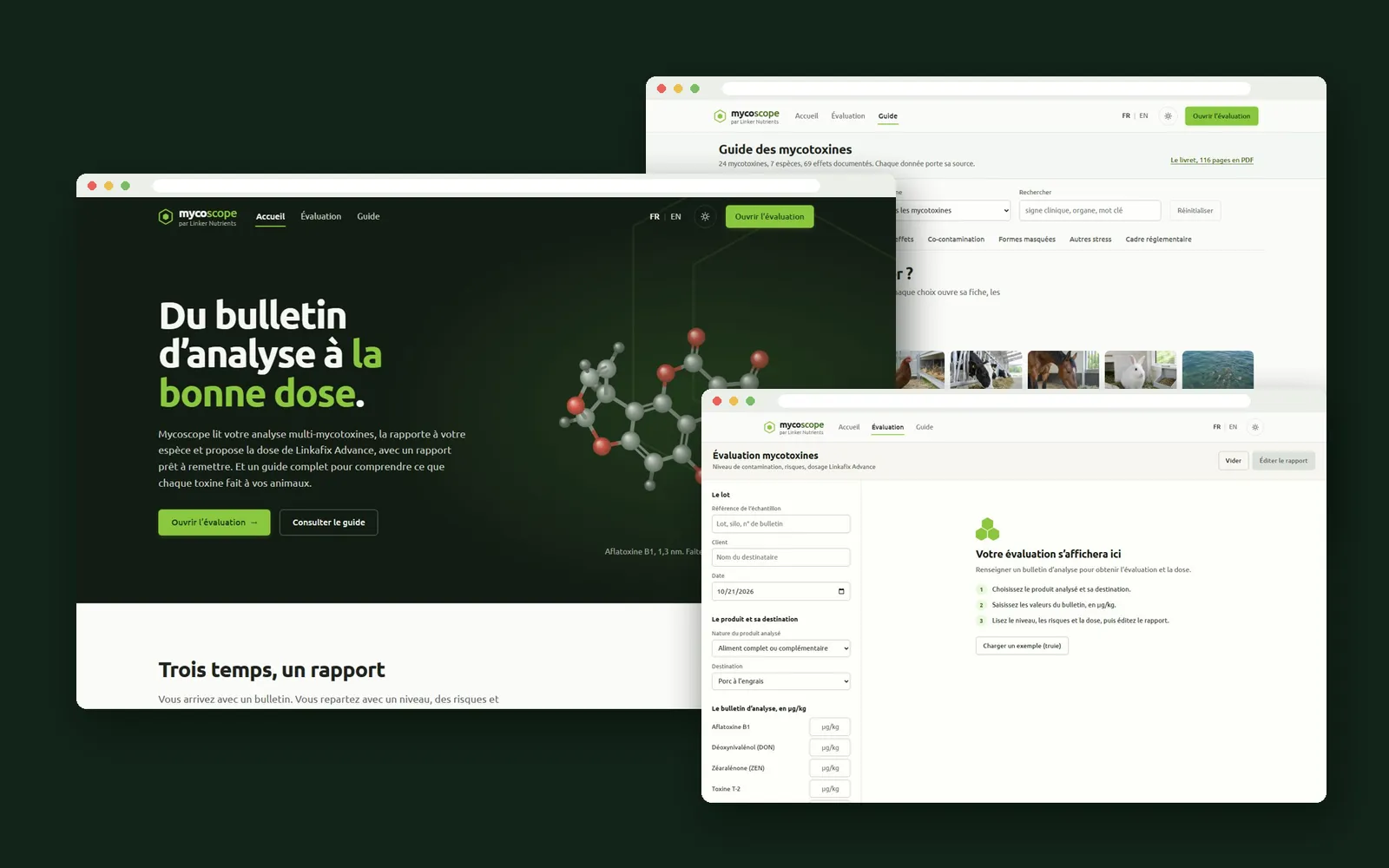
Mycoscope

Mycoscope: from the analysis report to the right dose

Our online mycotoxin tool: a guide by species, risk assessment from your analysis report, and the right Linkafix grade with its dose.

Access reserved for our partners

Request access →

Preview of Mycoscope: the home page, the mycotoxin assessment and the mycotoxin guide

In practice

What Linkafix is

Linkafix is a mycotoxin binder based on mineral clays and, for Linkafix Advance AC, a complementary adsorbent, for animal feed. Data sheet and safety data sheet: on request.

Linker products are additives and supplements for feed and drinking water, used within a farm’s programme.

Simplified technical data sheet

linkafix

What it is
Mycotoxin binder
Range
Feed Solutions · Feed safety and preservation
Species
Poultry, pigs, ruminants, aquaculture
Shelf life and storage
Secure, Advance: 36 monthsAdvance AC: As stated on the bag label
By grade
Form, key ingredients and rate: see the table Choose your grade
GradeForm and appearancePackagingShelf life and storageKey ingredientsIndicative rate
SecureVery fine creamy-brown powder25 kg bag36 monthsCarefully selected and sized natural clay.All species: 1–5 kg/t; young animals, breeders, ducks, turkeys, fish: 2–5 kg/t; ruminants: 2–8 kg/t; poultry on anticoccidials: 5 kg/t at most
AdvanceUltrafine light beige-brown powder20 kg bag36 monthsMicronised fibrous clay.0.5–1 kg/t at low risk, 1–1.5 kg/t at medium risk, 1.5–3 kg/t at high risk; ruminants 1–2 g/kg of dry-matter intake; aquaculture 1–3 kg/t
Advance ACUltrafine beige-brown powder, slightly darker than Advance20 kg bagAs stated on the bag labelFormulated on Linkafix Advance, with a complementary adsorbent.0.5–1 kg/t at low risk, 1–1.5 kg/t at medium risk, 1.5–3 kg/t at high risk; ruminants 1–2 g/kg of dry-matter intake; aquaculture 1–3 kg/t

Simplified sheet, for information only: the full technical data sheet of the grade and the label prevail.

Get the full technical data sheet →

Made on sites certified to GMP+ FSA, FAMI-QS, FCA or an equivalent feed safety scheme.
Linker Nutrients SAS · Centre d’Affaires Lorient Mer, 1 rue Honoré d’Estienne d’Orves, 56100 Lorient, France · +33 2 30 91 59 15 · contact@linkernutrients.com
www.linkernutrients.com/en/products/linkafix · Updated 4 November 2026

The data sheet, and someone to read your analyses with you

The documents you need

Send us your analyses

Toxins tested, levels, raw materials, species and stage: with these, a technician proposes a grade and a rate.

Ask about Linkafix →

Frequently asked questions

Is Linkafix a clay?

Yes: a carefully selected clay (Secure) and an activated fibrous clay (Advance), for animal feed; Linkafix Advance AC is formulated on Linkafix Advance, with a complementary adsorbent. Their specifications are on each grade’s data sheet, which we send on request.

Do I need a binder when my analyses are good?

An analysis describes a sample, not the whole batch, and the risk moves with origin, harvest and storage. Many mills include a binder at a base rate and raise it when the analysis or the season calls for it. We decide it with you, on your results.

Does Linkafix bind DON?

Clays alone bind little DON. When DON is in your analysis, that is the role of Linkafix Advance AC, formulated on Linkafix Advance, with a complementary adsorbent. Raw-material choice and cleaning still matter: let us talk it through.

Does Linkafix replace a mould inhibitor?

No. A mould inhibitor such as Linkamold holds back mould growth during storage. A binder acts on toxins that have already formed. The two work together.