
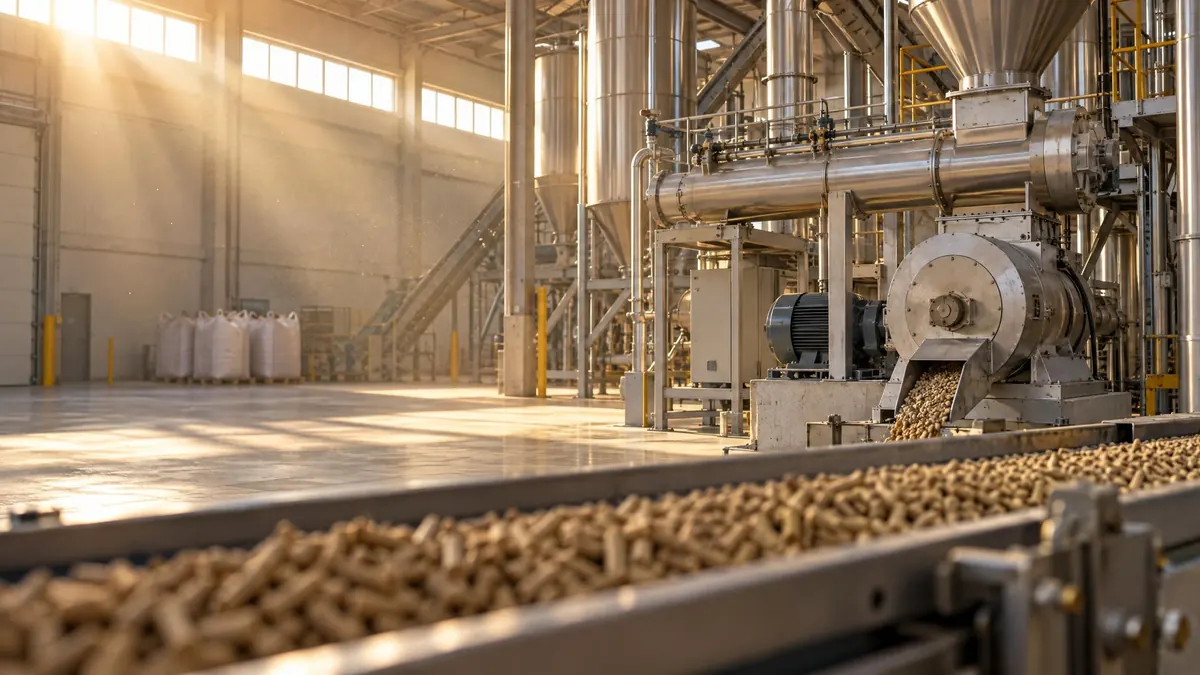
Pellet quality, moisture and mill throughput: what the mill controls
From steam to bag: durability, fines, moisture lost, water added at the mixer, and the preservation risk that comes with it.
In short
Pellet quality is how well a feed pellet holds up on its way to the feeder: the share of pellets that stay whole, summed up by the pellet durability index (PDI), and the amount of fines produced along the way. It is decided in the mill, between the formula, conditioner steam, the press die and cooling, and it goes hand in hand with the moisture the feed keeps until the bag.
- What is measured
- The PDI, with its method, and the fines level on the farm
- What shapes it
- The formula, steam, the die, cooling
- Water
- Supplied by steam and by the mixer, partly removed at the cooler
- The risk
- A moister feed keeps less well: water activity decides
The problem
Moisture lost in pelleting: what does the mill measure?
Five stages, with the reference values published in university feed-manufacturing guides. Exact values are set on your own line.
- The mixer.Raw materials and liquids are dosed here. In the Kansas State guide’s example, the mash arrives at 12 % moisture. Fat added here weakens the pellet: about 1 % at most at the mixer, the rest after the press.
- The conditioner.Steam heats the mash, to 82–93 °C for a corn and soybean feed, for 30 to 45 seconds, and brings it to 17 or 18 % moisture at the die. A rule of thumb from the same guide: every 25 °F rise (about 14 °C) adds about 1 % water. Above 18 %, the press can choke.
- The press and die.Compression through the die gives the pellet its shape. The higher the ratio of die thickness to hole diameter, the harder the pellet, but the more power the press draws and the lower its output.
- The cooler.Pellets leave at 80 to 90 °C with 15 to 17 % moisture. An airflow brings them down to about 8 °C above ambient and to 10 or 12 % moisture. Kansas State states the objective: return to a moisture equal to or below that of the starting mash.
- The bin and the bag.A still-warm pellet loaded into a cold bin lets its water migrate towards the walls. What reaches the bag is the formula moisture, minus whatever extra the cooler has removed.
Moisture
Moisture shrink in pelleting: a feed drier than its formula
All the water steam adds leaves again at the cooler, and often a little more. The feed then leaves drier than its formula: fewer kilos for the same dry matter bought. Mills call this loss shrink. It is not only moisture: dust, bags and scales are part of it too.
Published orders of magnitude are scarce. An industry survey in the United States, relayed by the trade press (Stark, Kansas State), reports an average total shrink of 0.81 %, from a gain of 1.09 % to a loss of 2.5 % depending on the mill. Trade-press articles give, without citing a source, 1 to 2 % of tonnage. None of these values replaces your own.
The right reference is therefore local: formula moisture on one side, moisture measured in the bag on the other, batch by batch and season by season. To reach 88 °C at the conditioner, the Kansas State guide works out about 6 % water added to a winter mash and about 4 % to a summer mash; a 2026 study (Renner et al.) looks at the combined effect of ambient temperature and conditioning temperature on the moisture added. The same setting does not give the same result all year.
The measure
Pellet durability index (PDI): how it is measured, what shapes it
The PDI is the percentage of pellets that stay whole after a standard abrasion test. The tumbling-can method (standard ASAE S269.5) turns 500 g of pellets, with their fines removed, for 10 minutes at 50 rpm, then screens them again. The “modified” variant adds hex nuts to imitate handling all the way to the farm: it is much harsher. The Holmen air-based tester is widespread in Europe.
A PDI only means something with its method. According to the Kansas State guide, depending on the starting quantity (300 to 600 g), the standard PDI varies from 87 to 90 % and the modified PDI from 47 to 76 %. No single value fits every mill: the aim is to reduce fines at the feeder, and each mill relates its PDI to the fines level recorded on the farm.
What drives durability is set in several places. The formula weighs most, about 40 % in the often-cited split by Reimer (1992), ahead of heat conditioning (20 %), the die (15 %) and cooling (5 %). On a pilot press, raising conditioning from 65 to 85 °C adds 7 points of PDI, and cutting the oil added at the mixer from 3 to 1 % adds 5.4 (Fahrenholz, 2012, as reported by the U.S. Grains Council).
What reaches the farm
Pellet fines and feed conversion: what trials show
In pigs, three Kansas State trials summarised by the Irish research body Teagasc (Badger et al., 2022) set feeds with 9.6 to 15.5 % fines against feeds with 83.6 to 90.4 %: feed conversion worsens by 5.9 %, 8.6 % and 6.4 %. A pellet with a low fines level still beats mash, by 4.1 to 6.7 %. Pelleting raises feed efficiency, provided the pellet reaches the feeder whole.
In broilers, results vary. A classic study (McKinney and Teeter, 2004) concludes that at least 40 % pellets at the feeder are needed for weight and conversion to progress. A 2025 conference presentation (Minson et al., not peer reviewed) finds, on the contrary, a better conversion as the share of fines rises. A 2025 meta-analysis on pellet binders (Ridla et al.) reports that binders raise PDI, hardness and moisture without changing intake, weight or conversion.
A better PDI therefore does not always turn into a gain on the farm. It is a tool for setting the process, not a measure of what the animal actually eats: hence the value of relating PDI to the fines recorded on the farm.
What a lost point of moisture costs
Four items, one of which can be calculated.
Kilos that cannot be sold
Dry matter is bought and formulated on a moisture basis. Take 1,000 kg of raw materials at 12 %, that is 880 kg of dry matter. If the feed leaves at 11 %, it weighs 988.8 kg; if it leaves at 12 %, it weighs 1,000 kg. Each point of moisture kept up to the formula moisture is therefore worth about 11 kg of feed per tonne produced. Multiply by your selling price (Linker calculation, assumptions above).
A feed more concentrated than its specification
Leaving drier, the delivered feed holds slightly more dry matter per kilo than the formula intends. The farmer receives more nutrients than planned, and the mill sells fewer kilos for the same material bought.
Fines and the return to the press
A pellet that crumbles produces fines that have to be screened and recycled: press time and energy spent twice. What remains at the feeder can also cost in performance.
Energy and throughput
Steam accounts for up to 72 % of the energy of pelleting (Skoch et al., 1983, cited by the U.S. Grains Council). For a broiler feed, a reasonable target is about 10 kWh of electricity per tonne (Payne, 2004, same source). A moister mash generally asks less of the press, up to the point where it chokes.
This gain only holds up to the formula moisture: beyond it, nutrients are diluted and the risk of mould rises, as set out in how far to add water.
One answer
Adding water at the mixer: what trials show
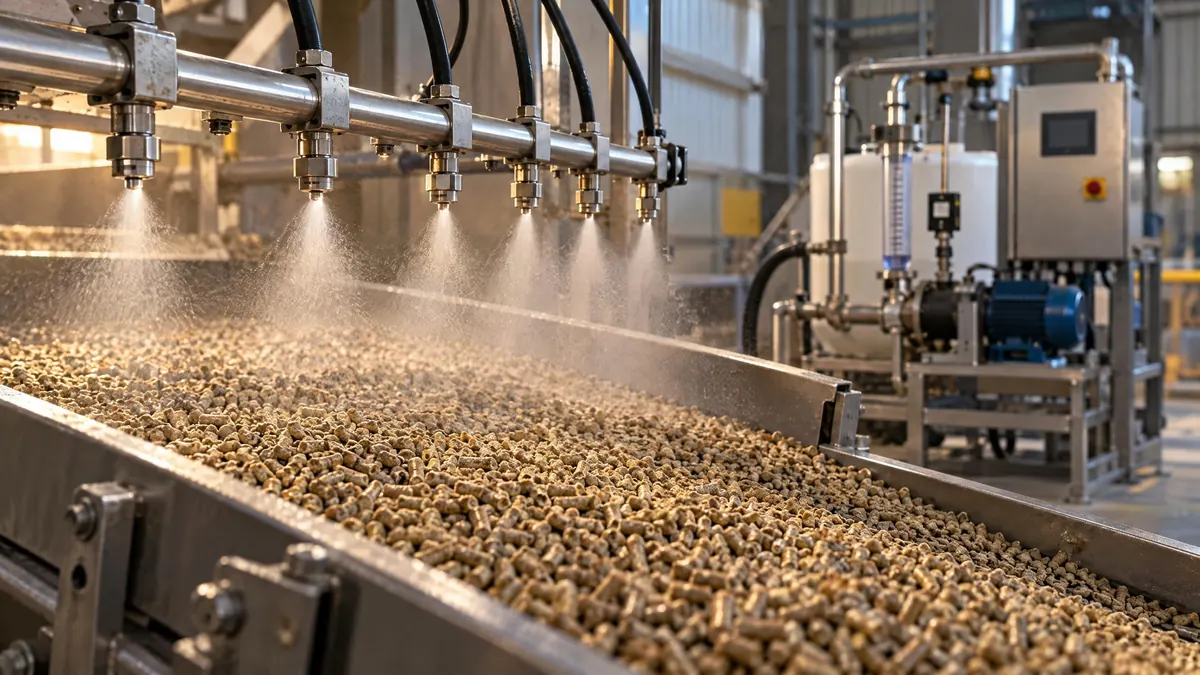
Adding water at the mixer, before the conditioner, binds particles by capillary action and has time to penetrate the particle, which steam, in 30 to 45 seconds, only partly achieves. On corn-based feeds, published trials range from 1 to 5 % added water: 1 and 2 % (Hott et al., 2008), 2 and 4 % (Buchanan and Moritz, 2009), 2.5 and 5 % (Moritz et al., 2003), up to 3 % (Lundblad et al., 2009), 1.5 % (Knarr, 2026).
In most of them, pellet durability and press throughput rise with the water added and, in several, the relative electrical energy of the press falls. In Moritz et al. (2003), PDI goes from 75.6 % with no water to 76.9 % with 2.5 % water, then to 79.6 % with 5 % (values reported by Muramatsu et al., 2015).
The effect still depends on the plant. Hott et al. (2008) compare a commercial mill and a pilot mill, with 1 and 2 % of a mix of water and a mould inhibitor: PDI rises in the commercial mill, not in the pilot mill, and the authors conclude that the result depends on the manufacturing technique. In a commercial mill studied in 2025 (You et al.), water added as a processing aid is among the variables unfavourable to PDI.
Water also lubricates the die. Too much water reduces friction and can cancel the effect of a thicker die; above 18 % total moisture at the die, the press can choke (Kansas State, 2021). Added water is therefore set on the moisture of the mash and on what the steam supplies, not blindly.
The limit
How far to add water: up to the formula moisture, no further
The doctoral thesis of Knarr (West Virginia University, 2026) sets the limit. On a low-moisture corn, 1.5 % water at the mixer raises throughput and durability, and the feed keeps more moisture throughout manufacture and storage. But in chicks aged 7 to 21 days, the same addition, with a thick die, worsened feed conversion: the authors see nutritional dilution, the feed holding fewer nutrients per kilo. They conclude that water at the mixer is not suitable if it is not removed afterwards, at cooling and drying.
The rule that follows is simple. Added water is there to recover the formula moisture that the cooler removes in excess, not to exceed it.
The risk
A moister feed: water activity decides how it keeps
Added water is also water available to moulds. The right indicator is not total moisture but water activity (aw): the share of that water that micro-organisms can use. FAO reference point: storage moulds grow from a water activity of 0.70. The full explanation is on the page mouldy feed in storage.
A point of moisture kept is therefore worth it only if it does not push the feed past the threshold where moulds start, in the bag, in the bin and in transit. A still-warm pellet loaded into a cold bin condenses water against its walls (Gerbitz, 2024); in hot, humid climates, every shelf life shortens. The places where water comes back are described in condensation in bins and trucks.
There is no universal shelf life for a pelleted feed. What shortens it: water activity, temperature, condensation and opened bags. Measuring water activity in the bag is the final test.
Pellet quality, moisture, throughput: the mill’s levers
Line management first. The product then protects the added water or the feed that has to wait; it replaces no setting.
No product
Management first
At the press and in the bin, before any additive.
Measure before adjusting
Mash moisture at the conditioner inlet, pellet moisture at the cooler outlet and bag moisture, batch by batch. PDI with its method, starting weight and delay, and the fines level recorded on the farm.
Good steam, a known mash
Poor steam, around 80 % steam quality, loses about 5 °F of heating for each 1 % water added, against good steam at around 97 %. The target temperature is set by the season: a cold mash takes more water for the same temperature.
A well-set cooler
An even bed, suitable airflow and air temperature, a residence time that lets water reach the surface of thick pellets. A poorly set cooler gives two opposite faults: a pellet that is too dry, or one still hot and moist at the core that sweats afterwards.
Fat in the right place
About 1 % at most at the mixer, the rest after the press on a cooled pellet: above 3 % liquid before the cooler, it may be drawn off. Fat added after the press is exposed to air and to the heat of storage.
Store dry
Pellets cooled to within a few degrees of ambient air before the bin, ventilated bins, bags on pallets, rotating stocks. The detail is in preserving feed.
Feed Solutions
Through the feed
When water is added at the mixer, or when the feed has to wait.
Protect the water added at the mixer
Linkamold Ultra L is a liquid mould inhibitor, organic acids led by propionic. It is mixed with water, then sprayed at the mixer, and the formula helps the water enter the particle, where it stays bound rather than free at the surface. Published rate: 0.5 to 2.0 kg per tonne of compound feed. Drum or IBC. The spray bar is set to the line throughput, which is the job of Linker Flow.
Protect the feed and raw materials that wait
Linkamold LAS is a powder, organic acids and their salts led by propionic. It goes in at the mixer, onto compound feed or onto raw material. Published rate: 0.5 to 1.5 kg per tonne, and 1 to 1.5 kg per tonne in hot, humid climates. 25 kg bag.
Protect fats and vitamins
Linkatiox is an antioxidant for fats, oils, vitamins and premixes: it slows the oxidation of fats, before and after pelleting. It lengthens the time before fat oxidises; it does not repair fat that is already oxidised. Published rate: 125 g per tonne of complete feed, supplied through the premix (one grade is recalculated on the fat content of the feed: see its page).
The fats of a rich ration
Linkalyso is an emulsifier based on lysophospholipids for the fats in feed, in rations with more than 3.5 % fat. Published rate: 0.15 to 0.30 kg per tonne, all species. It acts on the fat in the ration, not on how well the pellet holds: the setting for fat at the mixer remains the press’s.
Linkamold Ultra L
Ultra L: +1 to 2 % added water, not moisture kept in the bag
The target setting for Linkamold Ultra L, +1 to 2 %, is a quantity of water: the water added at the mixer with the product. It is not the moisture found in the bag. Between the two sit the conditioner, the press and above all the cooler, which removes part of that water, more or less depending on the plant and the season.
What published trials lead you to expect in the bag is more modest. In a 2024 study on two cattle-feed mills (Budak and Bilgeçli), an organic acid blend added at the mixer left 0.65 to 1.4 points more moisture at the cooler outlet than feed with no addition. That study concerns a commercial product that is not a Linker product, and one of its authors works for the company that sells it; the quantity of water added is not stated, and neither durability nor water activity was measured.
To our knowledge, no independent study has measured added water, a mould inhibitor, PDI, press energy and water activity in the bag together. The result on your line is therefore measured on your line: moisture and water activity in the bag, over several batches, without exceeding the formula moisture. A trial run with you is the way to do it.
How to choose
The Linker platforms involved
Three Feed Solutions platforms. Each has its own page: grades, use, documents.
| Platform | Where it works | When |
|---|---|---|
linkamoldMould inhibitor · feedLaboratory testIn inoculated feed stored for 90 days at 25 °C, the inoculated moulds were brought down to non-detectable levels, while the control exceeded 10⁸ CFU/g.ConditionsLaboratory test on mash feed, closed jars; two doses, 1.5 and 3 kg/t; counts at 60 and 90 days. | At the mixer: in the added water (Ultra L, liquid), or as a powder on the feed and raw material (LAS) | When water is added at the mixer, or when the feed has to wait: long storage, hot and humid climate |
linkatioxAntioxidant · feedLaboratory testIn a trial on our ethoxyquin-free antioxidant formulas (Rancimat test on lard), the induction period extended 39% more than with ethoxyquin alone, at the same dose.Conditions100 °C under air flow; 200 ppm of antioxidants; formula tested in liquid form. | In the premix and the feed, for fats and vitamins | When fat is added after the press, or when the feed waits |
linkalysoEmulsifier · feedTrial on the productIn tilapia, over 60 days at 0.3 kg/t: feed conversion ratio of 1.42, against 1.82 for the control (university trial published in 2021).ConditionsNile tilapia of about 70 g at the start, three replicates per rate; 4 rates compared. | At the mixer, in the fat of the ration | In rations with more than 3.5 % fat |
Each platform’s rate is on its page once published; otherwise ask for it, with the type of line, the moisture targeted and the climate. To apply a liquid additive after the press: Linker Flow. The other risks to feed are gathered in feed safety and preservation.
The approach
Setting up a pelleting line: five steps
An approach to follow with the production manager and the formulator.
- Measure the gap.Moisture of the formula, of the pellet at the cooler outlet and of the bag, over several batches and seasons: that is your line’s moisture shrink.
- Review the process.Temperature and moisture at the die, steam quality, cooler, fat at the mixer: what can be set without a product is set first.
- Relate PDI to fines.PDI with its method, the fines level recorded on the farm: the aim is the feeder, not a number.
- Decide on added water.How much, on which mash, in which climate, and with what protection against moulds.
- Measure in the bag.Moisture, water activity, appearance, batch by batch, before drawing a conclusion.
Sources
- Evaluating factors affecting pellet durability and energy consumption in a pilot feed mill and comparing methods for evaluating pellet durability (external site)Kansas State University, doctoral thesis · Fahrenholz, 2012
- The importance of pellet quality (external site)Teagasc · Lawlor, 9 August 2024 (summarises Badger et al., 2022, KAES Research Reports 8 (10))
- Feeding pellets for broiler performance improvements (external site)Penn State Extension · Boney, updated 7 November 2025 (cites McKinney and Teeter, 2004)
- Pellet feed diameter affects broiler growth (external site)The Poultry Site · Minson et al., International Poultry Scientific Forum, Kansas State, 19 May 2025 (conference presentation)
- Impact of pellet binder on feed quality, broiler performance, carcass yield, and organ development: a meta-analysis (external site)Veterinary Integrative Sciences · Ridla, Adawiyah, Nahrowi and Sukarman, 2025, vol. 23 (2)
- Feed operations: how expensive is shrink? (external site)World Grain · survey by Stark, Kansas State
- Interaction of ambient temperature and conditioning temperatures on moisture addition throughout pelleting, the pelleting process, and enzyme activity (external site)Journal of Applied Poultry Research · Renner et al., 2026, vol. 35 (1), 100636
- Effect of formulation density, moisture, and surfactant on feed manufacturing, pellet quality, and broiler performance (external site)Journal of Applied Poultry Research · Moritz et al., 2002, vol. 11, p. 155-163
- Feed manufacture and feeding of rations with graded levels of added moisture formulated to different energy densities (external site)Journal of Applied Poultry Research · Moritz, Cramer, Wilson and Beyer, 2003, vol. 12, p. 371-381
- Main effects and interactions of varying formulation protein, fiber, and moisture on feed manufacture and pellet quality (external site)Journal of Applied Poultry Research · Buchanan and Moritz, 2009, vol. 18, p. 274-283
- The effect of adding water into the mixer on pelleting efficiency and pellet quality in diets for finishing pigs without and with use of an expander (external site)Animal Feed Science and Technology · Lundblad et al., 2009, vol. 150, p. 295-302
- The effect of moisture addition with a mold inhibitor on pellet quality, feed manufacture, and broiler performance (external site)Journal of Applied Poultry Research · Hott, Buchanan, Cutlip and Moritz, 2008, vol. 17, p. 262-271
- Optimization of feed manufacturing productive capacity, feed quality, and feed safety utilizing a variety of pellet die parameters, feed additives, conditioning specifications, and simulated feed bin storages (external site)West Virginia University, doctoral thesis · Knarr, 2026
- Prediction of pellet durability index in a commercial feed mill using multiple linear regression with variable selection and dimensionality reduction (external site)Journal of Animal Science · You, Tulpan, Krziyzek and Ellis, 2025, vol. 103, skaf021
- Moisture optimization and energy saving effects of combined organic acid and surfactant inclusion in pelleted feed production (external site)Turkish Journal of Agriculture - Food Science and Technology · Budak and Bilgeçli, 2024, vol. 12 (2), p. 208-213 · accessed
- On-farm mycotoxin control in food and feed grain (external site)FAO · Golob, Good practices for animal feed and livestock, training manual no. 1, 2007
- What’s in your pellet bin (external site)Ag Proud · Gerbitz, 11 August 2024
Sources checked on .
The Kansas State guides (2021 and 2015), the U.S. Grains Council chapter, the review by Muramatsu et al. and the study by Budak and Bilgeçli were read in full on 24 October 2026. For the other publications, only the official abstract or a report of the work could be read: the figures come from there. This page describes publications; it is not technical advice for a given line.
Frequently asked questions
What is the PDI of a pelleted feed, and how is it read?
It is the percentage of pellets that stay whole after a standard abrasion test, always to be read with its method: see pellet durability index.
What pellet durability (PDI) should you aim for?
No single value fits every mill; the PDI is compared with the fines level recorded at the farm: see pellet durability index.
Do pellet fines really cost performance?
In pigs, yes in published trials; in broilers, results vary: see pellet fines.
Why is there moisture shrink in a feed mill?
Because the cooler removes the steam’s water, and often a little more: see moisture shrink.
What is a point of moisture kept in the feed worth?
About 11 kg of saleable feed per tonne produced, to be multiplied by your selling price: see what a lost point of moisture costs.
Adding water at the mixer: how far can you go?
Up to the formula moisture, no further, watching the press and water activity: see how far to add water.
Why pair a mould inhibitor with added water?
Because added water is water available to moulds: see water activity and the levers through feed.
What does “+1 to 2 %” mean for Linkamold Ultra L?
It is the water added at the mixer, not the moisture kept in the bag, which is measured on your line: see Ultra L.
How do you preserve a pelleted feed in a hot, humid climate?
With a well-cooled pellet, ventilated bins, bags on pallets and rotating stocks: see the levers by management.
Review your pelleting line
You run a pelleting line
Send us what you measure: moisture of the formula and of the bag, PDI, fines, conditioner and cooler settings. We look with you at where the water comes in and where it goes out.
Request a site visit →Propose a trial on your line →You add water at the mixer
Line throughput, added water, cooling, moisture in the bag: let us talk about Linkamold Ultra L and how it is sprayed.
Ask about Linkamold Ultra L →See the Linkamold page →Or directly: +33 2 30 91 59 15 · contact@linkernutrients.com
Further reading
- Mouldy feed in storage →
Water activity, condensation, and the mill’s preservation levers.
- Linker Flow →
Applying liquid additives at the feed mill, up to after pelleting.
- Feed safety and preservation →
Moulds, fat oxidation, mycotoxins: three risks, three tools.
- Linkamold →
The grades, powder and liquid, and water added at the mixer.