
Linker Flow
Linker Flow: liquid additive application in feed mills, through to post-pelleting (PPLA)
A liquid additive is only as good as the line that applies it. Linker Flow supplies both: the liquid additives, and the dosing and spraying equipment, designed, installed and maintained by technical partners. One contact for the product and the machine.
Definition
What is PPLA?
Post-pelleting liquid application (PPLA) means spraying a liquid additive onto the pellets after the press and the cooler, instead of mixing it into the mash before pelleting. The additive never goes through conditioning steam or the die, so it escapes the heat losses of pelleting; what reaches the bag is then checked on finished feed.
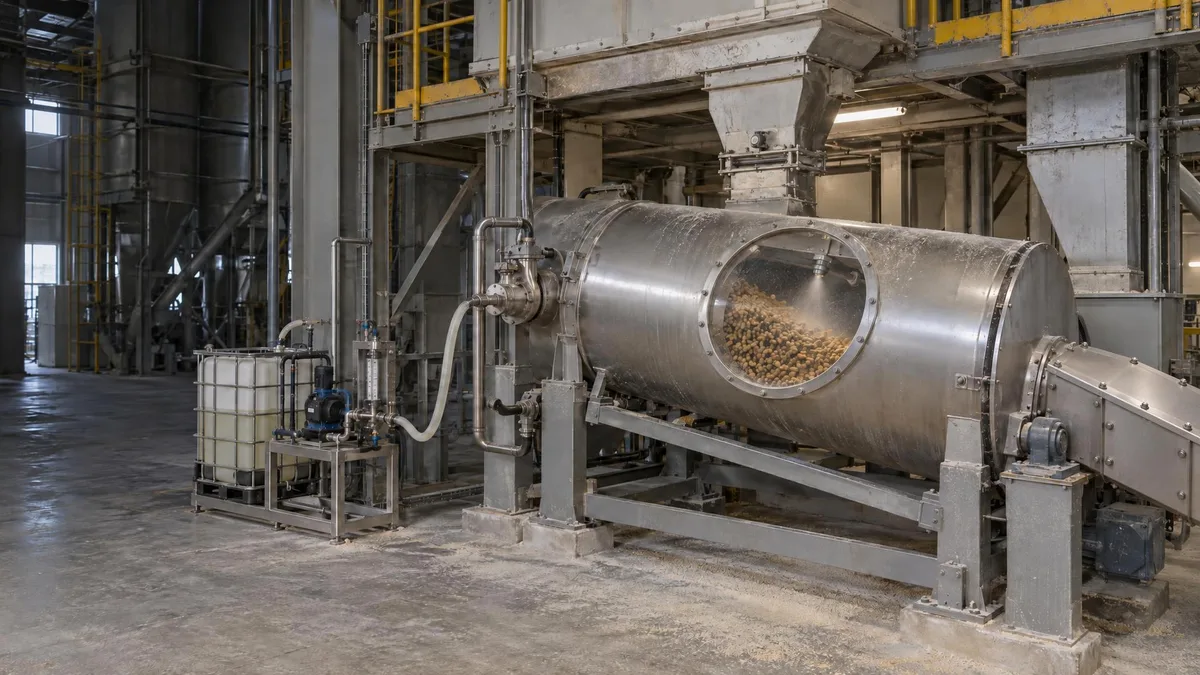
Depending on the line, the liquid is sprayed onto a moving pellet stream, applied by a liquid coating system in a chamber or a drum, or vacuum-coated when it has to reach the core of the pellet. The right liquid application system for a feed mill depends on its layout, its throughput and the product: that is what the site visit establishes.
Why liquid
Why feed mills move to liquid feed additives
The reasons almost always arrive in the same order. None of them is about the liquid itself: they are about what powder costs the mill beyond the price of the bag.
- The heat of the press. Conditioning and pelleting degrade part of the heat-sensitive additives: some enzymes, vitamins, aromatic fractions or volatile acids. Overdosing before the press to make up for it costs money on every tonne; applying after the press removes the question.
- Micro-doses. Spreading a few hundred grams through a tonne of feed asks a lot of a mixer, and a fine powder can still segregate in the conveyor, the bin or the truck. A liquid sprayed at a controlled rate goes where the pellets go.
- Dust and bags. Opening, weighing and emptying bags exposes operators to dust and multiplies handling errors. A liquid in an IBC is pumped.
- The micro-dosing bin. Every additive moved to liquid frees a micro-dosing bin for another product.
- Traceability. A controlled liquid dosing system records what was applied, to which recipe and which batch; a bag emptied by hand records nothing.
Where to apply
Three liquid application points in a feed mill
The application point is chosen from the product and the line: the site visit settles it.
| Application point | For which additives | What it takes |
|---|---|---|
| At raw material intake | Preserving a raw material before long storage | A spray bar on the conveyor or screw, a rate slaved to the material flow |
| At the mixer, before pelleting | Products that withstand the press: preservatives, acidifiers, added water with a mould inhibitor (Linkamold Ultra L) | A spray bar in the mixer, dosing set on the batch, mixing time respected |
| After the press and the cooler | Heat-sensitive additives, and those meant to sit on the pellet surface | Fines removed before the application point, continuous dosing with the application rate slaved to line throughput, spraying that does not break the pellet |
On the farm, liquid supplements go through the water line and the dosing pump: different equipment, and a different family, Farm Solutions.
Pellets, fines and moisture
What the mill measures around the application point
A post-pellet liquid application is judged on the finished feed, not on the pump setting. Three measurements tell you whether it works: pellet durability (PDI), the fines fraction at the application point, and feed moisture in the bag. The pellet durability index test measures the share of pellets that survive a standard tumbling; conditioning steam affects pellet quality, as do the formula and the die.
Fines have a far larger surface area than pellets: they soak up a share of the liquid out of proportion to their weight, then get screened off and returned. Removing them before the application point is not a refinement. Likewise, spraying too aggressively breaks the pellet the press has just made: the liquid only stays on the pellet if the pellet holds together.
On the moisture side, water added at the mixer is a mould risk until the feeder: Linkamold Ultra L is designed for it.
What goes wrong
Six faults that start between the liquid and the machine
Most mills disappointed by a liquid line were let down by one of these six, rarely by the additive.
- A blocked nozzle that drips instead of atomising: part of the stream is under-dosed, part over-dosed, at the same average consumption.
- A volumetric pump that drifts with temperature, viscosity and seal wear, with nothing recalibrating itself.
- Fines that drink the liquid because they were not removed before the application point.
- Pellets that break at the application point or in the conveyor that follows.
- Corrosion, when the wetted parts were not chosen for the chemistry of the product, organic acids in particular.
- Nobody measures the result. The only honest indicator is the coefficient of variation (CV) of the additive across samples of finished feed: the average tells you what left the tank, the CV tells you what reached the animal.
The offer
Linker Flow, from site visit to maintenance
None of these faults comes from the liquid alone or from the machine alone: they start where the two meet. Linker Flow holds both ends.
- 1Site visitProcess, layout, throughput, constraints: where the application point can realistically go.
- 2Project definitionApplication point, target rate, products to apply, equipment scope.
- 3Liquid productsAdditives formulated to be sprayed, stable in the line and compatible with its materials.
- 4Equipment and installationStorage, pump and flow measurement, nozzles, control: a complete fluid application system, designed, installed and maintained by technical partners.
- 5Commissioning and follow-upStart-up with the real product, operator training, maintenance of wear parts.
For you, one contact answers for the product and for how it is applied. How Linker works, from selecting a product to a trial at the customer’s site, is set out in how we work.
The liquid range
Liquid feed additives for the mill
On the mill side, the liquid range currently covers feed preservation, with Linkamold Ultra L, Linker’s mould inhibitor, and feed hygiene, with Linkasalm:
- Linkamold Ultra L: a liquid mould inhibitor designed to be diluted in the water added at the mixer; trial results on request.
- Linkasalm FA L: a feed hygiene liquid, sprayed on raw materials at intake or on compound feed; available in South-East Asia, data sheet and rate on request.
And the liquids your line already applies?
A mill that invests rarely applies a single product. Which liquids go through the line, and how they get on with each other and with the materials of the installation, is settled at project definition and written into the specification before the order.
Linker Flow extends the feed safety and preservation platforms: when a preservative has to be applied as a liquid, the same team chooses the grade, the rate and the application point.
Let’s talk about your line
You run a feed mill
We come and look at the layout, the throughput and the space after the cooler, before anyone quotes anything.
Request a site visit →You formulate
A question about water added at the mixer, the rate or the compatibility of a liquid preservative?
Ask about Linkamold Ultra L →Or directly: +33 2 30 91 59 15 · contact@linkernutrients.com
Frequently asked questions
What is post-pelleting liquid application (PPLA)?
PPLA is spraying a liquid additive onto the pellets after the press and the cooler, instead of mixing it into the mash before pelleting. The additive never meets conditioning steam or the die: it is the route for heat-sensitive additives and micro-doses.
Which additives are worth applying as a liquid rather than a powder?
Mainly two groups: those the heat of the press degrades, which have to be applied after it, and those dosed in very small amounts, which a liquid sprayed at a controlled rate distributes better than a fine powder in a mixer. Any application protocol, for an enzyme or another heat-sensitive additive, starts from the application point and the line throughput.
How do I know my liquid application is even?
By the coefficient of variation (CV) of the additive, measured on samples of finished feed taken during production, not by the pump setting. The average tells you what left the tank; the CV tells you whether every pellet got its share.
Does Linker supply the equipment as well as the liquid additives?
Yes, that is what Linker Flow (formerly Linker Flow Solutions) is: the liquid additives, and the dosing and spraying equipment, designed, installed and maintained by technical partners. You have one contact for the product and how it is applied.
Can an existing feed mill be fitted with a liquid line?
That is what the site visit settles: the space at the application point, the line throughput and the tie-in decide the solution. Installation time and production stop are worked out after the visit, not before.
Why remove fines before spraying?
Because fines soak up a share of the liquid out of proportion to their weight, then get screened off and returned, leaving the pellets under-dosed. Any serious post-pelleting design starts there.