
Fat oxidation in feed: rancidity, before you can see it
How oxidation spreads from the fat tank to the finished feed, how to track it, what it costs and how to slow it down.
In short
Fat oxidation in feed, also called oxidative rancidity, is the reaction between oxygen in the air and the unsaturated fatty acids of fats, oils and fat-rich raw materials. A chain reaction, sped up by heat, copper and iron, it destroys vitamins and pigments along the way, and can only be smelled once it is well advanced. It is tracked by analysis, and slowed first by the way fats are stored and handled, then by antioxidants.
- What oxidises
- Fats and oils, fish meal, vitamins A, D3 and E, pigments
- What speeds it up
- Heat, air, copper and iron, unsaturated fats
- Where
- From the fat tank to the premix and the finished feed
- How to track it
- Peroxide value, anisidine value, oxidative stability (Rancimat)
- First lever
- Management: temperature, air, metals, stock rotation
The problem
Fat oxidation: why rancidity spreads without a sign
Fat oxidation is a chain reaction. An unsaturated fatty acid loses a hydrogen atom and becomes a radical; oxygen binds to it, and the new radical takes a hydrogen from the next fatty acid, which becomes a radical in turn. Each step feeds the next: the reaction starts slowly, then runs away. The more unsaturated the fat, as with fish oil or soybean oil, the faster it goes.
The first products are peroxides. They have no smell and no taste, and they are unstable: they break down into aldehydes and ketones, volatile compounds that give the rancid smell and taste. By the time you can smell it, the fat has already lost a good part of its value, and so have the vitamins that came with it.
A feed mill brings together everything that speeds it up: a heated fat tank where new fat lands on a heel of old fat; the air of every transfer and every spray; the heat of conditioning, extrusion and drying; the copper and iron of the premix, right next to the vitamins; then weeks of storage, often in the heat.
Another kind of damage is often confused with it: hydrolysis. Water splits fat and releases its fatty acids; their level measures hydrolysis, not oxidation. The two are tracked separately, and a clean, dry tank keeps hydrolysis in check.
An antioxidant extends the time during which the fat stays intact. It does not repair fat that has already oxidised: all of its value lies in the time before the damage.
Testing
Peroxide value, anisidine, Rancimat: how to test for rancidity
Three ways of measuring rancidity in feed fats, and they do not say the same thing. These are method guides, not limits: read them together, on the same fat, and follow how they change rather than a single value.
- Take and keep the sample.Fat keeps oxidising in its bottle. Sample from the bulk rather than the top of the tank, fill the bottle, close it, keep it cool and have it analysed quickly: otherwise the result tells the story of the bottle, not of the tank.
- Peroxide value.It measures the oxygen bound in the fat as peroxides, the first products of the reaction (ISO 3960). It is a moving value: it rises while peroxides form, then falls as they break down. A low value can therefore mean fresh fat, or fat already far into oxidation.
- Anisidine value.It measures aldehydes, mainly those formed as peroxides break down (ISO 6885). It reads the next stage of the reaction: together with the peroxide value, it tells fresh fat from fat that is already well on its way.
- Oxidative stability (Rancimat).An accelerated test: the fat is heated under a strong air flow and the induction period is measured, the time before oxidation takes off (ISO 6886). It does not predict how a fat keeps at room temperature; it compares fats with one another, and the protection an antioxidant brings. It shows how much reserve a fat has left.
What most often skews the reading
- A single value
- A low peroxide value is falsely reassuring if it is not read with the anisidine value.
- The bottle
- A sample left in the warm, or half empty, went on oxidising before the analysis.
- Free fatty acids
- They measure hydrolysis, a different kind of damage caused by water: not oxidation.
- The date
- A result taken at intake no longer holds for fat that has spent weeks in a warm tank.
What fat oxidation costs
Nothing shows at the mill: the losses appear later, at the feeder and in the farm results.
Energy
Fat goes into the formula for its energy. Once oxidised, it supplies less than the formula counted on, and no label shows the gap.
Vitamins
Vitamins A, D3 and E oxidise along with the fat, and vitamin E is used up holding the reaction back. A feed or premix that met its specification when it was made may no longer meet it at the feeder.
Pigments
The carotenoids added for yolk or skin colour oxidise too: the expected colour does not come through.
Palatability
Rancid fat can be smelled and tasted. The feed is less readily eaten, and the smell follows the batch all the way to the farm.
The downgraded batch
Fat or fish meal that arrives too oxidised is renegotiated or set aside; feed that smells rancid comes back to the mill.
No figures here: the loss depends on the fat, how unsaturated it is, the process and the storage time. Publications on peroxidised fats are listed in the sources.
How to prevent rancidity in feed: management first, then the feed
An antioxidant buys time on fat that is still sound. It cannot make up for a poorly kept tank, or for fat that arrived already oxidised: management comes first.
No product
Management first
At the mill, from intake to the feed bin: what is settled before any additive.
Buy and receive on analysis
A written specification for every fat, oil and fish meal, with peroxide value and anisidine value at intake, and a rule to accept, set aside or reject a batch. For fish meal, also ask which antioxidant stabilised it, and whether that antioxidant is allowed in the destination country: see ethoxyquin and fish meal.
Heat little, and slowly
Run every operation at the lowest temperature that allows it: the reaction is faster when hot. The Codex code of practice for fats and oils in bulk asks for solid fat to be warmed slowly before transfer, never by more than 5 °C in 24 hours, and for the heating to be switched off when a liquid oil is stored for a long time.
Keep the air out
Closed, tall and narrow tanks, to cut the surface in contact with the air; filling from the bottom, without splashing or drawing in air; never pumping new fat onto a heel of old fat. For long storage, a blanket of inert gas.
Keep copper out, watch iron
No copper, brass or bronze in contact with the fat: pipes, fittings, valves, pumps, heating coils, sampling equipment. Iron is a catalyst too, if a weaker one; stainless steel remains the metal of choice. In the premix, the longer vitamins wait next to copper and iron, the more they oxidise: a premix is made to be used quickly.
Rotate the stock
First in, first out, for fat as for premix and feed. Tanks emptied, cleaned and dried between batches; premix bags kept closed, cool and dry.
Feed Solutions
Through the feed
Two application points, the premix and the mixer, and a rate calculated on the fat.
Protect the vitamins in the premix
In the premix, two jobs work together: a chelator binds the copper and iron that start the reaction, and antioxidants stop the chain once it has begun. This is where vitamins wait the longest.
Protect the compound feed and its pigments
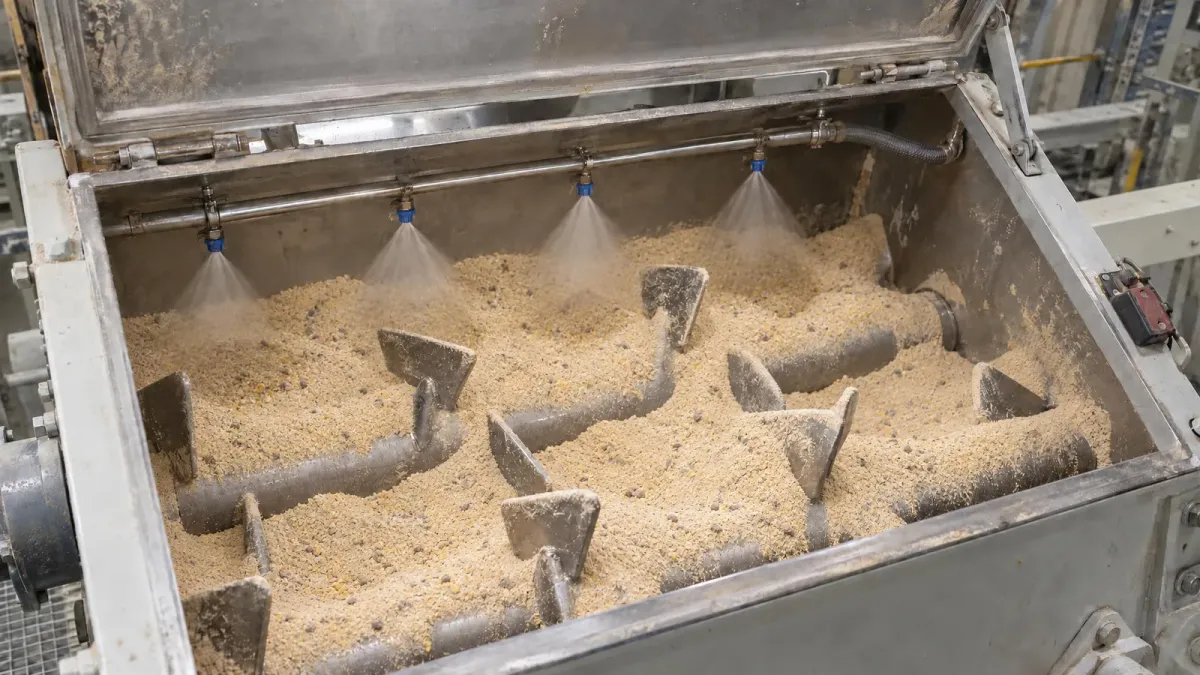
At the mixer, the antioxidant follows the fat in the feed and its pigments through conditioning, pelleting or extrusion, then storage. Its heat stability is chosen to suit the process.
On the fat itself, case by case
Direct application on a fat remains possible, when its unsaturation or a long storage period calls for it. It is the exception: keeping a sound fat sound starts with how the tank is run, then continues in the premix and at the mixer.
Set the rate on the fat
The rate is calculated on the fat to be protected, not on the tonne of feed, then adjusted for how unsaturated it is, the process temperature, the storage time and the metals in the premix. With or without ethoxyquin, the destination market decides: see replacing ethoxyquin.
For EFSA, the efficacy of a feed antioxidant is shown by the protection of key nutrients against oxidation during processing or storage, for the period claimed (2024 guidance).
The Linker platform involved
One Feed Solutions platform, in two lines: Shield, with ethoxyquin, and Vital, ethoxyquin-free. Its page gives the grades, use and documents.
| Platform | Where it works | When |
|---|---|---|
linkatioxAntioxidant · feedLaboratory testIn a trial on our ethoxyquin-free antioxidant formulas (Rancimat test on lard), the induction period extended 39% more than with ethoxyquin alone, at the same dose.Conditions100 °C under air flow; 200 ppm of antioxidants; formula tested in liquid form. | In the vitamin and trace-mineral premix, or at the mixer in the compound feed; on the fat, case by case | When the premix or the feed is made, before it is stored |
The rate is on the product page when it is published; otherwise ask for it, with the type and level of fat, the process temperature and the destination market. Linkatiox belongs to the feed safety and preservation category, alongside the tools against moulds and mycotoxins.
Sources
- ISO 3960:2017, Animal and vegetable fats and oils, Determination of peroxide value, Iodometric (visual) endpoint determination (external site)International Organization for Standardization (ISO) · international standard, edition 5, 2017; official summary · accessed
- ISO 6885:2016, Animal and vegetable fats and oils, Determination of anisidine value (external site)International Organization for Standardization (ISO) · international standard, edition 4, 2016; official summary · accessed
- ISO 6886:2016, Animal and vegetable fats and oils, Determination of oxidative stability (accelerated oxidation test) (external site)International Organization for Standardization (ISO) · international standard, edition 3, 2016; official summary · accessed
- Recommended International Code of Practice for the Storage and Transport of Edible Fats and Oils in Bulk (external site)Codex Alimentarius (FAO and WHO), text published by FAO · CAC/RCP 36-1987, revision 1-1999 · accessed
- Guidance on the assessment of the efficacy of feed additives (external site)European Food Safety Authority (EFSA), FEEDAP Panel · EFSA Journal 2024, 22(7), e8856 · accessed
- Growth performance, oxidative stress and immune status of newly weaned pigs fed peroxidized lipids with or without supplemental vitamin E or polyphenols (external site)Journal of Animal Science and Biotechnology · Silva-Guillén et al., 2020, vol. 11, article 22 · accessed
Sources checked on .
This page explains; it does not replace the text of the analytical standards or the regulations of the destination country. The ISO standards are cited through their official summary.
Frequently asked questions
What is rancidity in fats?
The damage that gives fat a rancid smell and taste: most often through oxidation, sometimes through hydrolysis, caused by water. See why you cannot see it.
What is the difference between peroxide value and anisidine value?
The first measures peroxides, the first products of oxidation, which end up breaking down; the second measures the aldehydes that follow them. Read them together: see how to test for rancidity.
Does the Rancimat test tell you how long the feed will keep?
No. It is an accelerated test at high temperature that compares fats and antioxidants with one another; it does not predict how a fat keeps at room temperature.
Can an antioxidant save fat that is already rancid?
No. Oxidation cannot be undone: an antioxidant only buys time on fat that is still sound, which is why fats are received on analysis and the antioxidant goes in early, in the premix or at the mixer.
Why do vitamins lose their value in a premix?
Because they wait there next to copper and iron, which catalyse their oxidation, sometimes for months. See the levers.
Is oxidised fat a risk for the animals?
It supplies less energy and fewer vitamins, and the feed is less readily eaten: see what it costs. If animals have been given rancid feed and their results drop, the diagnosis is a matter for the veterinarian.
Do free fatty acids measure oxidation?
No: they measure hydrolysis, a different kind of damage caused by water. Oxidation is tracked through peroxide value, anisidine value and oxidative stability.
Send us your fat analyses
You run quality or formulation
Type and level of fat, peroxide and anisidine values, process temperature, storage time, destination market: we read your results with you and tell you what comes down to management, and what calls for an antioxidant.
Have your fat analyses read →Request the Linkatiox data sheet →You make premixes
Vitamins, trace minerals, storage time, an ethoxyquin-free specification: let us talk about protecting your premixes.
Talk about your premixes →Or directly: +33 2 30 91 59 15 · contact@linkernutrients.com