
Raw material intake: what to check at the feed mill, and the limits to hold
What to check at intake, the limits to hold in storage, then the levers: management first, the feed second.
In short
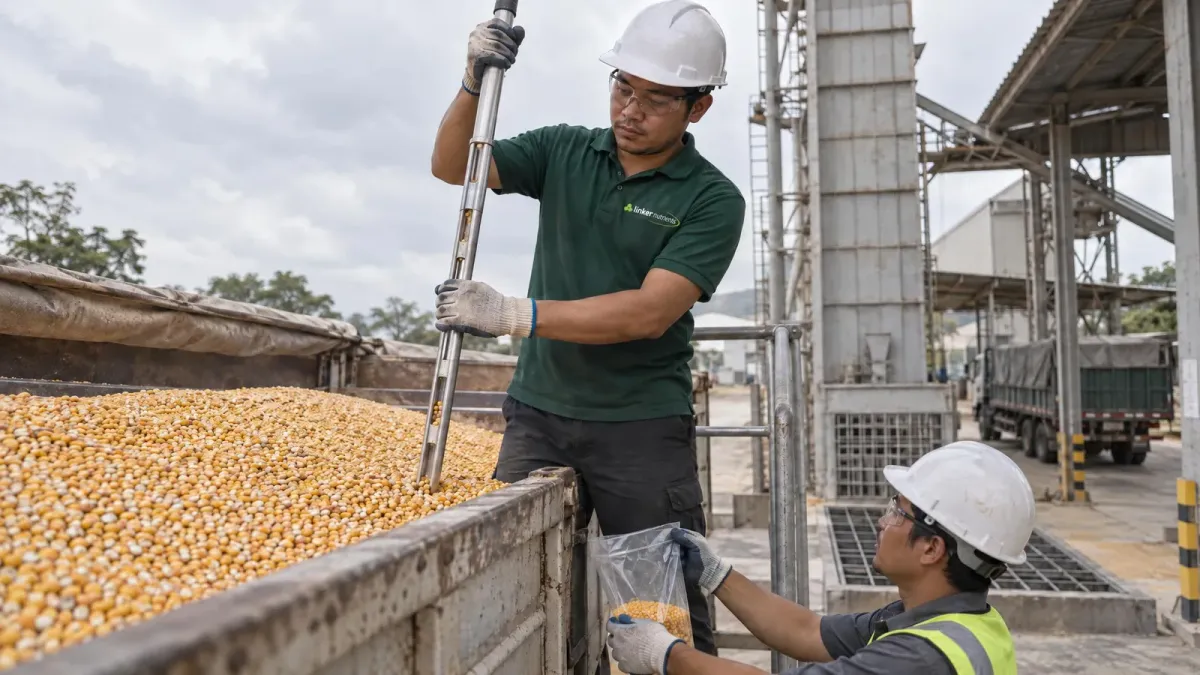
Raw material intake is the moment when a feed mill accepts, sorts, dries, redirects or rejects a lot before it goes into a bin: moisture, temperature, appearance, mycotoxins, the state of fats and meals. It is the last point where action is still possible: a mycotoxin that has formed does not disappear in grinding or pelleting, and a rancid fat does not turn fresh again.
- Master parameter
- Available water, measured as water activity (aw)
- Benchmark
- aw below 0.70, about 14 % moisture for maize at 20 °C (FAO)
- Maximum
- No point in the lot above 15 %
- Framework
- HACCP plan, official sampling rules, multi-toxin analysis
- First lever
- A dry lot, sampled, analysed, then sent to an identified silo
The problem
Moisture and water activity: the limit to hold at raw material intake
Grain does not keep because it looks dry: it keeps because the water it holds is hardly available to moulds. That is what water activity (aw) measures, on a scale from 0 to 1. The FAO benchmark: below 0.70, most moulds do not grow, which is about 14 % moisture for maize and 7 % for groundnut, at 20 °C. The hotter it is, the lower the safe moisture.
So a maximum has to be set, not just an average. The FAO gives the example of maize at 14 %, with no part above 15 %: an average hides wet pockets, hence readings at several points of the lot, ten at least.
Time weighs as much as the level. A commodity left more than 48 hours at an unsafe moisture can already produce toxins, and sun drying done in time beats mechanical drying that comes late. In the tropics, rainy-season maize arrives on the cob at about 35 % moisture: in the FAO example for South-East Asian maize, it is brought below 22 % in the field, to 16 % or less within 48 hours, then to 14 % before storage.
Not every toxin is controlled in the same place. Fusarium, the field moulds, leave DON, zearalenone and fumonisins in the grain before harvest: they are found by analysis at intake. Aspergillus and Penicillium, the storage moulds, form aflatoxins and ochratoxin A in the silo too: that is where storage practice counts. See field or storage and where feed picks up water again.
A moisture that is safe at 20 °C is no longer safe at 30 °C: moisture is always read together with grain temperature.
Allowable time
Grain storage: how long does grain keep?
Approximate times before 0.5 % dry-matter loss, the commercial downgrading threshold for grain. Read the table with grain temperature, not air temperature.
| Grain moisture | At 10 °C | At 16 °C | At 21 °C | At 27 °C |
|---|---|---|---|---|
| 14 % | over 300 days | over 300 days | 200 days | 140 days |
| 15 % | over 300 days | 240 days | 125 days | 70 days |
| 16 % | 230 days | 120 days | 70 days | 40 days |
| 18 % | 90 days | 50 days | 30 days | 15 days |
| 20 % | 50 days | 25 days | 14 days | 7 days |
| 24 % | 15 days | 10 days | 6 days | 2 days |
Table from North Dakota State University (2011), stated to be approximate; the original values are in degrees Fahrenheit, converted here. The clock starts at harvest and does not reset after drying. Immature or damaged grain keeps for less time, broken kernels and dust spoil faster than whole grain, and for grain storage in the tropics times are shorter still: these tables stop at 27 °C. Sources at the foot of the page.
By family
Cereals, oilseed meals, by-products, meals, fats: each family has its weak point
What threatens each material, and what is measured to see it coming.
| Family | Main risk | What to measure |
|---|---|---|
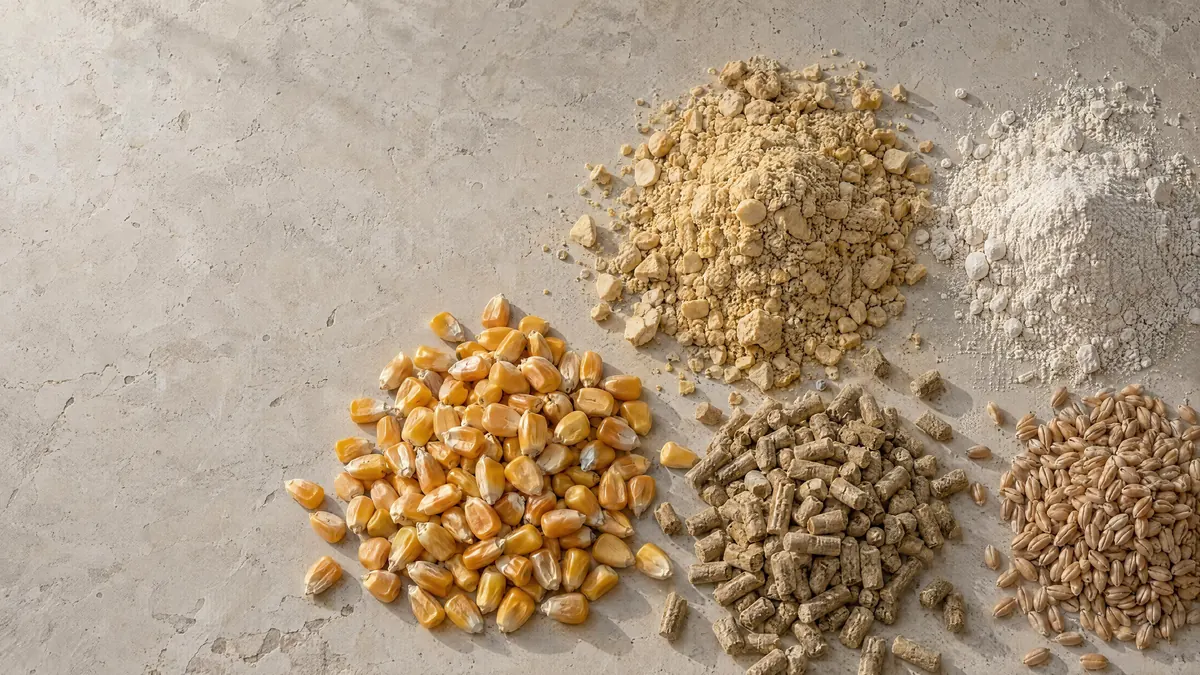
| Cereals: maize, wheat, barley, sorghum, broken rice | High or uneven moisture, storage moulds, field and storage mycotoxins, insects, broken kernels | Mean and maximum moisture, lot temperature, broken and mouldy kernels, mycotoxins |
| Oilseed meals: soya, sunflower, rapeseed, copra, palm kernel, groundnut, cotton | Moisture pick-up, aflatoxins (groundnut, copra, cotton), heating, rancidity of the residual fat | Moisture, temperature, aflatoxin B1, acidity of the fat |
| By-products: bran, distillers’ grains, gluten feed, middlings | Toxins concentrated in the outer fractions of the grain, variable moisture, fast heating | Moisture, mycotoxins |
| Fish meal and meat meal | Lipid oxidation, spontaneous heating, bacterial load | Peroxide value, acidity, residual antioxidant, microbiology |
| Oils and fats | Oxidation, hydrolysis (free fatty acids), moisture and impurities | Peroxide value, anisidine value, acidity, moisture, insoluble matter |
Rancidity and how it is measured are covered in fat oxidation in feed.
The control plan
Intake quality control for raw materials, in five steps
A result is only as good as the sample it comes from: mistakes are made far more often at sampling than in the laboratory.
- Look before you weigh.Delivery note, country of origin, the supplier’s certificate of analysis; then the truck or the hold: a smell of mould, fermentation or rancidity, insects, foreign matter, lot temperature with a probe. A hot lot, or one that smells mouldy, is set aside before any test.
- Sample according to tonnage.Mycotoxins are spread in pockets: a few kernels can carry most of a lot’s toxin. Regulation (EC) No 152/2009, amended by Regulation (EU) No 691/2013, sets 58 incremental samples for a 25 t truck, combined into a 4 kg aggregate sample; the final sample is at least 500 g, and a sealed sample is kept.
- Measure on the spot.Moisture at ten points at least, mean and maximum; water activity on materials whose moisture is misleading, oilseed meals and by-products; a rapid mycotoxin test, strips or ELISA, set to a threshold fixed in advance (the FAO mentions 5 or 20 µg/kg of the target toxin); peroxide value and acidity on fats.
- Confirm in the laboratory.Multi-toxin chromatography for lots at risk, following the monitoring plan: with Recommendation (EU) 2026/1801, screening no longer stops at aflatoxin.
- Decide, then record.Accept, dry, set aside, redirect to a less sensitive species or reject, using the grid below; send the lot to an identified silo; record the lot, the results, the silo and the link to the feed batches made from it.
What most often distorts the decision
- The mean without the maximum
- A lot averaging 14 % can hold a pocket at 17 %. The maximum decides.
- The moisture meter
- It must be corrected for grain temperature: on grain coming out of a high-temperature dryer, it reads about 2 % low.
- A single sample
- A scoop from the surface says nothing about a truck: the sampling plan is fixed before the truck arrives.
- The toxins nobody looked for
- An analysis only finds what it is asked for. A lot that is fine for aflatoxin can be loaded with DON or fumonisins.
The limits
Accept, accept on condition, reject: a grid written before you need it
A written rule says what happens to each lot, without improvising in front of a truck.
| Criterion | Accept | On condition | Reject or set aside |
|---|---|---|---|
| Maize moisture | 14 % or less, no point above 15 % | Immediate drying, or quick use | Wet lot that cannot be dried within 48 hours |
| Lot temperature | Close to ambient | A few degrees above: closer checks, use first | Hot lot, smell of mould or fermentation |
| Appearance | Sound | Broken or mouldy kernels outside specification: cleaning, sorting | Widespread mould, many live insects |
| Mycotoxins | Below the contract limit | Below the guidance value but above the contract: least sensitive species, buyer informed | Above the legal maximum (aflatoxin B1): reject, no dilution |
| Fats, fish meal | Indices and residual antioxidant within the specification | Antioxidant protection at once, use first | Fat already oxidised |
Starting values, to be adapted to the mill, its species and its climate. Maize moisture comes from the FAO, the legal maximum from Directive 2002/32/EC.
What the rule says
Recommendation (EU) 2026/1801 and aflatoxin B1: what the rule sets at intake
Aflatoxin B1 has a legal maximum. Directive 2002/32/EC sets it at 0.02 mg/kg in feed materials, 0.01 in complete feed and 0.005 in compound feed for dairy cattle and young animals, for feed at 12 % moisture. It also forbids blending a product that exceeds the maximum with another to dilute it: a non-compliant lot is set aside, it is not rescued. The full values are in the EU mycotoxin limits and guidance values.
Recommendation (EU) 2026/1801 of 24 July 2026 lowers guidance values, recommended benchmarks and not legal limits, for five families of toxins: deoxynivalenol (DON), zearalenone, ochratoxin A, T-2 and HT-2 toxins, fumonisins. For complete pig feed: DON 0.7, fumonisins 1.0 and ochratoxin A 0.01 mg/kg; for broilers and turkeys, DON 1.0; for poultry other than turkeys and ducks, fumonisins 2.0. It applies from 1 July 2027, and from 1 October 2027 for maize, sorghum, soya, sunflower and their products.
What this changes at intake:
- Analyse five families together, at least by sampling, according to origin, harvest and material, and build them into the HACCP plan.
- Renegotiate supplier specifications: suppliers must give the mill the mycotoxin levels of their raw materials.
- Follow each material against its inclusion rate: a maize that complies as a raw material can push a pig feed over its guidance value.
- Tie results to the lot: without intake traceability, there is no way to inform the buyer when a value is exceeded.
What a missed check at intake costs
Four items that show up neither at the same time nor in the same department.
Material losses
A 0.5 % dry-matter loss is enough to downgrade grain, and storage losses of cereals are estimated at 10 % at least worldwide, up to 50 % in tropical regions (Mannaa and Kim, 2017). What respires in the bin no longer feeds the animal.
The lot set aside or downgraded
A lot above a legal maximum is set aside; above a guidance value, it is redirected or renegotiated. Meanwhile a bin is tied up and the formula is rewritten.
Fat that goes rancid
An oxidised fat or meal loses energy and protects the feed’s vitamins poorly: see what oxidation costs.
Commercial risk
Feed delivered above a maximum means a withdrawal, sometimes a recall, and a customer relationship to rebuild. Buyers increasingly ask for the analysis results before they sign.
Actual losses depend on the harvest, the climate and the storage time: they are measured on your own lots.
Intake and storage: management first, then the feed
No additive replaces the drying of wet grain, or makes a lot above a legal maximum compliant.
No product
Management first
At the mill, from the truck to the silo: what is settled before any additive.
Dry fast and evenly
This is the most effective measure against aflatoxin, and delay weighs heavily: 16 % or less within 48 hours, then 14 % before storage, no part above 15 %. Drying done in time beats mechanical drying that comes late.
Clean, sort, rotate
Cleaning and sorting out broken kernels, dust and mouldy grain is the only common way to reduce a mycotoxin that has already formed; the removed fractions concentrate toxins and do not go back into the feed. First in, first out; bins emptied and cleaned between lots; watertight roofs; grain screened before it goes into the bin.
Ventilate, cool, follow the temperature
Respiration of grain and insects produces water and heat: it creates hot spots where moulds start. Ventilate in the cool, dry hours and follow temperature with cables in the silo; a local rise signals mould or insect activity.
Write the plan and keep to it
A HACCP plan is mandatory for compound feed manufacturers. In the FAO example of a maize-based feed, intake is a critical point: an aflatoxin test on each lot, a maximum moisture, drying or rejection as the corrective action, a change of supplier if rejections are too frequent. Lot traceability right through to the feed made.
Feed Solutions
Through the feed
The intake plan decides what comes in; the products help keep sound what has been accepted.
Hold back moulds on material that is already dry
A mould inhibitor combines organic acids and their salts. It protects material at a safe moisture from water pick-up, condensation and long storage, in hot and humid climates above all: as a powder on the raw material at intake or at the mixer, as a liquid sprayed with the water added at the mixer. It does not remove a toxin that has already formed, and it does not replace drying.
Protect fats from the day they arrive
An antioxidant lengthens the period before oxidation; it does not repair an oxidised fat. It goes in when oils and fats arrive still fresh, on meals that are not protected enough, and in premixes. Monitoring and limits: fat oxidation in feed.
Bind in the feed what is left
A mycotoxin binder is a clay added at manufacture: Linkafix Secure is a bentonite, Linkafix Advance an activated fibrous clay. It comes after intake, when analysis shows a presence below the legal maximums or a risk (origin, season, several toxins), to help reduce animals’ exposure. Never to make a lot compliant: see the mycotoxin levers.
Look after raw-material hygiene, outside the European Union
A feed hygiene agent helps reduce the bacterial load of raw materials that need bacterial control, animal meals and oilseed meals, from intake onwards, and then that of the finished feed. Linkasalm FA L: not marketed in the European Union.
Four Linker platforms, four moments from intake to storage
They do not act in the same place and do not replace one another. Each has its own page: forms, use, documents.
| Platform | Where it works | When |
|---|---|---|
linkamoldMould inhibitor · feedLaboratory testIn inoculated feed stored for 90 days at 25 °C, the inoculated moulds were brought down to non-detectable levels, while the control exceeded 10⁸ CFU/g.ConditionsLaboratory test on mash feed, closed jars; two doses, 1.5 and 3 kg/t; counts at 60 and 90 days. | On the raw material at intake, or in the feed at the mixer | Material already at a safe moisture, long storage, hot and humid climate, water added at the mixer |
linkatioxAntioxidant · feedLaboratory testIn a trial on our ethoxyquin-free antioxidant formulas (Rancimat test on lard), the induction period extended 39% more than with ethoxyquin alone, at the same dose.Conditions100 °C under air flow; 200 ppm of antioxidants; formula tested in liquid form. | On oils and fats, and in premixes | From arrival, while the fat is still fresh |
linkafixMycotoxin binder · feedLaboratory testWith all six mycotoxins in the same solution, Linkafix Advance AC retains 51.9% of DON, against 7.3% for Linkafix Advance alone in the same series.ConditionsIn vitro test: adsorption at pH 3, then desorption at pH 6.5; aflatoxin B1 at 4,000 ppb, zearalenone, T-2, fumonisin and ochratoxin A at 500 ppb, DON at 1,000 ppb, all together. | At the mixer, in the compound feed or through the premix | When analysis shows a presence below the legal maximums, or a risk: origin, season, several toxins |
| linkasalmFeed hygiene · feed | On raw materials at intake, then on the finished feed | Raw materials that need bacterial control. Not marketed in the European Union |
The rate is on each platform page when it is published; otherwise ask for it, with the material, its moisture, the storage time and the climate. The risks to feed are gathered in feed safety and preservation.
Sources
- Commission Recommendation (EU) 2026/1801 of 24 July 2026 on the presence of deoxynivalenol, zearalenone, ochratoxin A, T-2 and HT-2 toxins and fumonisins in feed (external site)EUR-Lex · OJ L, 2026/1801, 28.7.2026
- Directive 2002/32/EC of the European Parliament and of the Council of 7 May 2002 on undesirable substances in animal feed, consolidated version of 28 November 2019 (external site)EUR-Lex · OJ L 140, 30.5.2002, p. 10
- Commission Regulation (EC) No 152/2009 of 27 January 2009 laying down the methods of sampling and analysis for the official control of feed (external site)EUR-Lex · OJ L 54, 26.2.2009
- Commission Regulation (EU) No 691/2013 of 19 July 2013 amending Regulation (EC) No 152/2009 as regards methods of sampling and analysis (external site)EUR-Lex · OJ L 197, 20.7.2013
- Regulation (EC) No 183/2005 of the European Parliament and of the Council of 12 January 2005 laying down requirements for feed hygiene (external site)EUR-Lex · OJ L 35, 8.2.2005
- Manual on the application of the HACCP system in mycotoxin prevention and control (external site)FAO and IAEA · FAO Food and Nutrition Paper 73, 2001 · accessed
- High-moisture grains for swine (external site)University of Minnesota · Hawton, Bache and McKenzie, fact sheet PIH-73 · accessed
- Influence of Temperature and Water Activity on Deleterious Fungi and Mycotoxin Production during Grain Storage (external site)Mycobiology · Mannaa and Kim, 2017, vol. 45, p. 240 · accessed
Texts re-read on 24 October 2026 in the repository of the Publications Office of the European Union, which feeds EUR-Lex. Storage benchmarks come from FAO manuals and university extension services; they are adjusted to your material, your climate and your installation. Only the version published in the Official Journal of the European Union is authentic.
Frequently asked questions
What moisture and water activity are safe for storing maize?
About 14 % moisture, with a maximum of 15 %: the FAO benchmark and its detail are in moisture and water activity.
Why does grain temperature matter so much?
Because moulds and insects work faster when it is warm: grain at 16 % moisture keeps about 230 days at 10 °C, about forty at 27 °C. See the storage-time table.
Do mycotoxins increase during storage?
Yes for those of storage moulds, aflatoxins and ochratoxin A, when water and heat allow; DON, zearalenone and fumonisins come mostly from the field. See field or storage.
What does Recommendation (EU) 2026/1801 change?
Lower guidance values and five families of toxins analysed together, from 1 July 2027. See what the rule sets.
How many samples for a truck of maize?
Under Regulation (EC) No 152/2009, 58 incremental samples for 25 t. See the five steps of the check.
Can a mould inhibitor replace drying?
No: it protects material that is already dry. Keeping wet grain without drying it is a separate technique, with pure propionic acid, from 5 kg/t at 16 to 18 % moisture up to 15 kg/t at 35 % for a year (University of Minnesota), with suitable equipment. See the levers through the feed.
Does a mycotoxin binder make a contaminated lot compliant?
No. A lot above a legal maximum cannot be diluted or rescued with an additive: it is set aside. See what the rule sets and the levers through the feed.
When should an antioxidant be added to fats and fish meal?
From arrival, on material that is still fresh: added to an oil that is already oxidised, it repairs nothing. See fat oxidation in feed.
Review your raw material intake
You receive maize, oilseed meals, by-products
Origins, moisture, storage time, climate, analysis results: we read your control plan with you and tell you what belongs to drying, sorting, preservation or a binder.
Review your intake checks →Request the Linkamold data sheet →You receive fats or meals
Type of fat, the indices you measure, the delay between arrival and use: let us talk about protecting your fats from the day they arrive.
Talk about your fats and meals →Request the Linkatiox data sheet →Or directly: +33 2 30 91 59 15 · contact@linkernutrients.com
Going further
- Mycotoxins in animal feed →
Where each toxin comes from, how it is measured, and the mill’s levers.
- Mouldy feed in storage →
Where feed picks up water, from silo to truck, and how to preserve it.
- Fat oxidation in feed →
Peroxide value, anisidine: following rancidity before it shows.
- EU mycotoxin limits and guidance values →
The European Union’s maximum levels and guidance values, with their sources.