
Mycotoxins in animal feed: aflatoxin, DON, and where they come from
What each toxin is, where it comes from, how it is measured, and what a feed mill can do: test, preserve, bind.
In short
Mycotoxins in animal feed are toxic substances produced by certain moulds, in the field or during storage, on maize, cereals, oilseed meals and their by-products. Invisible, odourless and stable to heat, they pass from the raw material into the finished feed with nothing to give them away: only an analysis reveals them.
- Moulds
- Fusarium in the field; Aspergillus and Penicillium mostly in storage
- The six to follow
- Aflatoxins, DON, zearalenone, fumonisins, ochratoxin A, T-2 and HT-2 toxins
- Raw materials
- Maize, wheat, barley, oats, sorghum, oilseed meals, cereal by-products
- Units
- µg/kg (ppb) or mg/kg (ppm): a factor of one thousand between the two
- First lever
- Analysis, on a properly taken sample
Where they come from
What is a mycotoxin, and where does it come from: field or storage?
A mycotoxin is a molecule that a mould produces without needing it to grow, often when drought, heat or competition from other micro-organisms put it under pressure. Several hundred have been described; half a dozen really matter in animal feed.
In the field, the main moulds are Fusarium. They infect the ear during flowering and grain fill, in wet weather, and leave deoxynivalenol (DON), zearalenone, fumonisins or T-2 and HT-2 toxins. The toxin is in the grain before harvest: no storage, however good, will take it out.
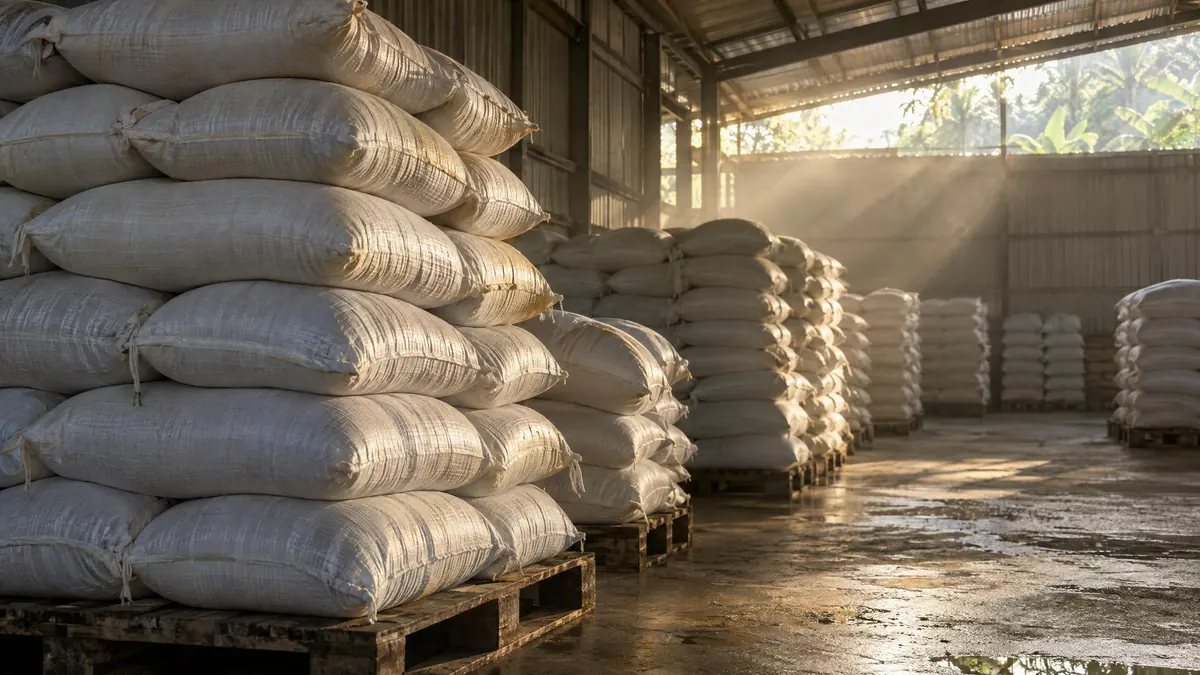
In storage, the main moulds are Aspergillus and Penicillium. They grow as soon as available water, heat and time come together, and they produce aflatoxins and ochratoxin A. In hot climates, Aspergillus flavus also contaminates maize on the plant, mostly after a drought.
Two practical consequences. The mould may be gone while its toxin is still there: a lot that looks clean can be heavily loaded. And mycotoxins survive ordinary processing: neither grinding nor the heat of pelleting destroys them.
One lot often carries several toxins at once: one mould produces several, and several moulds follow one another from field to silo. An analysis that looks only for aflatoxin says nothing about the rest.
The six families
Aflatoxins, DON, zearalenone, fumonisins, ochratoxin A, T-2: the essentials by toxin
Six families, three groups of moulds, different raw materials and different species. Read the table line by line, with your own analysis results beside it.
| Mycotoxin | Moulds | Raw materials most affected | Field or storage | Most sensitive species |
|---|---|---|---|---|
| Aflatoxins (B1, B2, G1, G2) | Aspergillus flavus, A. parasiticus | Maize, groundnut, cottonseed and copra meals, sorghum, rice bran | Hot, humid storage; in the field in hot, dry climates | Poultry, ducks above all; young animals; dairy cows, because of the milk |
| DON (deoxynivalenol, vomitoxin) | Fusarium graminearum, F. culmorum | Wheat, barley, maize, triticale, oats, and their by-products | In the field, rain at flowering | Pigs first: less feed is eaten |
| Zearalenone (ZEN, ZEA) | The same Fusarium as for DON | Maize above all, wheat, barley, maize silage | In the field; maize harvested late or stored wet | Gilts and sows: it acts like an oestrogen |
| Fumonisins (B1, B2, B3) | Fusarium verticillioides, F. proliferatum | Maize and maize by-products, almost exclusively | In the field, in hot weather | Pigs and horses |
| Ochratoxin A (OTA) | Aspergillus and Penicillium | Stored cereals: barley, wheat, oats, maize | Storage | Pigs and poultry; the rumen breaks most of it down |
| T-2 and HT-2 toxins | Fusarium sporotrichioides, F. langsethiae | Oats, barley, other small grains | In the field, cool and wet weather | Pigs and poultry |
Based on the EFSA scientific opinions, toxin by toxin, listed at the bottom of the page. Effects depend on dose, duration and species: on a farm, diagnosing them is the veterinarian’s job.
Aflatoxins (B1, B2, G1, G2, M1): which raw materials, which rule?
Four aflatoxins form in grain: B1, B2, G1 and G2, named after their blue or green fluorescence under ultraviolet light. Aflatoxin B1 is the most common and the most toxic, and the one that analyses and regulations target. In the liver it is turned into a highly reactive compound, an epoxide, which binds to DNA and proteins.
Aflatoxin M1 does not form in grain: it is the form in which a cow passes into her milk part of the B1 she has eaten. Hence the stricter requirements for the feed of dairy animals.
Aflatoxins are a hot-climate risk: maize, groundnut and cottonseed meals, copra, sorghum, rice bran, and anything stored hot and humid. In temperate regions they arrive mostly with imported raw materials, and with maize in heatwave years.
In Europe, aflatoxin B1 is the most tightly regulated mycotoxin in feed: it has a maximum level, where the others have guidance values. The texts, the values and the date they were last checked are gathered in EU regulatory values for mycotoxins. Elsewhere, each country has its own limits: a result is always read against those of the destination country.
DON (vomitoxin): in which cereals, and why is pig feed targeted?
Deoxynivalenol, or DON, is the most common mycotoxin of cereals in temperate climates. The Fusarium that produce it infect the ear of wheat, barley or maize when flowering happens in the rain: it is a field toxin, already there at harvest. It concentrates in the outer layers of the grain, and so in bran, distillers’ grains and other by-products.
Its nickname, vomitoxin, comes from the pig, the most sensitive farm species: contaminated feed is eaten less, then refused. Poultry and ruminants cope with it better. That is why pig feed has one of the lowest guidance values, and why a mill that makes pig feed follows DON lot by lot, starting with wheat, maize and their by-products.
DON is also the toxin that clays hold least. When it dominates your analyses, the answer starts with choosing, cleaning and allocating raw materials: see the levers.
By species
Poultry, pigs, dairy cows, fish: which mycotoxins to follow in which feed?
| Feed | Follow first | Why |
|---|---|---|
| Poultry: broilers, layers, ducks | Aflatoxins, ochratoxin A, T-2 and HT-2 toxins | Poultry cope with DON better than pigs. Aflatoxin targets the liver; T-2 toxin, the lining of the mouth and the digestive tract. |
| Pigs: piglets, sows, finishers | DON, zearalenone, fumonisins, ochratoxin A | The species most sensitive to Fusarium toxins: feed intake for DON, reproduction for zearalenone. |
| Dairy cows and other ruminants | Aflatoxin B1; DON and zearalenone from maize silage | The rumen breaks down part of some toxins, but not aflatoxin, part of which passes into the milk as M1. |
| Fish and shrimp | Aflatoxins, fumonisins | Feeds rich in plant proteins, stored in heat and humidity. |
General guidance, to be set against your own raw materials, their origins and your analysis results.
What mycotoxins cost
Four items that are rarely added up together, because they fall neither at the same time nor in the same department.
Performance that slips
Intake that drops, a feed conversion ratio that worsens by a few points, less regular reproduction: diffuse losses, on the farm, first blamed on the season, the ventilation or the genetics.
The downgraded or rejected lot
A raw material above the limit is renegotiated, redirected or set aside. Meanwhile a bin is tied up and the formula is rewritten.
Control
Sampling plan, rapid tests at intake, confirmation analyses: monitoring has a cost, far below that of a lot that went through unseen.
Commercial risk
A feed delivered above a maximum level means a withdrawal, sometimes a recall, and a customer relationship to rebuild. More and more buyers ask for analysis results before they sign.
No figure here: the cost depends on the harvest, the species and your own limits. It is measured on your lots and on your farm results.
Testing
How are mycotoxins measured in feed?
An analysis result is only as good as the sample behind it: the error is made far more often at sampling than in the laboratory.
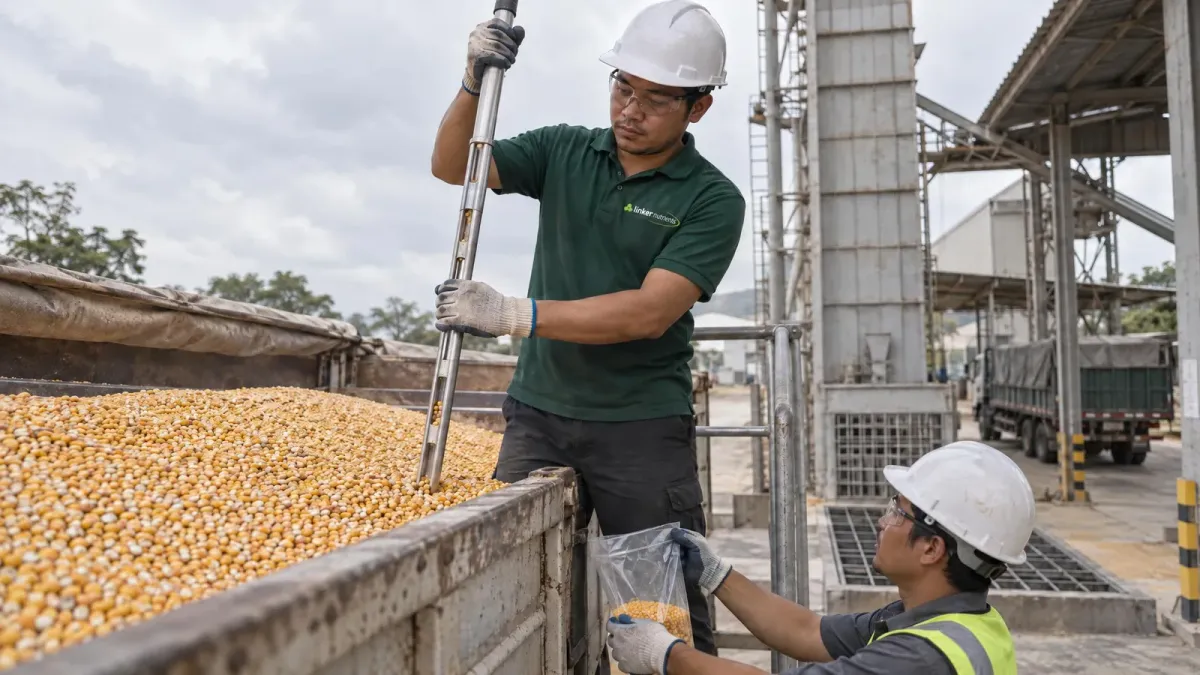
- Sample.Mycotoxins sit in hot spots: a few heavily loaded kernels in a sound mass. One grab from the surface tells you nothing. Take many increments from the lot while it moves, at unloading or where a conveyor drops, combine them, grind, then divide. That is the whole craft of sampling a lot.
- Screen at intake.Test strips and ELISA kits answer on one toxin within minutes: enough to accept, set aside or reject a truck.
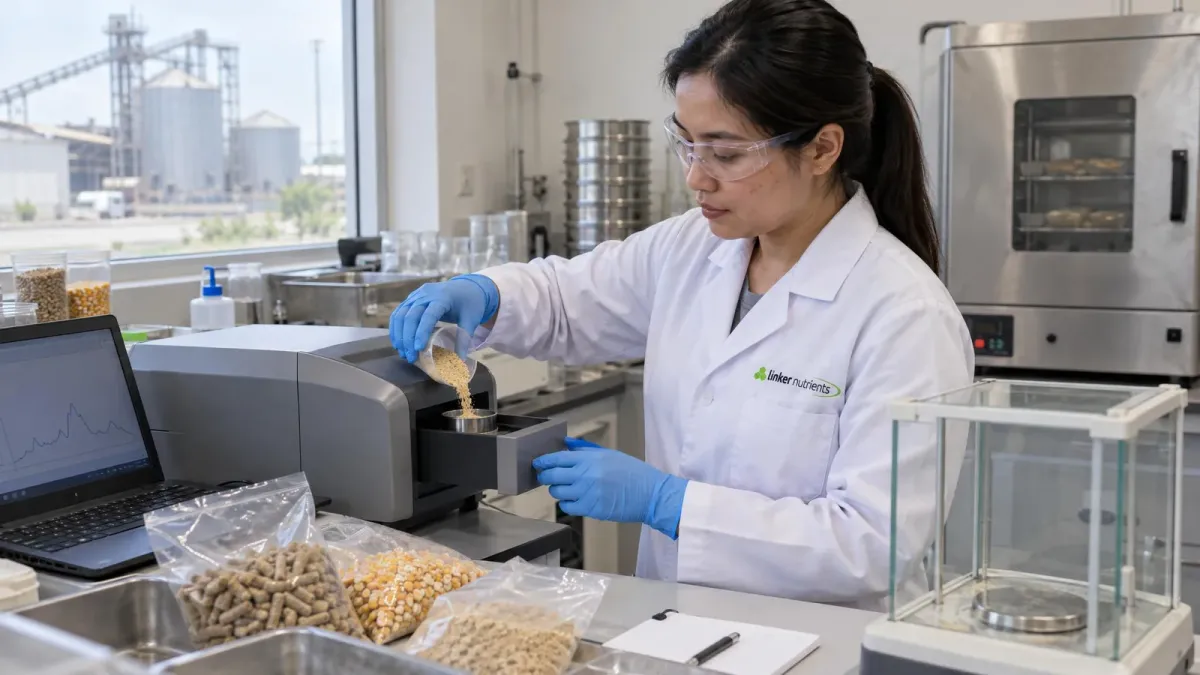
- Confirm in the laboratory.Chromatography, HPLC or LC-MS/MS, gives the exact level and, in a single analysis, the full profile of the lot.
- Read the result.Check the unit, the toxin measured (B1 alone, or total aflatoxins) and the moisture basis of the result, then compare with the right limit: the regulatory values of the destination country, the customer’s specification, your internal limit.
What most often distorts the reading
- Units
- 1 mg/kg (ppm) equals 1,000 µg/kg (ppb). Aflatoxin is read in ppb, DON often in ppm: an error by a factor of one thousand is the classic trap.
- The UV lamp
- Maize that glows under black light shows that Aspergillus has been there, not an aflatoxin level: it is a screen, not a measurement.
- What was not looked for
- An analysis finds only the toxins requested. A lot that is fine for aflatoxin can be loaded with DON or fumonisins.
- The date
- A result at intake no longer holds for a lot that has spent weeks in a hot, humid bin.
Mycotoxin risk management: the levers, in order
Test first, preserve next, bind last. None of the three replaces the other two.
No product
Management first
At the mill as on the farm: what is settled before any additive.
Buy and receive on analysis
A control plan by raw material, by origin and by harvest; a rapid test at intake for lots at risk; a written rule to accept, set aside or reject.
Clean and dry
Dust, broken kernels and hulls concentrate the toxins: cleaning the grain removes part of them. Fast drying after harvest stops moulds before they settle in.
Store dry, cool and not for long
Clean, ventilated bins with no condensation; first in, first out. On the farm, a silo emptied and cleaned between two deliveries, and hoppers free of crusts.
Allocate the lots
Below the limits, the most loaded lots go to the least sensitive species and stages, never to young animals or breeding stock. Above the limits, a lot is not diluted: it is set aside.
Feed Solutions
Through the feed
Two additives, two jobs: one acts on the moulds in the feed, the other on toxins already formed.
Keep moulds from growing in storage
A mould inhibitor holds back moulds and yeasts in the raw material and in the feed while they wait. Its rate follows moisture, water activity and the time to cover. It does not remove a toxin that has already formed.
Bind in the feed what is already there
A mycotoxin binder is a clay added at the mixer: its surface holds part of the toxins during digestion, and what is bound leaves the animal with it. Each toxin is its own case: aflatoxin B1 binds very well, Fusarium toxins less well, DON very little.
Set the grade and the rate on the analysis
The contamination profile, the species, the stage and the length of exposure decide the grade and the rate: neither a blind precautionary dose, nor a saving that leaves the additive useless.
To size up the risk in your raw materials: Mycoscope, assessment tool available to our customers, on request.
Evidence
What trials and publications show
Measured results can be read on the page of each platform, once published, with their conditions: Linkamold and Linkafix. The references of the publications cited are in the sources; details are available on request.
The Linker platforms involved
Two Feed Solutions platforms, two jobs that do not replace each other. Each has its own page: grades, use, documents.
| Platform | When |
|---|---|
linkamoldMould inhibitor · feedLaboratory testIn inoculated feed stored for 90 days at 25 °C, the inoculated moulds were brought down to non-detectable levels, while the control exceeded 10⁸ CFU/g.ConditionsLaboratory test on mash feed, closed jars; two doses, 1.5 and 3 kg/t; counts at 60 and 90 days. | At intake of a wet raw material, or at the mixer |
linkafixMycotoxin binder · feedLaboratory testWith all six mycotoxins in the same solution, Linkafix Advance AC retains 51.9% of DON, against 7.3% for Linkafix Advance alone in the same series.ConditionsIn vitro test: adsorption at pH 3, then desorption at pH 6.5; aflatoxin B1 at 4,000 ppb, zearalenone, T-2, fumonisin and ochratoxin A at 500 ppb, DON at 1,000 ppb, all together. | At the mixer, in the compound feed or through the premix, with the grade chosen on the analysis |
The rate is on each platform’s page when it is published; otherwise ask for it, with your analysis results, the species and the stage. The difference between the two tools is set out in mould inhibitor or mycotoxin binder.
Sources
- Mycotoxins (external site)European Food Safety Authority (EFSA) · topic page · accessed
- Les mycotoxines (external site)Anses (French food safety agency) · page updated on 24 January 2013, in French · accessed
- Mycotoxins (external site)World Health Organization · fact sheet, 2 October 2023 · accessed
- Opinion of the Scientific Panel on contaminants in the food chain related to Aflatoxin B1 as undesirable substance in animal feed (external site)EFSA · EFSA Journal 2004, 2(3), 39 · accessed
- Risks to human and animal health related to the presence of deoxynivalenol and its acetylated and modified forms in food and feed (external site)EFSA · EFSA Journal 2017, 15(9), e04718 · accessed
- Risks for animal health related to the presence of zearalenone and its modified forms in feed (external site)EFSA · EFSA Journal 2017, 15(7), e04851 · accessed
- Risks for animal health related to the presence of fumonisins, their modified forms and hidden forms in feed (external site)EFSA · EFSA Journal 2018, 16(5), e05242 · accessed
- Risks for animal health related to the presence of ochratoxin A (OTA) in feed (external site)EFSA · EFSA Journal 2023, 21(11), e08375 · accessed
- Scientific Opinion on the risks for animal and public health related to the presence of T-2 and HT-2 toxin in food and feed (external site)EFSA · EFSA Journal 2011, 9(12), 2481 · accessed
- Undesirable substances in animal feed (external site)European Commission · information page: maximum levels and recommendations on mycotoxins · accessed
- Water availability and calcium propionate affect fungal population and aflatoxins production in broiler finisher feed during storage (external site)Food Additives & Contaminants: Part A · Alam et al., 2014, 31(11), 1896-1903 · accessed
- The efficacy of mycotoxin binders to control mycotoxins in feeds and the potential risk of interactions with nutrient: a review (external site)Journal of Animal Science · Kihal et al., 2022, 100(11), skac328 · accessed
This page explains; it does not replace your veterinarian’s advice or a reading of the regulations of the destination country.
Frequently asked questions
What is the difference between a mycotoxin and an aflatoxin?
Aflatoxins are one family of mycotoxins among others: those produced by Aspergillus flavus and Aspergillus parasiticus. Every aflatoxin is a mycotoxin; the reverse is not true. DON (vomitoxin), zearalenone, fumonisins, ochratoxin A and T-2 and HT-2 toxins are other mycotoxins, produced by other moulds.
Can you see or smell mycotoxin contamination?
No. Mycotoxins have no colour and no smell, and the mould that produced them may be gone. A clean-looking lot can be loaded; a mouldy lot may contain none of the toxins tested. Only an analysis answers, on a properly taken sample.
Does pelleting destroy mycotoxins?
No: they are heat-stable, and neither steam nor the pellet press destroys them. See field or storage.
What is aflatoxin M1?
The form in which a cow passes into her milk part of the aflatoxin B1 she has eaten: see aflatoxins.
Which signs point to mycotoxins on a farm?
Signs that are not specific: feed eaten less or refused, growth that slows with no visible cause, swollen vulvas in young gilts, mouth lesions in poultry, less regular reproduction. None of them is enough to conclude. Diagnosis belongs to the veterinarian, and is confirmed by analysing the feed and the raw materials that were being fed at the time.
What should be done with a lot above the limit?
Set it aside, have the result confirmed by a laboratory, and inform the seller. Depending on the toxin, the level and the country’s regulations, it is redirected to a less sensitive species or set aside for good. A lot above a maximum level is not blended with a sound lot to bring it under the limit.
Does a mould inhibitor act on mycotoxins?
No. It holds back moulds in the feed during storage; it does not remove a toxin that formed in the field or before intake. That is the job of a mycotoxin binder, such as Linkafix.
Does a mycotoxin binder bind every toxin?
No. Clays bind aflatoxin B1 very well, Fusarium toxins less well, and DON very little. No binder binds everything: the grade is chosen on the contamination profile of the lot, and it does not replace analysis or the sorting of raw materials.
Send us your analyses
You run quality or formulation
Toxins measured, levels, raw materials, species and stage: we read your results with you and tell you what belongs to sorting, to preservation or to a binder.
Have your raw-material analyses read →Request the Linkafix data sheet →You store for a long time, or in a humid climate
Moisture, water activity, storage time, climate: let us talk about preserving your raw materials and your feed.
Talk about feed preservation →Or directly: +33 2 30 91 59 15 · contact@linkernutrients.com