
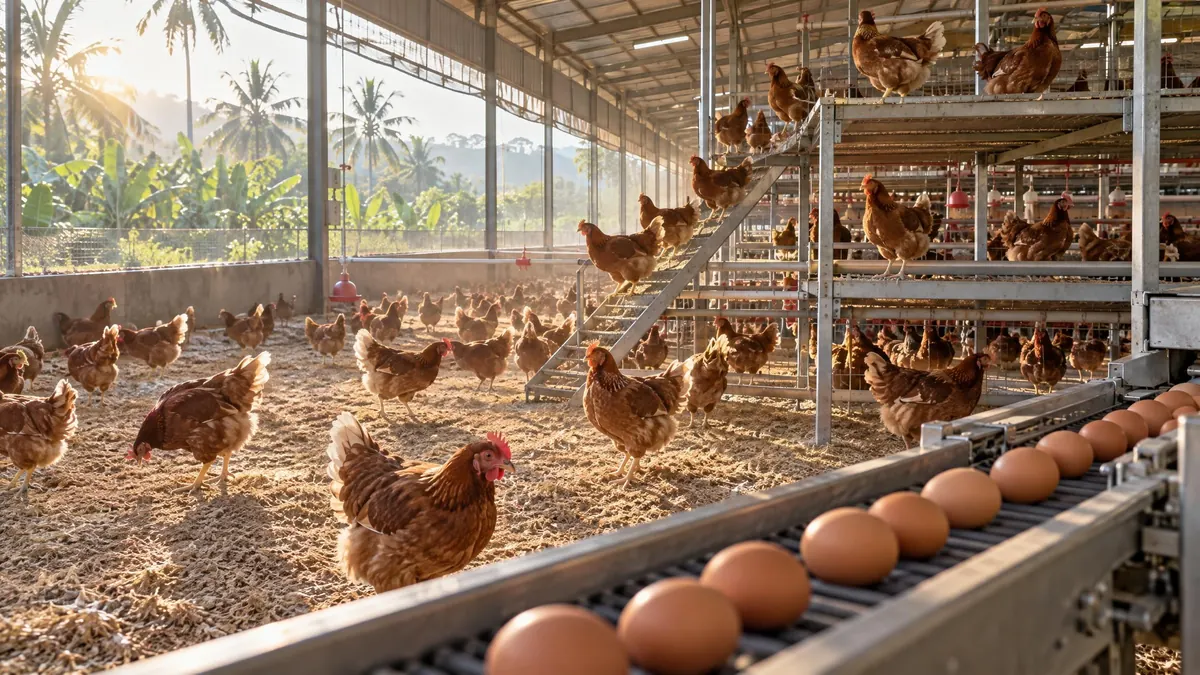
Eggshell quality from peak to late lay: what changes and what you can adjust
How the hen builds her shell, why it thins in late lay, and the levers in order: the ration, management, then drinking water.
In short
Eggshell quality is the ability of a hen’s eggshell to stay intact from laying to the consumer: thick and strong enough to get through collection, grading and transport. It shows at the packing station, in the share of cracked, broken or downgraded eggs. It tends to fall as the hen ages, above all in late lay, and depends on calcium, phosphorus, vitamin D, the timing of supply and heat.
- Birds
- Laying hens and breeders
- Period
- From peak lay to depopulation; late lay above all
- What is measured
- Cracked, broken or downgraded eggs, week by week
- First lever
- The ration and management: evening calcium, light, heat
- Through water
- Short supplies, at peak and in late lay
The problem
Thin egg shells in late lay: what changes in the hen
The shell is formed in the shell gland, the last part of the oviduct, where the egg stays for about 19 hours. Most of the calcification happens at night, when the hen is no longer eating. Each egg takes 2.2 g of calcium on average.
About two thirds of that calcium can come straight from the ration. What the hen eats late in the day partly stays in her crop overnight. When the gut has no more calcium to give, she draws on her medullary bone, a reserve built up at the start of lay and topped up from the day’s feed.
Two nutrients govern this circuit. Vitamin D, in its active form, controls how much calcium the gut absorbs; the vitamin D3 in the ration first has to be converted by the liver before it can be used. Phosphorus shares the bone with calcium, but too much of it in the ration harms the shell: balance is what counts.
With age, everything gets tighter. Eggs keep getting bigger while shell quality tends to decline, and the hen mobilises her calcium less well. Adding more calcium to the ration does not stop that decline: the guides focus instead on the form of the calcium and the time of day it is eaten.
Heat adds to it. The hen eats less, and by panting she breathes off the carbon dioxide that the shell’s carbonate is made from: see heat stress.
Fragile shells, thin egg shells, soft-shelled eggs: a single case does not mean the same as a run of them. When a whole flock lays soft, rough or misshapen shells and production drops at the same time, the health of the flock comes first: that is a matter for the veterinarian before it is a matter of ration or product.
The benchmarks
Calcium, light, appetite: the published benchmarks for laying hens
Values taken from a scientific review and from two breeding companies’ guides, listed at the bottom of the page. They vary with the breed, the ration and the climate: your own breed guide has the last word.
| Benchmark | Published value | What to do with it |
|---|---|---|
| Calcium laid down in one shell | 2.2 g per egg on average | An everyday requirement: the calcium level for each phase is set with the nutritionist and the breed guide. |
| Shell formation | About 19 hours in the shell gland, mostly at night | When calcium is supplied matters as much as how much: it has to be there during the night. |
| Where shell calcium comes from | About two thirds from the ration; the rest from medullary bone | The more the ration covers the night, the less the hen draws on her bone reserve. |
| Appetite for calcium | Strongest in the last 5 to 6 hours of daylight, a few hours before lights-out | Feed and limestone available in the afternoon and evening. One guide advises emptying the feeders for 1 to 1.5 hours in the middle of the day to boost afternoon intake. |
| Limestone particle size | 1.5 to 4 mm for coarse limestone fed in the afternoon or evening; in another guide, between 65% coarse and 35% fine, and half and half | A sieved sample of each limestone delivery: the stated particle size can be checked, delivery after delivery. |
| Midnight lighting | No more than 2 hours, switched on 3 hours after evening lights-out | Hens eat again while the shell is forming. To fit with the breed’s lighting programme. |
| Phosphorus in the ration | Too much harms shell quality | The calcium to phosphorus ratio is worked out on the whole ration, with the nutritionist. |
A breeding company’s guide gives values for its own breed; another guide may give others. This table replaces neither that guide nor your nutritionist’s advice.
The laying curve
Peak production, persistency of lay, late lay: which benchmarks to follow?
Peak egg production comes early in the life of the flock; after that, the laying rate comes down slowly. Persistency of lay is the flock’s ability to stay close to its breed curve for as long as possible.
Today, falling egg numbers combined with deteriorating shell quality are the main reasons for replacing a flock, at around 72 weeks. The stated aim is to stretch laying cycles to 90 to 100 weeks: late lay gets longer, and eggshell quality becomes a concern for the whole second half of the cycle.
What to track every week, on one flock record:
- Laying rate, against the breed guide’s curve at the same age.
- Average egg weight: it keeps rising with age, and the shell has to keep up.
- Cracked, broken and downgraded eggs, recorded at the packing station as a share of eggs collected.
- Feed and water intake: a drop often comes before everything else, especially in hot weather.
- Flock events: a feed change, a heatwave, a vaccination. They often explain a week that slips.
What cracked and downgraded eggs cost
Nothing dramatic on any given day: downgrade points that add up, week after week, in late lay.
The broken egg
Broken in the cage, on the belt or at grading, it cannot be sold. Everything it cost in feed, water and housing is lost.
The cracked or downgraded egg
It drops out of the best-paid grade: sold for less, or sent to another outlet, depending on the market.
The eggs it soils
An egg that breaks on the belt or in the pack soils its neighbours, which are downgraded in turn.
Grading and handling
Every cracked egg is one more egg to spot and take off the line: extra grading time at every collection.
The flock replaced early
When the shell no longer holds, the flock is replaced before production would call for it: the last weeks of the cycle are lost.
No figure here: the loss depends on flock age, the market and the sales channel. It shows in your packing-station records, and one downgrade point less translates directly into eggs sold.
How to improve egg shell quality: the levers, in order
The ration and management first: no supply through the water makes up for calcium that is missing at night. Drinking water comes next, in short supplies, when demand outruns what the hen eats.
No product
Management first
Settings decided with the nutritionist and the breed guide, before any supplement.
Evening calcium
Coarse limestone fed in the afternoon and evening, when the appetite for calcium is strongest: it stays available through the night while the shell forms, and the hen draws less on her bone.
A checked particle size
A mix of coarse and fine particles, in the proportion your breed guide gives. A sample of the delivered limestone is sieved from time to time, to check the stated size.
A balanced formula
Calcium, phosphorus and vitamin D are worked out together, phase by phase. Too much phosphorus harms the shell, and extra calcium on its own does not make up for age.
Light
The breed’s lighting programme, kept as written. A short midnight lighting period lets hens eat again while the shell is forming: it is decided with that programme.
Heat
Ventilation, cool water at all times, feed given in the cool hours: summer management comes first, and it is prepared before the season.
Measure every week
Laying rate, egg weight, cracked and downgraded eggs: the flock record tells you when the shell starts to slip, and so when to act.
Farm Solutions
Through the drinking water
Water can be adjusted within hours, on the one flock that needs it, without changing the formula: it is the route for short supplies.
Calcium and vitamin D, at peak and in late lay
At peak lay, calcium demand is at its highest; in late lay, the older hen mobilises her reserves less well. Calcium in a soluble form and vitamin D in a form that has already passed the liver step then come through the water, in supplies of a few days repeated according to the laying curve and the downgrade rate. Stronger shells, steadier lay: that is the promise of Linkamax HD.
Phosphorus and calcium, in the right ratio
Phosphorus and calcium in a set ratio, with magnesium and trace minerals, so as not to upset what the ration already provides. For bone as for shell, balance is what counts, not the amount of a single mineral.
Vitamins and amino acids, at peak
At peak lay, the hen deposits part of her vitamins in the egg every day. Vitamins, amino acids and electrolytes go through the water for a few days; in hot weather too, when she eats less.
Never in the same water as a live vaccine: flush the line, vaccinate, then resume. Two products go through the water together only once their compatibility has been checked; when in doubt, separate them in time.
Where each Linker platform fits
None of them replaces the calcium in the ration: they come on top of management that is already in place. Each has its own page: form, use, documents.
| Platform | When |
|---|---|
| linkamax HDCalcium for the eggshell · drinking water | At peak lay, then in late lay, in supplies of a few days repeated according to the curve and the downgrade rate |
| linkaphosPhosphorus and calcium · drinking water | In the first week of lay, then at peak and in the last month of lay |
| linkastimVitamins, amino acids and electrolytes · drinking water | At peak lay, and around a heatwave |
The rate is on each platform’s page when it is published; otherwise ask for it, with flock age, laying curve and downgrade rate. Calcium and vitamin D through the water are covered on the Linkamax HD page; all supplies for laying hens, under drinking water.
Sources
- Increasing persistency in lay and stabilising egg quality in longer laying cycles. What are the challenges? (external site)British Poultry Science · M. M. Bain, Y. Nys and I. C. Dunn, 2016, vol. 57 (3), pp. 330-338; open-access review · accessed
- Factors Affecting Egg Internal Quality and Egg Shell Quality in Laying Hens (external site)The Journal of Poultry Science · J. R. Roberts, 2004, vol. 41 (3), pp. 161-177; review · accessed
- Optimal Calcium Supply of Laying Hens (external site)Lohmann Breeders, Poultry News · H.-H. Thiele et al., issue 2015/1; breeding company guide · accessed
- Optimal Egg Shell Quality: Nutrition Essentials (external site)Hendrix Genetics · P. Grignon Dumoulin, 1 October 2016; breeding company guide · accessed
Sources checked on .
General physiology and management benchmarks, quoted with their source. They replace neither your breed guide, nor your nutritionist’s advice, nor your veterinarian’s opinion.
Frequently asked questions
Thin egg shells in laying hens: what causes them?
Mostly age: as the hen gets older, her eggs get bigger and she mobilises calcium less well. Evening calcium, heat and the health of the flock add to it; the detail is in what changes in the hen.
How to improve egg shell quality in layers?
Start with the ration and management: coarse limestone in the afternoon and evening, a checked particle size, a balanced formula, the lighting programme and heat control. Drinking water comes after, in short targeted supplies: the levers, in order.
Soft-shelled eggs: should you worry?
Not for the odd egg. A run of them across a whole flock, especially if production drops at the same time, should be looked at first with the veterinarian, then with the nutritionist.
When does a laying hen reach the end of lay?
There is no fixed age: it depends on the breed, the flock’s curve and the farmer’s choice. Flocks are often replaced at around 72 weeks, and the trend is towards longer cycles: see the benchmarks to follow.
Liquid calcium for hens, or calcium in the feed?
They do different jobs: feed covers the everyday requirement, while water brings a targeted supply over a few days, at peak and in late lay, without changing the formula. That is the role of Linkamax HD.
Can calcium in the water replace evening limestone?
No. The ration carries most of the calcium, and the coarse limestone eaten late in the day is what supplies it overnight. Water adds to it; it does not replace it.
Why does vitamin D3 matter for eggshell quality?
Because its active form governs how calcium gets in through the gut. It first passes through the liver, where it is converted: Linkamax HD supplies vitamin D in the form that comes out of that step, through the water.
Does heat damage the eggshell?
Yes: the hen eats less, and panting makes her lose part of what the shell is built from. What to adjust before and during a heatwave is explained under heat stress.
Can a water supplement be given on a vaccination day?
No: never in the same water as a live vaccine. Flush the line, vaccinate as your veterinarian instructs, then resume. The rule applies to the whole range.
Prepare for late lay
You keep laying hens
Tell us the breed, flock age, laying curve, downgrade rate, ration and water: a technician proposes a programme of supplies for peak and late lay, with rates and what must not run at the same time.
Prepare for late lay →Request the Linkamax HD data sheet →You supervise farms
Technician, veterinarian, integrator or distributor: tell us your country and your species, and we tell you where to find our products.
Where to find our products →Or directly: +33 2 30 91 59 15 · contact@linkernutrients.com
Further reading
- From start of lay to late lay →
Drinking water supplies, moment by moment.
- Heat stress →
When heat weighs on feed intake, and on the shell.
- Layer chicks →
What changes at brooding, long before the start of lay.