
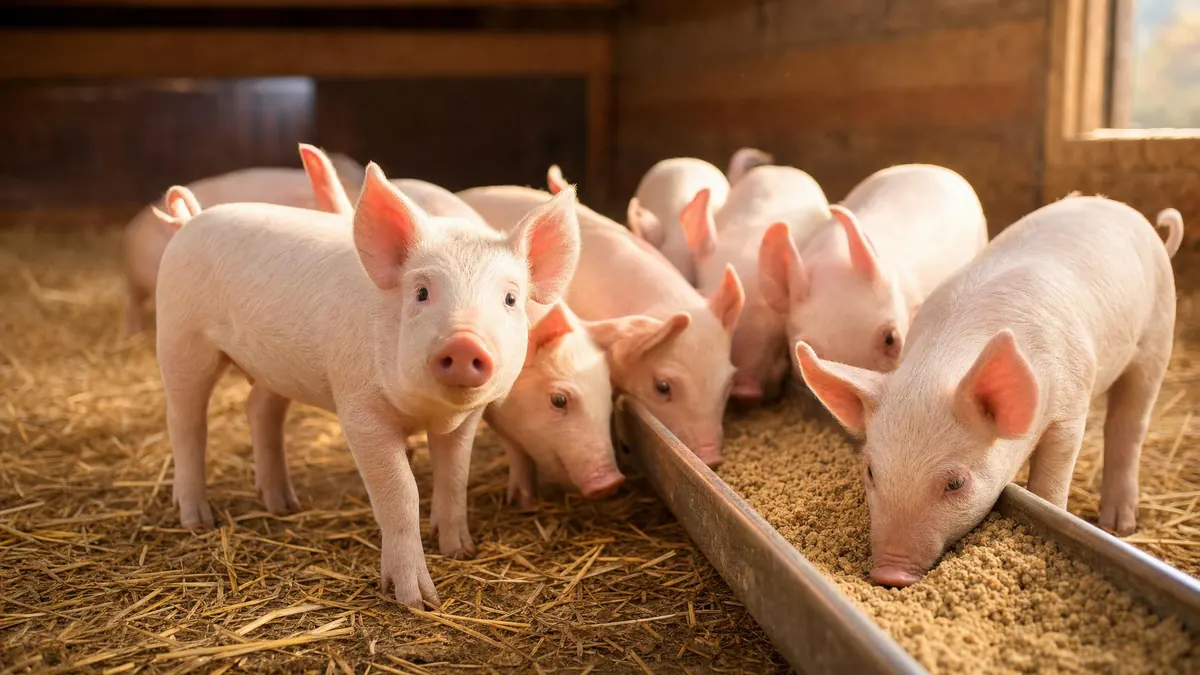
Piglet weaning: what changes at weaning, and what feed and water can do
What happens at weaning, what to adjust and in what order (management, feed, drinking water), and how to choose.
In short
Piglet weaning is the moment a piglet leaves the sow and her milk for dry feed, in a new pen and a new group. Its stomach does not yet acidify well and its enzymes are set for milk: it eats little for a few days, digests protein poorly, and its gut lining suffers. It is the most fragile period in pig production; it is prepared through management, feed and drinking water.
- Period
- Entry to the nursery and the two weeks that follow
- Signs
- Low feed intake, hollow-flanked piglets, uneven pens, loose faeces
- What is at stake
- Stomach acidity, protein digestion, the gut lining
- First lever
- Management: temperature, water, access to the feeder, hygiene
The problem
What changes at weaning, within a few days
Four changes arrive on the same day. None of them is a disease: this is what is called weaning stress, the physiology of a young animal moving from milk to dry feed.
- The milk stops.Warm, liquid, drunk every hour: the sow’s milk is gone overnight. Dry feed becomes the only food, water has to be drunk separately, and many piglets eat very little in the first days.
- The stomach acidifies poorly.Under the sow, the lactose in milk, fermented into lactic acid, did part of the work. On its own, the stomach still makes little acid, and the feed asks for a lot: pH rises, and pepsin digests protein poorly.
- Protein gets through.What the stomach has not digested reaches the intestine, where it feeds a flora you do not want to see settle in.
- The gut lining takes the hit.Starved, then loaded all at once, it loses part of its absorptive surface, just as the flora reorganises.
What widens the gap from one batch to the next
- Age and weight
- The younger and lighter the piglet, the less ready its stomach is.
- Cold
- A cold piglet eats less and digests less well.
- Water
- A piglet that cannot find water does not eat.
- Feed
- Too rich in protein or too buffered, it asks for more acid than the stomach makes.
Gut health
Post-weaning diarrhoea: why this window, and whose job it is
Can weaning cause diarrhoea? Yes, through the chain described above: a stomach that acidifies poorly, undigested protein in the intestine, a weakened gut lining, a flora that reorganises. Post-weaning diarrhoea in piglets (post weaning diarrhea, or PWD) appears most often in the two weeks after entry to the pen.
Several factors favour it without being the single cause: early weaning or light piglets, a cold room or draughts, water that is hard to reach, a feed too rich in protein or too buffered, an abrupt feed change, pens poorly cleaned between batches.
It is a disease: its diagnosis, the search for its cause and its care belong to the veterinarian. Linker products are additives and supplements for feed and drinking water, used within a farm’s programme. What the farm and the feed mill control are the conditions of weaning: that is what the rest of this page is about.
What the weaning dip costs
Four items that are rarely counted together.
Days lost
A piglet that loses weight in the first week leaves later or lighter: the delay is still there at the end of finishing.
A batch that spreads out
The lightest fall behind most. An uneven pen complicates feeding, sorting and sale.
Labour and care
Pens to watch closely, animals to isolate, extra visits and prescriptions.
The most expensive feed, poorly used
Creep and starter feed is the most expensive feed in a pig’s life. Poorly eaten or poorly digested, it is paid for twice.
No figures here: the loss depends on weaning age and weight, the building and the health status of the farm. It is measured on your own batches, pen by pen.
Piglet weaning: the levers, in order
Management comes before any additive. Feed deals with what happens in the feeder and in the stomach; water stays open when the piglet eats little.
No product
Management first
No additive makes up for a cold room or water the piglet cannot find.
A warm, dry, draught-free room
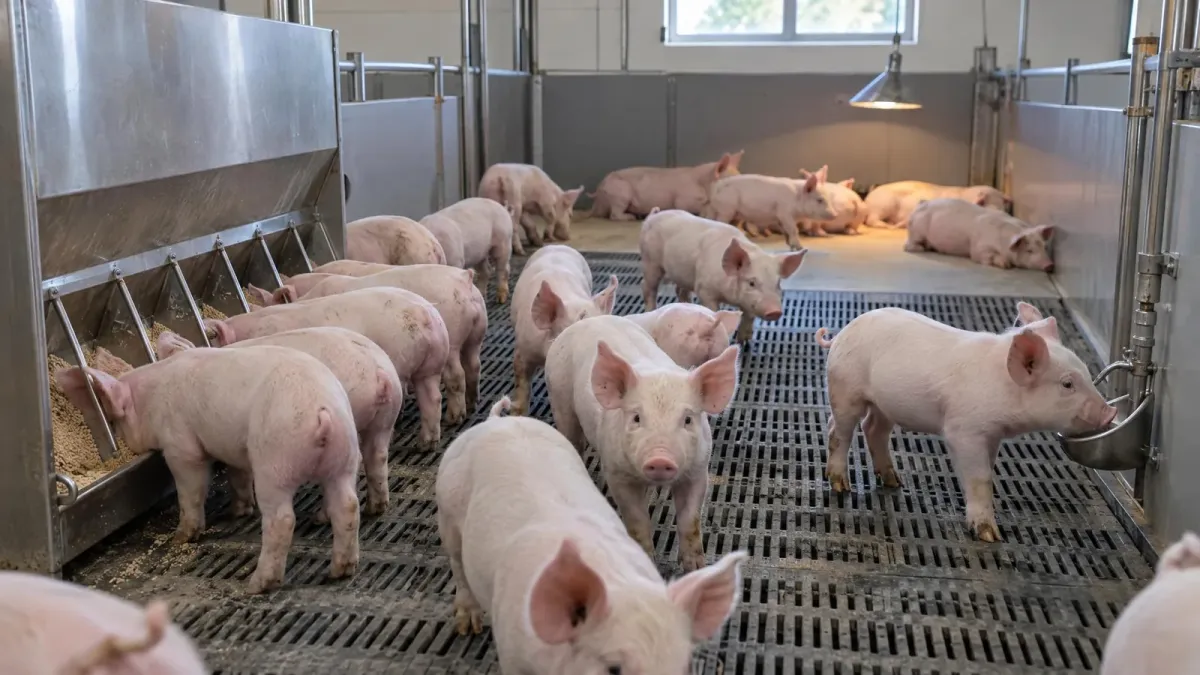
Room washed, dried and pre-heated before entry; temperature read at piglet level, on the first day above all.
Water found within the first hour
Drinkers at the right height, flow checked, an extra visible water point for the first days.
A feed it already knows
Creep feed offered under the sow teaches the piglet to eat dry feed. After weaning: small fresh amounts, often.
Even groups, a slow transition
Sort by weight, do not overstock pens, change feed over several days.
Feed Solutions
Through the feed
A feed that gets eaten
A milky profile takes over from sow’s milk, and the same note from one feed to the next avoids a second dip. Sweet taste belongs with flavours and sweeteners.
A stomach that acidifies
First a feed with low buffering capacity, then an acidifier dosed on it: this is the pH pepsin needs. In pigs, benzoic acid stays in its active form at stomach pH.
Less undigested protein
Digestible proteins, at a level suited to the piglet’s age and balanced with amino acids. A formulation setting, with no product.
Energy for the gut lining
Butyric acid is an energy source for the cells of the gut lining. A salt releases it early, a coated salt further on, tributyrin in the small intestine.
A flora that reorganises
Monoglycerides whose action does not depend on pH, lactic acid bacteria, inactivated or live, tannins that bind to proteins: to choose from, not to stack.
Farm Solutions
Through the drinking water
A piglet that eats little keeps drinking: water is decided in the morning, for one room, for a few days.
Water at the right pH
Acidified water, set on the alkalinity of the farm’s water and checked at the last drinker.
What the feed no longer supplies
When feed intake drops, vitamins, amino acids and electrolytes go through the water, for a few days.
A digestive tract that adapts
An inactivated yeast and acids, in short, repeated courses.
A clean line, a checked pump
Lines cleaned between batches, dosing pump checked, and never in the same water as a live vaccine.
How to choose
Nine platforms through the feed, three through the water: which one for which question?
They do not work in the same place and do not simply add up. The table says where each one works and when it has its place; each has its own page.
| Platform | Where it works | When |
|---|---|---|
| linkastyFlavours · feed | At the nose, before the first mouthful | Always first, on a well-formulated, well-stored feed, with the same note from one feed to the next |
linkacidAcidifier · feedLaboratory testLaboratory measurement: 100 g of Linkacid Premium LP deliver 380 mmol of acidifying capacity at pH 4, a figure used to set the rate against the feed’s buffering capacity.Conditions100 g of product in 200 mL of water at 37 °C, titration with sodium hydroxide; measured in 2022. | In the feed and in the stomach | A starter feed rich in protein and minerals, heavily buffered |
linkazoicBenzoic acid · feedTrial on the productStudy published in 2024 in weaned piglets: with coated benzoic acid, dry matter digestibility rose from 88.2% to 90.5%.Conditions32 piglets in individual cages, 21 days; trial rate of 3 kg/t, above the use rate of the grade. | In the stomach; further on in its coated form | Pig feeds only, from creep feed to finishing |
linkaselButyrate · feedTrial on the productIn a broiler trial (42 days), Linkasel’s coated calcium butyrate improved feed conversion from 1.83 to 1.76.Conditions2 groups of 6 replicates, 150 birds per group; 1.2 then 0.6 then 0.3 kg/t depending on the phase. | Stomach and upper intestine for a plain salt; further on for a coated salt | When the gut lining is the priority |
linkatribTributyrin · feedPublication on the ingredientIn post-peak laying hens, a published university study reports a 3.1% thicker eggshell with tributyrin at 500 g/t.Conditions384 hens, 8 replicates of 24 per group, 16 weeks; significant difference (P = 0.01). | In the small intestine, where lipase releases the butyrate | Butyrate further on, without a coating, in a pelleted feed |
linkalphaMonoglycerides · feedPublication on the ingredientIn vitro, monolaurin is four times more active than free lauric acid on a Gram-positive bacterial strain (2009 publication).ConditionsInhibitory concentrations measured in culture, on pure monolaurin and lauric acid. | In contact with the flora, whatever the pH | Alongside an acidifier, where pH limits the acids |
linkabiomePostbiotic · feedPartner dataIn broilers, from day 7 to day 49, at 1 kg/t: weight gain 10.7% above the control (university trial).ConditionsTwo diets compared; significant difference (P < 0.01); no effect in the first week. | In contact with the gut lining and the flora | When the feed is pelleted |
| linkafloreProbiotic · feed | In contact with the gut lining and the flora | When your process allows a live probiotic |
linkatanTannins · feedTrial on the productOn farm, in 200 weaned piglets followed for 32 days at 1.5 kg/t: +34 g of daily gain versus the control.ConditionsTwo diets, 5 pens of 20 piglets each; P = 0.05. | In the intestine, where tannins bind to proteins | Over a short, sensitive phase, at a measured rate that keeps the feed palatable |
| linkacid Prime LWater acidifier · drinking water | In the water line, room by room | Continuously, nursery room |
| linkastimVitamins, amino acids and electrolytes · drinking water | In the water line, room by room | The days when the piglet drinks but eats little, alongside creep and starter feed |
| linkamuneInactivated yeast and acids · drinking water | In the water line, room by room | Short, repeated courses |
Where to start? With what the piglet eats and drinks, then with stomach acidity; the gut lining and the flora come next. Two or three well-set levers are worth more than six stacked together: we look at your formula, and also tell you which one to stop. Butyrate or tributyrin: the comparison is made criterion by criterion in tributyrin vs sodium butyrate. The rate is on each platform’s page when it is published; otherwise ask for it, with weaning age, the formula and the goal. For sweet taste: Linkasweet.
Feed
Creep feed and starter feed: what should they bring at weaning?
The feed a piglet gets around weaning is not a small grower feed. It has three jobs: teach the piglet to eat dry feed, bring nutrients an immature stomach can digest, and not overload that stomach.
Names change from one mill to the next; the logic stays. Creep feed teaches the piglet to eat before weaning; starter feed, the first weaner diet, covers weaning and the weeks that follow; the second-stage weaner feed takes over once intake has picked up. A creep or weaner feed formula, its ingredients and inclusion rates, is not published as a recipe: it is built on your raw materials and on weaning age and weight.
- Palatable and recognisable. Fresh raw materials, a milky profile, the same note as the feed that follows.
- Digestible. Dairy products and processed proteins rather than too much oilseed meal; a reasoned protein level, balanced with amino acids.
- Low in buffering capacity. Limestone, phosphates and protein sources push the acid-binding capacity up: measure it, bring it down through the formula, then dose the acidifier on it.
- Well presented. Small pellet or crumble, few fines, offered fresh and in small amounts.
- Followed by a transition. The next feed comes in gradually, over several days, without a change of flavour.
Information
Zinc oxide in pig feed: what changed in Europe, and what it means for nursery pigs
For a long time, zinc oxide was given to piglets at pharmacological levels, in the feed of the first two weeks after weaning, on veterinary prescription. It was a very common answer to the diarrhoea of that period.
In the European Union, that use has ended. After a referral by two Member States, the European agency EMA concluded that the benefit did not outweigh the risks for the environment, and noted a risk of co-selection for antimicrobial resistance. The European Commission’s decision is dated 26 June 2017; Member States had up to five years to withdraw the authorisations of these veterinary products, that is, until June 2022.
Zinc itself has not left the diet: it is an essential trace element, supplied at nutritional levels, within the limits set by feed additive rules. Outside Europe, rules differ from one country to the next and keep changing: check them with your veterinarian and the authorities of your country.
What it means: no additive takes, on its own, the place high-dose zinc oxide used to hold, and we do not present any product as its replacement. Weaning without it means reworking weaning as a whole: age and weight, room temperature and hygiene, water, a feed lower in protein and in buffering capacity, slower transitions. The levers on this page fit into that work, each in its place.
Evidence
What research has measured
Measured results can be read on the page of each platform, once published, with their conditions. The references of the publications cited are in the sources; details are available on request.
Sources
- Evaluation of dietary acid-binding capacity level on nursery pig growth performance and fecal dry matter (external site)Journal of Animal Science · Stas et al., 2025, vol. 103, skaf039 · accessed
- Dietary Intervention of Benzoic Acid for Intestinal Health and Growth of Nursery Pigs (external site)Animals · Choi and Kim, 2024, vol. 14 (16), 2394 · accessed
Sources checked on .
The European decision on zinc oxide is cited from the page the European agency EMA devotes to this referral (“Zinc oxide - referral”), read on 7 October 2026.
Frequently asked questions
What is weaning in pigs, and why is it so delicate?
It is the separation of the piglet from the sow: milk stops, dry feed becomes the only food, and pen and group change on the same day. The piglet eats little for a few days, with a stomach that does not yet acidify well. What is lost at that point is rarely made up before slaughter.
Weaning age and weight: what do they change?
The younger and lighter the piglet, the less dry feed it has eaten and the less ready its stomach is: the step up is bigger. Weaning age is a matter of farm management and, depending on the country, of regulation; feed and water adapt to it.
Can weaning cause diarrhoea?
Yes: this is the window for post-weaning diarrhoea, explained in why this window, and whose job it is. It is a disease: its diagnosis and care belong to the veterinarian.
Can an additive replace zinc oxide?
No. No additive takes its place on its own, and we do not present any as such: see what changed in Europe, and what it means.
What about antibiotics?
No feed additive replaces an antibiotic. The levers on this page work on the feed, on the water and on the conditions of digestion; they have their place in programmes that aim at reducing antibiotic use, alongside husbandry, biosecurity and the veterinarian.
Should several levers be combined?
Not as a matter of principle. Their effects do not simply add up, and many weaner feeds already carry three or four additives without anyone knowing which one is working. We start from your formula and from what you see, and tell you which one to start with, and which one to stop.
Review your weaning programme
At the feed mill
Send us your current programme: starter formula, weaning age and weight, what you see. We tell you where it is losing ground, which lever to start with, and which one to stop.
Review your weaner feed →Propose a weaning trial →On the farm
Tell us the room, the water and the period: you receive a drinking-water programme, room by room.
Receive a programme →Or directly: +33 2 30 91 59 15 · contact@linkernutrients.com
Further reading
- Digestion and performance →
Acids, butyrates, monoglycerides, postbiotic, tannins: where each lever works.
- Flavours and sweeteners →
Getting creep feed eaten, and keeping the same note afterwards.
- Drinking water →
Supplements dosed in the water, and what makes a programme work.