
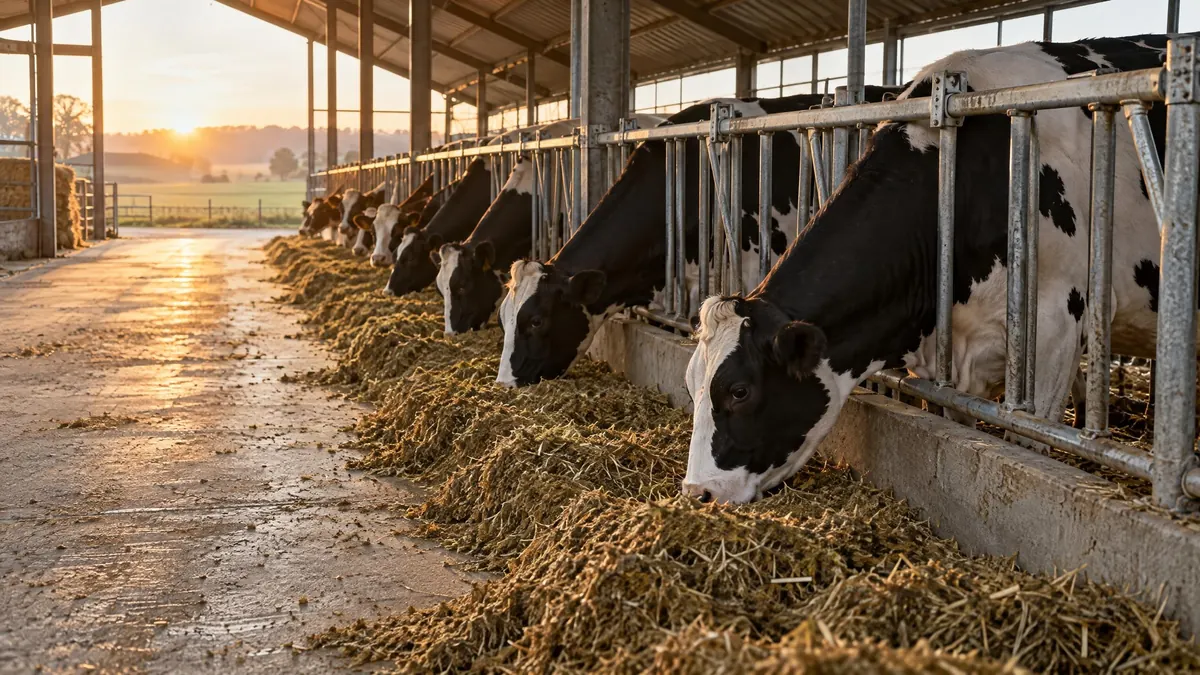
The dairy cow transition period around calving: calcium, energy and intake
What changes around calving, the levers in order, then Linkalci and Linkapatch with their published rates.
In short
The dairy cow transition period runs from three weeks before calving to three weeks after. The cow changes ration, group and metabolism: she eats less just as the udder suddenly demands calcium and energy. It is managed through the close-up diet, comfort and daily checks on fresh cows; an oral supply comes on top for the cows that need it most.
- Period
- From 3 weeks before to 3 weeks after calving
- What rises
- Calcium and energy needs, and milk
- What falls
- Feed intake, mostly in the last week before calving
- First lever
- The close-up diet, space at the feed fence and the bed, water
The problem
Six weeks when everything changes at once
Four changes pile up. None of them is a disease: this is the physiology of a cow moving from pregnancy to lactation.
- She eats less.Over the last three weeks of pregnancy, dry matter intake falls by about a third (32%), and nearly nine tenths of that fall (89%) happens in the last week (Hayirli et al., 2002). A high body condition at dry-off makes it worse.
- Calcium leaves all at once.Ten litres of colostrum carry away about 23 g of calcium in a single milking (Thilsing-Hansen et al., 2002). Intestinal absorption and bone mobilisation take hours, sometimes days, to catch up: blood calcium drops before it recovers.
- Energy runs short.After calving, intake climbs more slowly than milk. The cow draws on her fat reserves, and her liver makes ketone bodies, for which beta-hydroxybutyrate (BHB) is the blood marker.
- Everything else moves.New ration, new group, regrouping, a new place at the feed fence: the cow loses her bearings just when her ration matters most. In hot climates, heat cuts intake further.
What widens the gap from one cow to the next
- Parity
- The older the cow, the more common low blood calcium after calving (table below).
- Body condition
- A fat cow at dry-off eats less before calving and draws harder on her reserves afterwards.
- The close-up diet
- High in potassium (forages) or low in magnesium, it makes calcium regulation less responsive.
- Management
- Overcrowding, repeated group changes, limited access to water or the feed fence.
Calcium
Low blood calcium after calving: more common with age
Share of cows below 2.0 mmol/L of calcium within 48 h of calving, in two large surveys. You cannot see it: you find it by measuring.
| Lactation number | United States | Germany |
|---|---|---|
| 1st lactation | 25% | 5.7% |
| 2nd lactation | 41% | 29.0% |
| 3rd lactation | 49% | 49.4% |
| 4th lactation and over | 42 to 54% | 60.4% |
Surveys by Reinhardt et al. (2011) and Venjakob et al. (2017); thresholds and methods differ, so read the trend rather than the figures line by line. In France, 55% of the cows on 26 farms in the west were below this threshold at 24-48 h (Aubineau et al., 2022). A brief dip on day 1 is part of the adaptation: among multiparous cows, those that corrected it by day 4 produced on average 49.1 kg of milk a day over ten weeks, against 44.6 kg for cows whose calcium never dropped (McArt and Neves, 2020). It is the calcium levels that stay low, or come back on day 4, that go with less milk.
Energy
Energy: a peak between day 3 and day 5
Surveys measure blood BHB; the most common threshold is 1.2 mmol/L. In the United States, 43% of cows tested six times between day 3 and day 16 of lactation went above it at least once, with first positive tests peaking on day 5 (McArt et al., 2012). With a single sample per cow, a survey across several countries in the Americas, Africa, Asia, Oceania and Eastern Europe found 24% on average, from 8 to 40% depending on the country, Thailand and China being among the six countries above 17% (Brunner et al., 2019). On three grazing farms in New Zealand, 76% of cows went above it at least once before day 35, with a peak on day 3 (Hendriks et al., 2025).
These shares do not measure disease: they show how common the energy deficit is. They also show where to look, between day 3 and day 14. Calcium and energy go together: in the United States, cows above 2.0 mmol/L of calcium within 48 h had lower mobilised fatty acids, a sign of a better energy balance (Reinhardt et al., 2011).
What a difficult transition costs
Four items that are rarely counted together.
Lost intake days
Every day a fresh cow eats less than her ration allows, the missing energy comes out of her reserves, and peak milk depends on it.
Time spent on checks
Fresh cows are checked every day: appetite, rumination, temperature, blood or milk tests. When several drop at once, vet visits and labour add up.
A group that spreads out
Older cows, high producers and lame cows get through the transition less easily than heifers. The group becomes harder to manage.
A poorly targeted supply
A supply given to every cow, with no measured gain in milk, costs product and time. That is the reason for the section on targeted oral calcium.
No figure here: the cost depends on the milk price, the herd size and the share of cows affected. It is worked out on your own calvings.
How to manage the dairy cow transition period: the levers, in order
Management and the close-up diet do most of the work. An oral supply comes next, at calving, for the cows that need it most.
No product
Management first
No supplement makes up for a close-up diet that is badly run, or for a cow with no room to eat.
Room to eat and to lie down
Enough space at the feed fence and in the bedding area in close-up and fresh-cow groups; few group changes.
Clean, cool water, from calving on
Enough drinking points, reachable straight after calving.
Body condition under control from dry-off
It is easier to hold before calving than to correct afterwards: a fat cow eats less and draws harder on her reserves.
Shade, air and water in hot climates
High roof, open sides, ventilation, misting: heat adds to the drop in intake at calving.
Fresh cows checked every day
Appetite, rumination, temperature, blood or milk BHB between day 3 and day 14, blood calcium according to the vet’s protocol. A cow that is down is a case for the vet, straight away.
Feed Solutions
Through the feed
The ration is built with the nutritionist or the feed formulator, group by group.
A lower dietary cation-anion difference, over the last three weeks
The DCAD (the French BACA) is lowered with anionic salts, which makes the cow more responsive in regulating calcium. According to a meta-analysis, going from +200 to -100 mEq/kg of dry matter goes with, in multiparous cows, calcium of 1.86 to 2.04 mmol/L at calving, 1.0 kg more intake and 1.7 kg more milk after calving (Santos et al., 2019).
Urine pH, to check that acidification is reached
In 2026, a meta-analysis linked a lower urine pH to higher calcium within 48 h, and recommended moderate acidification, around 6.2 to 6.8 (Pattarajinda et al., 2026). On 26 French farms that fed anionic salts, the average DCAD was still +66 mEq/kg: acidification is measured, not assumed (Aubineau et al., 2022).
Magnesium, and phosphorus without excess
In the same French study, magnesium at 3.5 g/kg of dry matter and above went with fewer low-calcium cows, and high phosphorus with more.
A fresh-cow ration dense in energy
Introduced gradually, so that the rumen keeps up with the rise in intake after calving.
Calcium at calving
Calcium at calving: an oral supply, targeted rather than routine
Calcium at calving can be supplied by mouth over a short window: in cows given 43 g or 86 g of calcium on the day of calving, blood ionised calcium rose for only about 2 h, then under 8 h (Martinez et al., 2016). Hence protocols in several doses, at calving and then in the hours that follow: an oral calcium bolus is given in one go, a calcium drench is a liquid that also supplies energy sources. They come on top of the close-up diet; they do not replace it.
Given to every cow, oral calcium shows no gain in milk. A review of nine studies found no association with production (Valldecabres et al., 2023), and in 2025 a large trial with two boluses of 31 g of calcium changed neither milk nor the blood measures taken (Beiranvand et al., 2025).
The published responses concern targeted cows: third-lactation cows and over, high producers (2.9 kg more milk at the first test for those above 105% of the herd average, Oetzel and Miller, 2012) and lame cows. In first-calf heifers it is not advised as a routine: in a trial of 450 cows, high doses of some salts went with more health problems after calving in first-calf heifers (Martinez et al., 2016).
Benchmarks
Monitoring the transition: three published benchmarks
Values from the literature, to be set with your vet and your nutritionist, not alert thresholds to apply as they stand.
| What to track | When | Published benchmark |
|---|---|---|
| Urine pH | In the last three weeks before calving | About 6.2 to 6.8: moderate acidification (Pattarajinda et al., 2026) |
| Blood calcium | Within 48 h of calving, following the vet’s protocol | 2.0 mmol/L threshold in the large surveys; timing matters as much as the value |
| Blood or milk BHB | Day 3 to day 14 of lactation | 1.2 mmol/L is the most common threshold; first tests above it mostly between day 3 and day 5 |
Hot climates
In hot climates, heat adds to the transition
On 32 small Vietnamese farms, 96% of lactating cows were under moderate to strong heat stress in the afternoon (Bang et al., 2021). A panting cow eats less, and calving already asks her to eat more. Shade, ventilation, misting, cool water on demand, an energy-dense ration: the transition is prepared with the building as much as with the feed fence.
Linkalci and Linkapatch, in their place
Two platforms for the cow around calving, given by mouth, on top of a well-managed transition ration. Each has its own page: form, use, documents.
| Platform | Its role here | Where it works | When |
|---|---|---|---|
| linkalciCalcium at calving · house | Supports the dairy cow’s calcium status around calving. The drench is a liquid that supplies calcium together with energy sources; the bolus supplies calcium (53 g of calcium for 2 boluses). | By mouth: drench in a 500 mL bottle or a 5 or 20 L can; 95 g bolus, in a box of 2 | At the first signs of calving, then in the hours that follow; mainly for third-lactation cows and over and high producers |
| linkapatchClay, yeasts and a bitter plant · house | Supports the return to intake in the fresh cow that eats less: an oral powder based on clay and yeasts. | By mouth, in a 100 g sachet or a 5 kg bucket | Over a few days, not continuously |
Linkalci comes on top of a well-managed transition ration; it does not replace it. When a cow is ill, the diagnosis belongs to the veterinarian. Other supplies for ruminants are in Ruminant solutions.
Published rates
The published rates, and how to read them
Rates taken from our technical data sheets. A technician sets them with you and your vet according to the cow, the moment and your close-up diet.
Neither drench nor bolus for a cow that is down or cannot swallow: risk of inhalation. A cow that is down at calving is a case for the vet. Linkapatch is given for a few days, not continuously.
- Linkalci Bolus: Dairy cow, bolus: 2 boluses (53 g of calcium) at the first signs of calving; cow at risk: 2 more boluses within 24 h
- Linkalci Drench: Cow at risk, drench: 300–500 mL the day before, at calving, then 10 h and 24 h later
- Linkalci Drench: Other cows, drench: 300–500 mL at calving and 10 h later
- Linkapatch: Adult cattle: one 100 g sachet a day, 3 to 5 days, 8 consecutive days at most
- Linkapatch: Adult cattle, change of ration: 100 g a day mixed into the ration, 5 days
Sources
- Biology of dairy cows during the transition period: the final frontier? (external site)Journal of Dairy Science · Drackley, 1999, vol. 82, pp. 2259-2273 · accessed
- Animal and dietary factors affecting feed intake during the prefresh transition period in Holsteins (external site)Journal of Dairy Science · Hayirli et al., 2002, vol. 85, pp. 3430-3443 · accessed
- Milk fever control principles: a review (external site)Acta Veterinaria Scandinavica · Thilsing-Hansen, Jørgensen and Østergaard, 2002, vol. 43, pp. 1-19 · accessed
- Prevalence of subclinical hypocalcemia in dairy herds (external site)The Veterinary Journal · Reinhardt et al., 2011, vol. 188, pp. 122-124 · accessed
- Hypocalcemia: cow-level prevalence and preventive strategies in German dairy herds (external site)Journal of Dairy Science · Venjakob, Borchardt and Heuwieser, 2017, vol. 100, pp. 9258-9266 · accessed
- Acidified diet is not effective in preventing hypocalcemia in dairy cows on French commercial farms (external site)Frontiers in Animal Science · Aubineau, Boudon and Guatteo, 2022, vol. 3, 1027183 · accessed
- Association of transient, persistent, or delayed subclinical hypocalcemia with early lactation disease, removal, and milk yield in Holstein cows (external site)Journal of Dairy Science · McArt and Neves, 2020, vol. 103, pp. 690-701 · accessed
- Epidemiology of subclinical ketosis in early lactation dairy cattle (external site)Journal of Dairy Science · McArt, Nydam and Oetzel, 2012, vol. 95, pp. 5056-5066 · accessed
- Prevalence of subclinical ketosis and production diseases in dairy cows in Central and South America, Africa, Asia, Australia, New Zealand, and Eastern Europe (external site)Translational Animal Science · Brunner et al., 2019, vol. 3, pp. 84-92 · accessed
- Investigating the epidemiology of hyperketonemia in grazing dairy cows in early lactation (external site)Journal of Dairy Science · Hendriks, Roche et al., 2025 · accessed
- Meta-analysis of the effects of prepartum dietary cation-anion difference on performance and health of dairy cows (external site)Journal of Dairy Science · Santos et al., 2019, vol. 102, pp. 2134-2154 · accessed
- Association between prepartum urine pH and blood calcium concentration at calving in Holstein cows: a systematic review and meta-analysis (external site)Animal · Pattarajinda, Nekouei et al., 2026 · accessed
- Effects of oral calcium supplementation on mineral and acid-base status, energy metabolites, and health of postpartum dairy cows (external site)Journal of Dairy Science · Martinez et al., 2016, vol. 99, pp. 8397-8416 · accessed
- Effect of oral calcium bolus supplementation on early-lactation health and milk yield in commercial dairy herds (external site)Journal of Dairy Science · Oetzel and Miller, 2012, vol. 95, pp. 7051-7065 · accessed
- Production and reproduction responses for dairy cattle supplemented with oral calcium bolus after calving: systematic review and meta-analysis (external site)JDS Communications · Valldecabres et al., 2023, vol. 4, pp. 9-13 · accessed
- A randomized controlled trial evaluating postpartum delayed milking strategy and oral calcium bolus administration on production and blood metabolites of Holstein cows (external site)Journal of Dairy Science · Beiranvand, Alamouti et al., 2025 · accessed
- Assessment of performance and some welfare indicators of cows in Vietnamese smallholder dairy farms (external site)Animals · Bang et al., 2021, vol. 11, 674 · accessed
Sources checked on .
Studies on the dairy cow in general: never results for a Linker product. Each figure was re-read in its source (full text, or the full abstract on PubMed for closed-access journals).
Frequently asked questions
What is the transition period of the dairy cow?
The three weeks before and the three weeks after calving: see what changes.
Why does blood calcium fall after calving?
Because the udder takes the calcium of the colostrum faster than the gut and the bone can keep up. A brief dip is part of the adaptation; what matters is that it does not last: blood calcium by lactation number.
Does every cow need oral calcium?
No, according to the studies: responses show up in targeted cows, not in all of them. The detail is in targeted rather than routine.
Oral calcium bolus or drench: which to choose?
The bolus is given in one go; the drench is a liquid that supplies calcium together with energy sources. The choice depends on the farm, the cow and the moment. Either way, never to a cow that is down or cannot swallow: call the vet.
When should Linkalci be given?
At the first signs of calving, then in the hours that follow, depending on the form: the published rates give the detail, and a technician sets the protocol with you and your vet.
What is Linkapatch for around calving?
It supports the fresh cow that eats less, for a few days, not continuously: see the published rates.
What urine pH should we aim for before calving?
A urine pH of about 6.2 to 6.8, according to a 2026 meta-analysis: moderate acidification, to be set with your nutritionist. See the close-up diet.
Review your calvings with us
On the farm
Tell us the herd size, the calving period, your close-up diet and the cows that worry you: a technician proposes the form, the timing and the rate, together with your vet.
Get setup advice →Request the Linkalci technical data sheet →Nutritionist or feed mill
The close-up and fresh-cow rations are set with your formulator: cation-anion balance, magnesium, energy.
Talk to a ruminant specialist →Or directly: +33 2 30 91 59 15 · contact@linkernutrients.com
Further reading
- Ruminant solutions →
All the oral and drinking-water supplies for cattle, sheep and goats.
- Additives for cattle →
From calf to dairy cow: each stage and the platforms involved.
- Mycotoxins in feed →
For a sound ration, from forage to feed fence.