
Broiler brooding: the first seven days that set up the flock
The published benchmarks for the first week, how to check them, and what drinking water and feed can add.
In short
Broiler brooding is the period from chick placement to seven days of age, for a flock of broilers or of pullets. A day-old chick cannot yet regulate its body temperature and has to find water and feed in the first hours: litter warmth, access to water and the way feed is presented decide the weight and uniformity of the flock at seven days.
- Length
- From placement to seven days; heating goes on beyond that
- Birds
- Broilers; layer pullets, with their own breed guide
- First check
- Crop fill, two hours after arrival
- First lever
- Management: warm litter, water, feed within reach
- The verdict
- Flock weight and uniformity at seven days
The problem
What is at stake in the first seven days
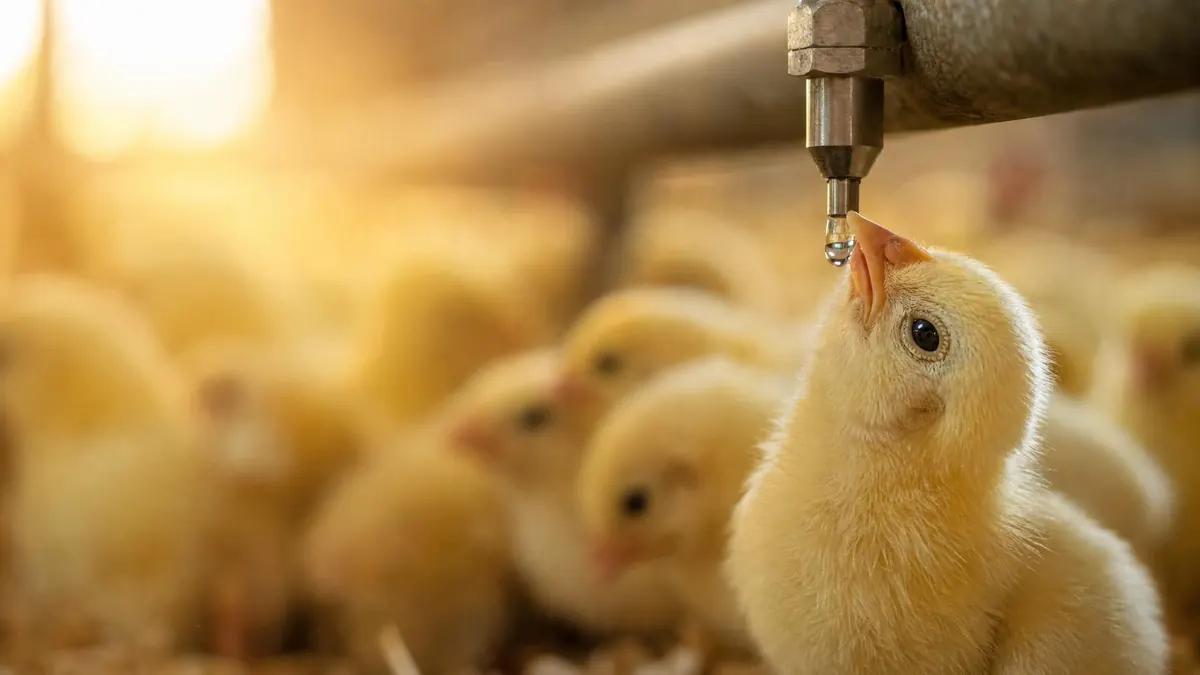
At hatch, a chick cannot yet hold its own temperature: for the first days, the litter and the air of the house hold it for the chick. Too cold, it huddles with the others and goes neither to drink nor to eat. Too hot, it pants, dehydrates and moves away from the heat source.
It arrives with a reserve, what is left of its yolk: enough to get through sorting and transport, not enough to grow on. On delivery it is often already slightly dehydrated. A chick that drinks early eats early, and the feed of the first days starts the growth of the digestive tract, the skeleton and the muscles.
What is lost that week is hard to win back: a flock that starts unevenly stays uneven until it leaves. Brooding is therefore judged early, on simple checks, and corrected the same day.
When early chick mortality rises, the first causes to check are chick quality, transport, brooding temperature and access to water. It is a management question and, where needed, a veterinary one, before it is a product question.
The benchmarks
Temperature, water, crop fill: the published benchmarks for the first week
Values taken from a breeding company’s management guide and from a university extension service, listed at the bottom of the page. They vary with the breed, the heating system and the climate: your own breed guide has the last word.
| Benchmark | Published value | How to check it |
|---|---|---|
| Pre-heating the house | At least 24 hours before the chicks arrive | A hand on the litter, then the thermometer: the floor has to be warm, not only the air. |
| Litter temperature at placement | 28 to 30 °C in the breeding company’s guide; 32 °C on average at floor level in the university source | Infrared thermometer, at several points: under the lines, in the centre, along the walls. |
| Air temperature at chick height | 30 °C at a relative humidity of 60 to 70%; from 31 to 34 °C depending on the heating system | Probe at chick height, where the water and the feed are. Chick behaviour has the last word. |
| Relative humidity | 60 to 70% in the first days; 50 to 70% over the whole flock | Hygrometer at chick height. Air that is too dry dehydrates; air that is too humid makes it harder to lose heat. |
| Full crops after placement | 75% of chicks at 2 hours, 80% at 4 hours, more than 80% at 8 hours, more than 85% at 12 hours, more than 95% at 24 hours | 30 to 40 chicks taken from 3 or 4 places in the house, each crop felt between thumb and forefinger. |
| Chick temperature, taken at the vent | 39.4 to 40.5 °C during the first two days | Ear thermometer, on a few dry chicks taken from several places. |
| Light | At least 25 lux at bird level | A brooding area lit evenly, with no dark zone where chicks pile up. |
| Nipple drinkers | 12 chicks per nipple; line set low on day one, then raised | A visible drop on every nipple; the height is adjusted every day. |
| Water drunk compared with feed | About 1.6 to 1.8 litres of water per kilo of feed at 21 °C, more in the first days | Water meter read every day, at the same time. |
A breeding company’s guide gives values for its own breed; another guide may give others. This table replaces neither that guide nor your technician’s advice.
Water
Water at placement: what to check before the chicks arrive?
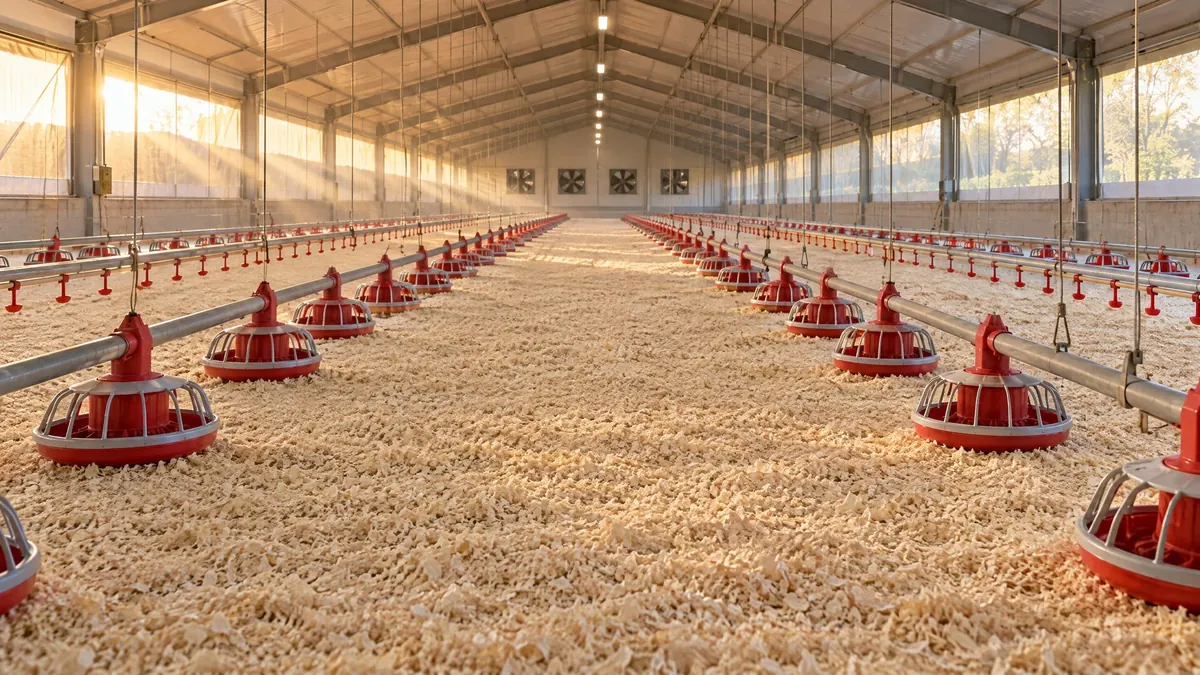
Day-old chicks need water as soon as they are set down on the litter: water is what lets them swallow and digest the crumb. They can use a nipple drinker from day one, on two conditions: the line is at their height, and the pressure is low enough for a drop to hang from every nipple.
After that, the water meter becomes the best indicator of the flock. Read every day at the same time, it climbs steadily; consumption that stalls or drops is often the first sign that something is wrong.
Before arrival, five checks that cost nothing:
- Clean, flushed lines. Cleaning is done between flocks. Just before arrival, flush the lines to replace the water that has stood and warmed up during pre-heating.
- Height and pressure. Line at the chick’s eye level, pressure at its lowest: the chick must trigger the nipple without effort.
- The end of the line. Check at the last nipple, not the first: the chicks at the far end drink the same water, later.
- Extra drinking points. Small drinkers or cups for the first days, set near the feed, cleaned and refilled every day.
- Known water. A recent analysis: pH, hardness, alkalinity, iron. It is what sets the rate of an acidifier: see water pH and alkalinity.
The first check
Crop fill in chicks: how to check it, and what does it tell you?
The crop is the pouch where feed and water collect before the stomach; in a chick it can be felt at the base of the neck. It is the simplest check of brooding: in a minute it tells you whether the chicks have found water and feed.
Take 30 to 40 chicks from 3 or 4 places in the house, two hours after placement, then at 4, 8, 12 and 24 hours. The published targets are in the benchmark table. Below target, do not wait for the next check: look straight away for what is keeping the chicks from drinking or eating.
Each crop falls into one of three cases:
- Full, soft and rounded: the chick has found feed and water.
- Full but hard, with the crumb still felt: it has eaten without drinking. Check line height, pressure and the extra drinking points.
- Empty: it has found neither. Check litter temperature, light, and where water and feed sit in relation to the heat.
Watching
What chick behaviour tells you better than the probe
| What you see | What it means | What to adjust |
|---|---|---|
| Chicks spread over the whole area, active, quiet cheeping | The temperature is right | Nothing: note it, and come back. |
| Chicks huddled under the heat source, noisy | Too cold | Raise the temperature; measure the litter. |
| Chicks pressed along the walls, beaks open | Too hot | Lower the temperature; check the humidity. |
| Chicks all on the same side of the area | A draught, or uneven lighting | Find the air inlet; even out the light. |
| Hard crops, very dry litter under the lines | Water is not being found | Lower the lines, check the pressure, add drinking points. |
| Wet litter under the lines | Pressure too high, or line too low | Adjust the pressure; raise the line. |
What a poor start costs
Nothing dramatic on day one: a delay that is paid for when the flock leaves.
An uneven flock
Chicks that did not find water and feed on day one stay behind. The gap between the lightest and the heaviest widens, and does not close.
Extra days
A seven-day weight below target means a slaughter weight reached later, or a flock that leaves lighter.
Culls and losses
The weakest birds are the ones culled or lost in the first days; those that remain weigh on uniformity at the processing plant.
The farmer’s time
A flock that started badly needs visits, adjustments and care for the whole cycle.
No figure here: the loss depends on the breed, the house and the season. It shows in your seven-day weights, flock after flock.
Broiler brooding: the levers, in order
Management first: no product replaces warm litter and water found within the hour. Feed and drinking water come next, each with its share.
No product
Management first
Four checks that cost nothing, before any supplement.
Warm litter, before warm air
Pre-heat early enough for the floor to be warm in depth; measure litter temperature, not only air temperature.
Water, found within the hour
Flushed lines at eye level, low pressure, extra drinking points: the first crop check tells you whether it worked.
Feed within reach
A fine, dust-free crumb, on paper and in pans on the floor, topped up in small amounts several times a day.
Look, then measure
Chick distribution several times a day, crops at set hours, the water meter every morning, a weighing at seven days.
Feed Solutions
Through the feed
A starter feed that is recognised and eaten
Presentation comes first: crumb size, no fines. In poultry, palatability works mostly through smell and texture; a flavour keeps the same profile from one delivery to the next.
A gut flora settling in
In the first days the digestive tract is being populated and built. A postbiotic supplies inactivated lactobacilli and their fermentation metabolites; it withstands the pelleting of starter feed.
A feed that arrives sound
Small deliveries, a clean silo, no feed heating up: preservation is worked out with the mill, like the risk of mycotoxins in feed.
Farm Solutions
Through the drinking water
Water at the right pH, set before arrival
Acidification is set on the alkalinity of the farm’s water and checked at the last nipple, before placement. A pH that is too low makes water less palatable: with day-old chicks, take no risk with water intake.
What the feed does not yet supply
In the first days, chicks drink before they eat their fill. Vitamins, electrolytes and amino acids go through the water, for a few days after placement.
A digestive tract that is adapting
An inactivated yeast and acids, through the water, in short applications: for the few days when the digestive tract adapts to the feed and the water of the farm.
Minerals, when growth speeds up
At the end of the first week, rapid growth begins and the skeleton has to keep up: phosphorus and calcium through the water, in a defined ratio.
Never in the same water as a live vaccine: flush the line, vaccinate, then resume. Two products go through the water together only once their compatibility has been checked.
Where each Linker platform fits
None of them is a prerequisite: they come on top of management that is already in place. Each has its own page: form, use, documents.
| Platform | Its role here | When |
|---|---|---|
| linkacid Prime LWater acidifier · drinking water | Set and checked before arrival, then continuous | |
| linkastimVitamins, amino acids and electrolytes · drinking water | A few days, from placement | |
| linkamuneInactivated yeast and acids · drinking water | A few days, at placement | |
| linkaphosPhosphorus and calcium · drinking water | From the end of the first week | |
| linkastyFlavours · feed | In the starter feed, at the mill | |
linkabiomePostbiotic · feedPartner dataIn broilers, from day 7 to day 49, at 1 kg/t: weight gain 10.7% above the control (university trial).ConditionsTwo diets compared; significant difference (P < 0.01); no effect in the first week. | In the starter feed, at the mill | |
linkadryLitter conditioner · houseTrial on the productField trial on an 800-sow farm: first colostrum intake within 5 minutes, against 20 for control piglets.ConditionsFarrowing unit, suckling piglets; 2017 trial. | A litter conditioner for where moisture builds up: under the water lines. | During the flock, depending on litter condition |
The other drinking-water platforms come later: Linkatol at the first feed change, Linkaresp when the heat rises, Linkamax HD for layers in production. The rate is on each platform’s page when it is published; otherwise ask for it, with the species, the age and the aim.
Layers
Brooding layer chicks: what changes
The same checks apply to layer pullets: warm litter, water found within the hour, crops checked. What changes is the values and the calendar. Growth is slower, heating lasts longer, the lighting programme is specific to the breed, and the aim is not a slaughter weight but a uniform flock at the start of lay. The breed guide gives its own temperatures and weights; the benchmarks in the table above are those for broilers.
Through the water, supplies follow the same logic: a few days, around placement and then around transfers. At the start of lay, other platforms take over: see from start of lay to end of lay.
Sources
- Ross Broiler Management Handbook, “Chick Management” section: crop fill (table 2.6), chick vent temperature; Ross Broiler Pocket Guide: conditions at placement, nipple drinkers, water to feed ratio (external site)Aviagen · handbook, 2025 edition; pocket guide, 2015 edition; documents available from the publisher’s technical centre · accessed
- Environmental Factors to Control when Brooding Chicks (external site)University of Georgia Extension · Bulletin 1287, B. D. Fairchild, 2012 · accessed
Sources checked on .
General management benchmarks, quoted with their source. They replace neither your breed guide, nor your technician’s advice, nor your veterinarian’s opinion.
Frequently asked questions
What is brooding in poultry, and how long does the brooding period last?
Brooding is the start of the flock, when chicks depend on the house for warmth. On this page it means the first seven days, from placement to the first weighing. Heating lasts longer: the set temperature comes down in steps over several weeks, and starter feed is fed until the first formula change.
What brooding temperature do broiler chicks need on day one?
Published guides give 28 to 32 °C on the litter and 30 to 34 °C in the air at chick height, depending on the breed, the humidity and the heating system. Litter temperature matters as much as air temperature, and behaviour has the last word: when chicks are evenly spread and active, the temperature is right.
Do day-old chicks need water straight away?
Yes. Their yolk reserve gets them through transport, no further, and they eat well only if they drink. Water must be available the moment they are set down on the litter; the first crop check, two hours later, tells you whether they have found it.
Can day-old chicks use a nipple waterer?
Yes, if the line is at eye level and the pressure is low enough for a drop to hang from every nipple. Extra drinking points, in the first days, help the slower chicks.
Day-old chicks are not drinking water: what should you check?
In this order: litter temperature, because a cold chick does not move; line height and pressure; light; then the water itself, too warm after pre-heating or too acid. Crops that are full but hard confirm that feed has been found, and water has not.
Early chick mortality: which causes should you check?
First chick quality on delivery and transport conditions, then brooding temperature and access to water: these are the most common causes, and management corrects them. When losses continue, or chicks are visibly ill, diagnosis belongs to the veterinarian.
Do chicks need vitamins or electrolytes in the water at placement?
Not as a rule. If the litter is warm, water is found and feed is eaten, the chick covers its needs. A supply through the water has its place when the flock arrives tired from a long journey, or in hot weather, once water and temperature have been checked: Linkastim is then used for a few days.
Can a water supplement be given on a vaccination day?
No: never in the same water as a live vaccine. Flush the line, vaccinate as your veterinarian instructs, then resume. The rule applies to the whole range.
Prepare your next placement
You run the farm
Tell us the breed, the house, the water and the arrival date: a technician proposes a programme for the first seven days, with rates, durations and what must not run at the same time.
Prepare your next placement →Request the Linkastim data sheet →You supervise farms
Technician, veterinarian, integrator or distributor: tell us your country and your species, and we tell you where to find our products.
Where to find our products →Or directly: +33 2 30 91 59 15 · contact@linkernutrients.com