
Reducing antibiotic use in livestock: the EU rules, and what feed and water can support
No feed additive replaces an antibiotic. The EU rules, the figures, and what feed and water can support.
In short
Reducing antibiotic use in livestock means keeping antibiotics for the sick animal, on a veterinarian’s diagnosis and prescription, and holding everything else through farm management. In the European Union, Regulation (EU) 2019/6 has required this since 28 January 2022: no routine use, no growth promotion, no collective preventive use. No feed additive replaces an antibiotic. Feed and water support a programme that the veterinarian leads.
- Species
- Poultry, pigs, calves, aquaculture
- Reference text
- Regulation (EU) 2019/6, Article 107, applying since 28 January 2022
- EU target
- Halve sales of antimicrobials by 2030, compared with 2018
- What remains
- Care for the sick animal, on a veterinarian’s diagnosis and prescription
Why reduce
Antibiotic resistance in livestock: why use is being reduced
The same families of antibiotics are used to care for animals and for people, and resistant bacteria and their genes move between farms, people and the environment. This is the “One Health” approach of WHO, FAO, WOAH and UNEP. Antibiotic resistance in livestock is one link in that chain: the more bacteria are exposed, the more the resistant ones spread. Preserving the effectiveness of antibiotics keeps care possible for both.
The GRAM study, published in The Lancet in September 2024, directly attributes 1.14 million deaths worldwide in 2021 to bacterial resistance and projects 1.91 million a year by 2050. In France, Anses reports that the fall in animal exposure goes together with a fall in multidrug-resistant bacteria in farm animals, and that resistance to critically important antibiotics remains stable and generally low.
The picture in 2026 argues against easing off. In their February 2026 report, EFSA and ECDC note resistance still common to older antibiotics, and progress slowing across the Union.
Reducing does not mean giving up on care. A sick animal is cared for, on a veterinarian’s diagnosis and prescription: that is the rule, in Europe and elsewhere.
Regulation
Antibiotics in livestock: what the EU rules have changed
Five steps, from 2006 to 2026. The texts are listed in the sources.
| Date | Text | What changes |
|---|---|---|
| 1 January 2006 | Regulation (EC) No 1831/2003, Article 11 | Antibiotic growth promoters leave feed: antibiotics are no longer admitted as additives, apart from coccidiostats and histomonostats. |
| 28 January 2022 | Regulation (EU) 2019/6, Article 107 | No routine use, no growth promotion, no collective preventive use: see the Article in plain terms. |
| 28 January 2022 | Regulation (EU) 2019/4, Article 17 | A feed containing an antimicrobial follows Article 107 of Regulation 2019/6 and is not used for prophylaxis. |
| June 2022 | European Commission decision of 26 June 2017 | End of pharmacological zinc oxide in piglet feed, in June 2022 at the latest: see weaning without zinc oxide. |
| 9 February 2023 | Implementing Regulation (EU) 2022/1255 | A list of antimicrobials reserved for certain infections in humans: they are banned in animals. |
| 3 September 2026 | Regulation (EU) 2019/6, Article 118 | Imported animals and animal products must come from operators that have used, throughout the animal’s life, neither antimicrobial growth promoters nor antimicrobials reserved for humans: see what markets ask for. |
The text
Regulation 2019/6, Article 107: what the rule says, in plain terms
Article 107 of Regulation (EU) 2019/6 has applied since 28 January 2022. Antibiotics are not used routinely, nor to make up for poor hygiene, inadequate farm management, lack of care or poor husbandry. They are not used to promote growth or to raise yield.
Prophylaxis, meaning giving them before any sign appears, is allowed only in exceptional cases: for a single animal when it is an antibiotic, where the risk of infection is very high and the consequences severe. That is the end of collective preventive use.
Metaphylaxis, meaning the care of a group of animals some of which are sick, is allowed only where the risk of the infection spreading within the group is high and no other suitable option exists, on the veterinarian’s diagnosis and prescription. Antimicrobials that the Union reserves for humans are not used in animals.
The first rule is the most useful to remember: the law itself says that an antibiotic does not make up for farm management. That is what gives biosecurity, water, housing and feed their place.
The “Farm to Fork” strategy (2020) sets a target: to halve, by 2030 and compared with 2018, sales of antimicrobials for farm animals and aquaculture. Between 2011 and 2022, sales fell by 53% across 25 countries (EMA, final ESVAC report, November 2023). But the EMA’s second ESUAvet report (December 2025) records a 5% rise in 2024 compared with 2023, and writes that the fall seen from 2010 to 2022 “may slow down or reverse”. What is left to gain is gained farm by farm.
The figures
Antibiotic use in livestock in France: exposure since 2011
In France, animal exposure to antibiotics fell by 49% between 2011 and 2024 (ALEA indicator, Anses). It stands at 0.307 in 2024, close to the target of the Écoantibio 3 plan: to stay below 0.3 over 2023-2028. Anses speaks of a plateau: exposure has hovered around that level since 2021-2022.
The distance travelled differs widely from one species to another (see the table below). Critically important antibiotics (fluoroquinolones, latest-generation cephalosporins) now make up only 1.2% of total exposure in 2024.
Care has left the feed. Antibiotics incorporated into feed have fallen by 71% since 2011 and account for less than 2% of the exposure of pigs, rabbits and poultry. Oral powders and solutions, so mostly drinking water, now account for 45% of it. Hence the importance of a clean, well-managed water line.
France: exposure to antibiotics by species, 2011 to 2024
| Species | Change in exposure, 2011 to 2024 |
|---|---|
| All species | Down 49% |
| Poultry | Down 71.1% |
| Pigs | Down 64.7% |
| Cattle | Down 15.5% |
Source: Anses, November 2025, 2024 data. The 2025 figures are due in November 2026.
Our markets
Antibiotics in livestock in Southeast Asia: what the texts say
Country by country, what published sources allow us to write. Rules change: check them with your veterinarian and the national authorities.
| Country | What the texts say |
|---|---|
| Vietnam | Circular 06/2016 limits the list of antibiotics admitted as growth promoters to 31 December 2017; the Ministry of Agriculture states that these uses have been banned since 1 January 2018. Decree 13/2020 (Article 12) reserves feed containing antibiotics for preventive purposes for young animals, in complete feed, with a deadline for each class of antibiotics up to 31 December 2025. Since 1 January 2026, the ministry announces that antibiotics are reserved for sick animals, on a veterinarian’s prescription. |
| Thailand | Antimicrobial growth promoters have been banned since 2015. In 2018 and 2019, successive restrictions kept colistin and fluoroquinolones out of feed, and a feed containing an antimicrobial can be supplied only on a veterinary prescription. |
| Indonesia | Permentan 14/2017 bans antibiotic growth promoters in feed from 1 January 2018; use under veterinary supervision remains allowed. Colistin has been banned in livestock since 1 July 2020. |
| Philippines | Republic Act 12308, approved on 25 September 2025, makes the Bureau of Animal Industry the sole regulator of veterinary products, and makes registration of feed with it compulsory. Rules change: check them with your veterinarian and the national authorities. |
These four countries are not Linker’s only markets: only texts read at source appear here.
A region where the fall is still to come
The WOAH’s ninth report (May 2025, 2020 to 2022 data) measures a 5% fall in antimicrobial use in animals worldwide: 23% in Europe, 20% in Africa, 4% in the Americas, and only 2% in Asia and the Pacific. Among participating countries, 71% have stopped using antimicrobials as growth promoters and 22% still do.
In a region where livestock and aquaculture production is intensifying, management comes before any additive: biosecurity, water quality, stocking density and the veterinarian’s follow-up.
What markets ask for
Exporting to the European Union from 2026: an attestation for each commodity
Since 3 September 2026, exporters to the Union must attest, in the health certificate, that the animals received, throughout their lives, neither antimicrobial growth promoters nor antimicrobials reserved for humans. Authorisation is given by country and by commodity, across twelve categories including poultry, aquaculture, eggs, pigmeat and beef. For long-cycle products, the guarantees apply from birth. The list of authorised countries is kept up to date by the Commission and is read country by country.
Retailers and brands also write into their specifications farms that exclude antibiotics from birth or from the end of weaning. Such a specification is held through farm management and the veterinarian’s follow-up; a sick animal is cared for, then follows the specification’s rule. Feed and water help hold the conditions of production; they do not guarantee a status.
The approach
Reducing antibiotic use: what farms have shown
Intervention studies on pig farms teach the same lesson: reduction comes first from a plan specific to each farm, drawn up with the veterinarian. Postma and colleagues (61 Flemish farms, 2017) measure a 52% fall in use from birth to slaughter, without damaging production parameters. Collineau and colleagues (70 farms in four countries, 2017) obtain a median fall of 47%, with no loss of technical performance.
In the study by Raasch and colleagues (2020, 68 farms), the measures chosen were biosecurity (29 farms), vaccination (30), care and welfare (21), housing climate (14) and, on 45 farms, a change in feeding or in drinking water quality. A farm often adopts several measures at once.
That is the place of feed and water: one measure among others, alongside biosecurity, vaccination and housing, never in their place.
Reducing antibiotics on farm: the levers, route by route
Management first: it carries everything else. Then feed, which sets the conditions of digestion, and drinking water, the main route for group care.
No product
Management first
Intervention studies show it: reduction comes first from management and the health plan, drawn up with the veterinarian.
External and internal biosecurity
Animal entries, vehicles, people, pests; one-way flow, all-in all-out, cleaning, disinfection and downtime.
A health plan drawn up with the veterinarian
Vaccination, laboratory diagnosis when needed, and follow-up of water consumption, batch uniformity and test results.
Clean water, with flow and pH held
Flow, potability, line cleanliness, pH and alkalinity, temperature. Water also carries the care prescribed: a poorly kept line works against it. Benchmarks are in drinking water quality.
Housing climate and stocking density set right
Temperature at animal level, ventilation, ammonia, litter moisture, feeder and drinker space: see ammonia and wet litter.
A managed start and weaning
Colostrum or feeding from hatch, warmth, quick access to water and feed; in piglets, weaning age and weight and gradual feed transitions: see piglet weaning.
Feed Solutions
Through the feed
Feed acts on the conditions of digestion; management comes first.
A formula that digests well
A protein level reduced for the age, balanced with amino acids, digestible sources and a measured buffering capacity: less protein fermented in the gut. A meta-analysis by Luise and colleagues (2021) links reduced protein after weaning to less fermentation in the gut; its authors conclude there is no penalty on performance, provided amino acids are covered.
Sound raw materials
Mycotoxins, moulds and oxidation weigh on digestion: sound raw materials spare it needless pressure. See mycotoxins in feed.
An acidified stomach
Organic acids lower the pH and buffering capacity of the feed. Benzoic acid works in its undissociated form, active at the pH of the pig’s stomach. An acidifier is dosed on the measured buffering capacity: see digestion and performance.
Energy for the gut lining
Butyrate is an energy source for the cells of the gut lining: as a salt, plain or coated depending on where it needs to arrive, or as tributyrin, released in the small intestine by lipase. The comparison is made in tributyrin vs sodium butyrate.
The balance of the piglet’s flora
Live lactobacilli supplied through the feed, when the piglet’s flora is reorganising, around weaning. The status of a probiotic depends on the market and the strain: it is checked with us.
Farm Solutions
Through the drinking water
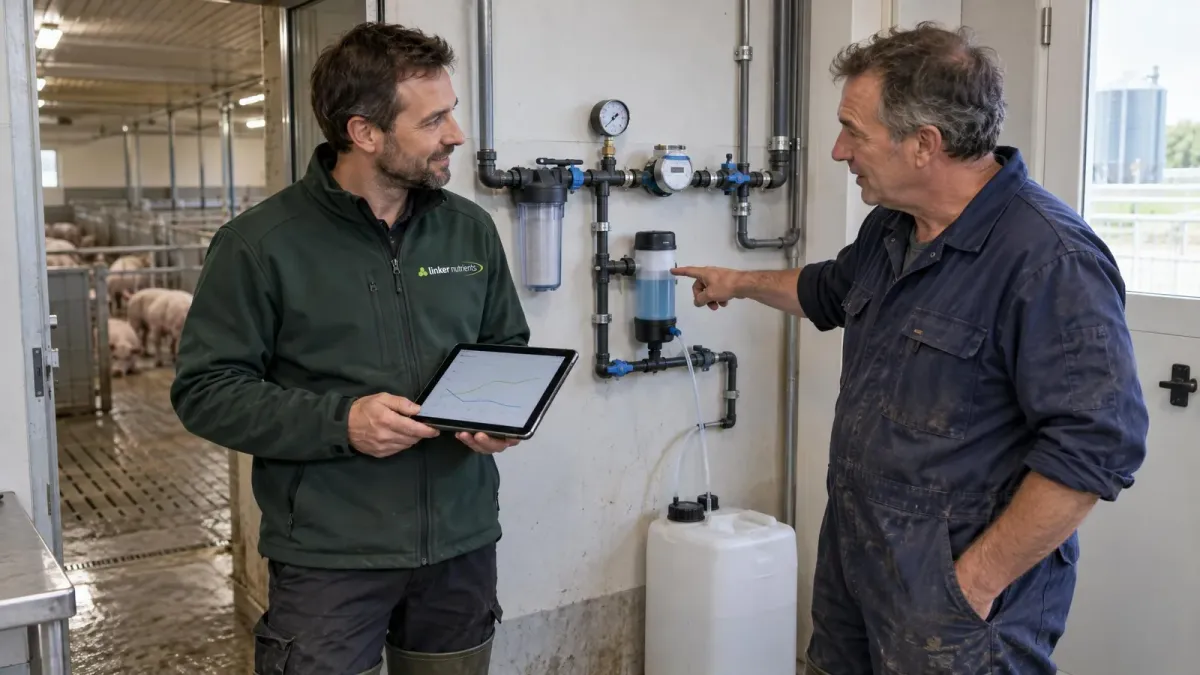
Water has become the main route for group care, and it stays open when the animal eats less: a clean line at the right pH serves the animal and the care the veterinarian prescribes.
A clean water line, with pH held
Lines cleaned between batches, pH and alkalinity measured, acidification set on the farm’s water: see drinking water.
A short supply when intake drops
Vitamins, amino acids and electrolytes through the water, for a few days, when the animal still drinks but eats less: transfer, transport, heat, peak lay.
An inactivated yeast and acids, in short courses
In short, repeated courses, on the batch that needs them, around sensitive phases: placement, transition, weaning.
A plant-derived aromatic substance
Oregano essential oil, rich in carvacrol, supplied through the drinking water of poultry and pigs, to support digestive comfort and intestinal balance during sensitive periods.
Comfort as the heat rises
Aromatic substances, eucalyptus first, in the drinking water, to be started the day before a forecast heat episode, for a few days.
How to choose
Nine platforms, each in its role: where it works, and when
Each works in a precise place, in support of a programme led with the veterinarian. The table shows those places and when each has its place; each has its own page.
| Platform | Its role here | Where it works | When |
|---|---|---|---|
linkazoicBenzoic acid · feedTrial on the productStudy published in 2024 in weaned piglets: with coated benzoic acid, dry matter digestibility rose from 88.2% to 90.5%.Conditions32 piglets in individual cages, 21 days; trial rate of 3 kg/t, above the use rate of the grade. | In the pig’s stomach, in its undissociated form | In pig feed, from the starter to the finishing stage | |
linkaselButyrate · feedTrial on the productIn a broiler trial (42 days), Linkasel’s coated calcium butyrate improved feed conversion from 1.83 to 1.76.Conditions2 groups of 6 replicates, 150 birds per group; 1.2 then 0.6 then 0.3 kg/t depending on the phase. | From stomach to intestine, depending on the form, plain or coated | When the gut lining is the priority | |
linkatribTributyrin · feedPublication on the ingredientIn post-peak laying hens, a published university study reports a 3.1% thicker eggshell with tributyrin at 500 g/t.Conditions384 hens, 8 replicates of 24 per group, 16 weeks; significant difference (P = 0.01). | In the small intestine, through the action of lipase | To carry butyrate further in a pelleted feed | |
| linkafloreProbiotic · feed | In the piglet’s intestine, with live lactobacilli | Around weaning, when manufacturing conditions, validated with us, allow it | |
| linkamuneInactivated yeast and acids · drinking water | In the water line, batch by batch | In short, repeated courses around sensitive phases | |
| linkastimVitamins, amino acids and electrolytes · drinking water | In the water line, on the house concerned only | The few days when the animal drinks but eats less | |
| linkadiarOregano essential oil · drinking water | In the water line, continuously or over a few days | During sensitive periods | |
linkarespFlavouring substances · drinking waterTrial on the productField trial, summer 2020, on more than 120,000 broilers: +2.3% slaughter weight.Conditions6 houses, 3 control and 3 with Linkaresp in drinking water; three series of applications from day 21; slaughter at day 42. | In the water line of poultry, pigs and dairy cows | The day before a forecast heat episode, for a few days | |
| linkapectinElectrolytes and pectins · house | A fibre powder with supplementary electrolytes, for the young animal. | In water or warm milk, at the meal; mixed into the feed for piglets | In calves, lambs, kids and piglets, in periods of transition |
No feed additive replaces an antibiotic. Where to start? With management, water and the formula; the levers are chosen next, on what you observe. The rate is on each platform’s page once published; otherwise ask for it, with the species, the stage and your objective. The status of an additive depends on the market: it is checked with us and with the national authorities. Never in the same water as a live vaccine; with another product in the water, or during care in progress, the programme is organised with the veterinarian. Other acidifiers are in digestion and performance and drinking water.
The approach
Reducing antibiotics: five steps
An approach to follow with the farm’s veterinarian.
- Review with the veterinarian.Current use, biosecurity, vaccination, water, housing climate, start-up: what can be set without a product is set first.
- Set management and water right.Clean water lines, pH held, housing climate, feeder space, gradual feed transitions.
- Review the feed.Protein, buffering capacity, sound raw materials: the formula shows where the stomach and intestine will be under most pressure.
- Choose two or three levers.An acidifier dosed on buffering capacity, then whatever answers your priority: the gut lining, the flora or the water.
- Follow and adjust.Use indicators, water consumption, batch uniformity, test results: the outcome shows in your batches, and the programme is adjusted with the veterinarian.
Evidence
What research has measured
Published meta-analyses on organic acids, butyrate, probiotics, postbiotics, plant extracts and yeasts describe real but modest effects on growth and feed conversion, varying widely from one farm to another. Their authors point to strong heterogeneity, publication bias and, at times, studies run or funded by manufacturers. These results are read as trends, never as a promise.
Results measured on our platforms can be read on the page of each, once published, with their conditions. References for the publications cited are listed in the sources; details are available on request.
Framework
What the rules say about additives
No feed additive replaces an antibiotic. An additive has another place: Regulation (EC) No 1831/2003 sorts it into a category (technological, sensory, nutritional, zootechnical), and zootechnical additives include digestibility enhancers and gut flora stabilisers.
What can be said about it is regulated. Article 13 of Regulation (EC) No 767/2009 requires a claim to be objective, verifiable by the authorities, understandable and scientifically substantiated from placing on the market. It allows claims on optimising nutrition and on supporting physiological conditions.
Under Article 4 of Regulation (EU) 2019/6, it is the presentation of a product (its name, its claims, its documentation) that decides whether it is a veterinary product. Diagnosis, the choice of care and prescription are the veterinarian’s.
Outside the Union, each country has its own rules on registration and claims: they are checked country by country, with your veterinarian and the national authorities.
Sources
- Regulation (EC) No 1831/2003 on additives for use in animal nutrition (external site)EUR-Lex · OJ L 268, 18.10.2003
- Regulation (EC) No 767/2009 on the placing on the market and use of feed (external site)EUR-Lex · OJ L 229, 1.9.2009
- Regulation (EU) 2019/6 of 11 December 2018, Articles 4, 107 and 118 (external site)EUR-Lex · OJ L 4, 7.1.2019
- Regulation (EU) 2019/4 of 11 December 2018, Article 17 (external site)EUR-Lex · OJ L 4, 7.1.2019
- Implementing Regulation (EU) 2022/1255 (antimicrobials reserved for certain infections in humans) (external site)EUR-Lex
- Rules on prohibited antimicrobials in imported animal products (external site)AGRINFO · accessed
- Farm to Fork Strategy (external site)European Commission · accessed
- Consumption of antimicrobials in animals reaches lowest level ever in Europe (external site)EMA, final ESVAC report, 20 November 2023 · accessed
- New data on antimicrobials sales and use in animals in the EU (external site)EMA, ESUAvet report, 9 December 2025 · accessed
- Antimicrobial resistance in foodborne bacteria remains a public health concern in Europe (external site)ECDC and EFSA, February 2026 · accessed
- Suivi des ventes d’antimicrobiens vétérinaires (external site)Anses, November 2025 · accessed
- Less antimicrobial use in animals: a win for everyone (external site)World Organisation for Animal Health (WOAH), 9th report, May 2025 · accessed
- Global burden of bacterial antimicrobial resistance 1990–2021: a systematic analysis with forecasts to 2050 (external site)The Lancet · GBD 2021 Antimicrobial Resistance Collaborators, 2024, vol. 404, pp. 1199-1226
- Decree No. 13/2020/ND-CP guiding the Law on Animal Husbandry (Vietnam), Article 12 (external site)LuatVietnam · accessed
- Circular 06/2016/TT-BNNPTNT of Ministry of Agriculture and Rural Development (Vietnam) (external site)LuatVietnam · accessed
- Vietnam implements antibiotic ban in livestock farming from 2026 (external site)VietnamNet, 6 December 2023 · accessed
- Voluntary optimisation of antimicrobial consumption in swine and poultry production in Thailand: a policy analysis (external site)Frontiers in Veterinary Science, 2024 · accessed
- Respon industri atas larangan antibiotik ternak (Indonesia, Permentan 14/2017) (external site)Kontan, 22 November 2017 · accessed
- COINCIDE: One Health study protocol on reducing colistin use in Indonesia (external site)One Health, 2026 · accessed
- Republic Act No. 12308 (Animal Industry Development and Competitiveness Act), Philippines (external site)Lawphil · accessed
- Reducing Antimicrobial Usage in Pig Production without Jeopardizing Production Parameters (external site)Zoonoses and Public Health · Postma et al., 2017, vol. 64, pp. 63-74
- Herd-specific interventions to reduce antimicrobial usage in pig production without jeopardising technical and economic performance (external site)Prev Vet Med · Collineau et al., 2017, vol. 144, pp. 167-178
- Effectiveness of alternative measures to reduce antimicrobial usage in pig production in four European countries (external site)Porcine Health Management · Raasch et al., 2020, vol. 6, article 6
- Meta-analysis to evaluate the impact of the reduction of dietary crude protein on the gut health of post-weaning pigs (external site)Italian Journal of Animal Science · Luise et al., 2021, vol. 20, pp. 1386-1397
Sources checked on .
The Articles cited from Regulations 2019/6, 2019/4 and 767/2009 were read on 22 and 24 October 2026 on the copies of the Union text published by legislation.gov.uk, and not in the repository of the Publications Office of the European Union, which feeds EUR-Lex. Sales and exposure figures are those of the reports cited. This page summarises texts; it is not legal advice.
Frequently asked questions
Why reduce antibiotic use in livestock?
To preserve their effectiveness in animals and in people: see the issue.
Are antibiotics banned in livestock production?
No. A sick animal is cared for, on a veterinarian’s diagnosis and prescription. What has ended in Europe: growth promoters, routine use and collective preventive use. The dates are in the EU table.
What does EU Regulation 2019/6 say?
Its Article 107 sets what an antibiotic can no longer do on a farm: see the Article in plain terms.
What is metaphylaxis?
It is the care of a group of animals some of which are sick, when the risk of spread is high and no other option exists. It is decided with the veterinarian: see Article 107.
What can an additive do in a reduction programme?
No feed additive replaces an antibiotic. It supports digestion and the animal’s conditions, alongside management: see what the rules say.
Where do you start to reduce antibiotic use?
With a review with the veterinarian: biosecurity, vaccination, water, housing climate, start-up. Intervention studies on pig farms reach about half: see what drives reduction.
What is the role of drinking water?
A central one, because it carries most group care: see the French figures and the levers through water.
Are the rules the same across Southeast Asia?
No, they differ from one country to another and change over time: see the country table.
What changes in 2026 for exporters to Europe?
An attestation in the health certificate, country by country and commodity by commodity, since 3 September 2026: see what markets ask for.
Build a reduction programme
At the feed mill
Send us your formula, the species and what you observe: we look with you at which two or three feed levers have their place in the programme set with your veterinarian.
Build a reduction programme with us →Propose a trial →On the farm
Tell us the species, the stage and the farm’s water: we build the drinking water programme with you, within the management set by your veterinarian.
Get a programme →Or directly: +33 2 30 91 59 15 · contact@linkernutrients.com
Further reading
- Piglet weaning →
The post-weaning window, lever by lever.
- Weaning without zinc oxide →
What changed in Europe, and the combination of levers that takes over.
- Diarrhoea on farm →
What to check first, and what water and feed support.
- Gut health →
What the feed can adjust for digestion.
- Digestion and performance →
Acids, butyrates, monoglycerides, postbiotic, tannins: where each lever works.
- Drinking water →
Everything Farm Solutions brings through the water line.
- Feed Solutions →
Additives for the feed mill.
- Farm Solutions →
Solutions for the farm, through drinking water and the house.